
Listen on:


 Transcript This Audio
Eric Lawrence (00:02.927) Hey everyone. Welcome back to Tales from the Pros. I'm your host, Eric Lawrence, Director of Growth at Imaginovation. So every once in a while we get a guest whose story stops you before you even get to the business topics. Today's guests started at 18 years old, homeless, 200 pounds to his name, a bag of clothes and a bus ticket. No safety net, no roadmap, just a decision to figure out. What came next was a custom software company building products for Kia Motors.
Draven McConville (00:03.658) Okay.
Eric Lawrence (00:32.475) Coca-Cola and Jaguar Land Rover. Then a successful exit. Then a second company, Klipboard a field service management platform he identified, built, raised 3 million for, scaled and exited as a large business in 2024. But we're not here to talk about exits today. We want to get into the product, the decisions, the moments where it could have gone sideways and what he learned building software for people who aren't sitting at a desk.
Draven McConville Welcome to Tales from the pros really glad that you're here.
Draven McConville (01:02.446) Great to be here. Looking forward to sharing some insights and knowledge. Hopefully your listeners will enjoy and get value from. So thank you for having me on.
Eric Lawrence (01:15.897) Yeah. Well, we are glad to have you because I think that there's a lot for us to dig into today, but before we get into any building products and questions around that, I think it's helpful for the listeners to kind of understand your background and where you came from and how that shaped your first company where you were building digital products for companies like Kia and Coca-Cola.
Draven McConville (01:40.827) I think, you touched upon it. And there's nearly a cliche I've said at least as for, you know, a homeless, this to a founder of a tech company. And, you know, I think the stories have kind of been heard before. You know, I experienced it sadly. Breakdown in family situations that forced me to to be properly homeless. And I did sleep rough on the streets for a number of months and then sofa surfed and had no fixed abode for at least a year and a half.
Very challenging. Definitely taught me the ability to be adaptable and understanding behavior is trying to read a situation very quickly. Also, I think over time you really don't become fear, encompassed by fear. You have initial fear, but you get stronger and stronger and stronger. think going off in an entrepreneurial path.
you need to have that resilience and have to have that ability to get over fear. So I started the first business when I was 26. I had a number of jobs prior to that. Everything from bar shifts to actually the photograph behind here is images of where I first started working, which is where I recycled the glass bottles into crates, cetera. So it's been a path.
I ended up marketing agencies and I decided to start my own digital product agency. And that's because I saw the advent of mobile apps and were the possibilities of those were, but where most people were focused on it from a consumer based point of view and what fun could we have with an app? My mindset turned to, well, how can we make this a B2B opportunity where, know, businesses that are
have mission critical elements or people out in the field, et cetera. And we focused on that, but we build every type of software under the sun from babysitting apps to loyalty apps to festival apps to really serious software for the oil and gas and pipeline industry. So a whole range of different products within that. And I think big is learning from it. Well, from my background that I transferred into the agency world was
Draven McConville (04:03.276) adaptability. I am really listening to people, reading the situation and trying to deliver value to them really.
Eric Lawrence (04:13.453) I feel like there's a lot that can be gained across all those different industries, because like you mentioned it, there's going to be some fun, creative apps like you can build with babysitters. But then what we see, there's a lot of boring apps for businesses that maybe be in manufacturing or oil, like you said, where they just need something that'll make them more efficient and better at what they do.
Draven McConville (04:26.83) it
Draven McConville (04:34.862) Boring is sexy, Eric. And boring is where money is most times as well. apps that have to perform a particular function, it's mission critical for a business is highly valuable. And I learned that early on. And it's creativity in a different way. And I have a weird ability of having even left-hand side of brain.
Eric Lawrence (04:38.042) Haha!
Draven McConville (05:03.798) and right-hand side of things. So can be highly logical and process driven, but incredibly creative on the other hand as well. And I think there has to be a level of creativity to producing any type of product. It's not necessarily fun, but getting the user to engage, whether that's a consumer user or a business user, you have to have some creative thinking to that for sure.
Eric Lawrence (05:27.503) Yeah. And I know when you were running that business, there's obviously the technical side that you guys have down and you have to have a product mindset. I think that's, that's critical, but to be able to go over and start Klipboard and make it successful. That's like your baby. That's, that's what you're working on. You say, Hey, does this have the legs? And you then kind of put your shoes in your client's shoes where you're trying to make something and go through the whole product life cycle, validate the idea.
Draven McConville (05:53.806) Thank
Eric Lawrence (05:56.378) make it successful, grow it. So I'm interested when you went from the agency life over to Klipboard where you're building a product, were there any lessons that you took over from your clients that you applied over to Klipboard?
Draven McConville (05:57.26) I'm sorry.
Draven McConville (06:11.149) Absolutely. Look, I think if we even step back to what you said earlier on, we created software in many different types of verticals. So you get insights into a lot of different types of businesses, how they operate, the end user, their pain points. But you then do discover that there's commonality amongst it in a particular way. And that commonality is usually the human. The human has to...
you know, engage with the interface that you create or the software that you create. So it's really understanding your client and your end user really, because we were building software for Kea, but we weren't really building it for the brand Kea. We were building it for Kea's employees and then a specific division of their employees. In particular, it was dealerships. then within the dealerships, it was actually the marketing.
within dealership. So it's not just K, it's actually that end user and is really getting down to that and understanding what the objective is for them, what they're wanting to achieve, what value we can deliver and what the end result would be. So it came to transferring that to a SaaS business, which isn't, you know, multiple different types of projects. It's one singular project, however,
You have a feature roadmap and within that is a project in itself and in each element. What determined that roadmap was the same mindset that we had with our clients in the agency world is well, who's the end user? What is it that they're needing, requiring and expecting to get back? Now we had a bit of a, how would you say a head start.
because within the agency, we got very heavily involved in the enterprise mobility, which was taking mission critical software products to work on mobile devices and tablet devices. And as I mentioned earlier, are oil and pipe, gas line industries, crane manufacturing, mining, et cetera. So we learned very much all the different types of field up or diffusers, what their pain was, their dislike of admin.
Draven McConville (08:35.201) That was one commonality amongst all of them.
Eric Lawrence (08:38.248) I think for basically every industry for sure.
Draven McConville (08:41.069) every industry. So yes, what we learned from the end client and agency world definitely sharpened our pencil to think about what we were building as a product and for who. And if it didn't have a commercial, if it didn't, sorry to interrupt, if it didn't have a commercial outcome to deliver value back to us, then we didn't do it.
Eric Lawrence (08:56.823) in specifically.
Draven McConville (09:07.287) but normally it has a commercial outcome because the customer, if you're listening deeply enough to your customer, your client, then you'll be delivering what they want.
Eric Lawrence (09:16.281) Yeah, I think that's a big piece because we do hear from a lot of people that are looking to build a business from the ground up. And for the ones that are thinking commercially, you can tell, okay, you have a path towards this being successful versus you sometimes get, you know, a scrappy founder that reaches out thinking that they can make their money back off of ad revenue from an app. Usually a tougher path to success.
Draven McConville (09:21.665) Looking to go.
Draven McConville (09:43.982) Totally, know, consumer apps is a very different world than B2B software. Obviously, it can be very scalable. You can get very large audiences, of course. But, you know, we really focused on B2B because that was the area that we understood. And we understood how to deliver value in that particular area and what the client needed. The product roadmap was always developed in the mindset of
listening to our end customer, was there a big enough voice within that community of customers for us to then go and develop it? We obviously had our own ideas too that we wanted to bring to the table, but we really validated it as well. And before we even built the Klipboard, the field service management software product, we validated the market and was there a market opportunity for it?
At the time, whenever I really looked at it, I realized that 52 % of field service businesses globally had no specific software that they were using. They were either completely manual or they were using a range of different software tools like a basic calendar and there I said WhatsApp to kind of communicate with their field. So we knew that there was a market and we validated that market and then we went and talked to that market.
If I hadn't done that, do I still have the idea of course? And could I have sat in my cupboard and said, well, this is the best idea ever. I'm just going to go and build it and they'll turn up. That's a high risky strategy. It's better to go listen to the market, validate the market. And then as you build for it, continue to do that in an iterative process.
Eric Lawrence (11:32.611) That's interesting. And when you were building the first version of this, were you trying to go feature rich? Were you thinking, Hey, what's like the basic amount of value that I can validate this thing in the people's hands? Like what was your mindset when you were building this for the first time?
Draven McConville (11:34.989) Hmm?
Draven McConville (11:44.151) you can copy this and repeat the thing.
Draven McConville (11:50.903) That's a really good question. And most people don't ever touch upon that. And there was actually one specific thing that we focused on because back then, eight years ago, nine years ago, we didn't have Copilot, Cloud, Cursor, and every other AI tool under the sun to help us develop and write code. You had to write code. Yeah, you had to write code. So...
Eric Lawrence (12:11.631) Yes.
had to walk uphill both ways, right?
Draven McConville (12:20.064) You you couldn't go feature mad. And to be perfectly honest, overdevelopment of features doesn't necessarily mean that you'll have a highly sticky customer or retained customer or even the opportunity to win a customer. There's a lot of other things in that formula. But we came to market with one simple goal. When we validated that the field service industry needed better software,
we focused in on where their biggest pain point was. And it was paperwork in the field and getting paper forms back from the field to the office, where they're being manually rekeyed into something else. And it was delaying invoicing and billing. It was delaying everything. So these guys going out with a triplicate pad, notepad, whatever it may be, getting in the van, it gets wrecked, couldn't get back. That was the biggest thing.
The second biggest thing was scheduling and how did dispatch work and when. So when we came to market, they were the two things that we focused on, nothing else. We focused on doing them really well. So when we went and showed a prospective customer, this is what we were doing and how well we were solving that specific pain point, we could get them bought into the fact that come on a journey with us.
Eric Lawrence (13:28.965) That's smart.
Draven McConville (13:48.801) because if we do this bit really well, we do see what we're gonna do next and we'll do really well. Plus, we wanna hear from you. We're gonna build out with you. And that's how we got those early adopters and we focused on that and we didn't run off going, let's build this, let's build this, let's build that. And it made for a much more cohesive platform, user-friendly platform and more industry specific. At the end of the day, I'm not a plumber.
I'm not a fire safety guy, not an AeroCon guy. I build product, I'm a tech guy. No, don't get me wrong. know I could probably go out and be a plumber because I know so much about being in the field and then doing those field services. But that's simply because we research and we talk to those customers so much. So yeah, we focus on one singular massive pain point, did that well, and then built that right.
Eric Lawrence (14:28.9) Yeah.
Eric Lawrence (14:46.127) That's brilliant. Yeah, I think that's it. You basically have to be in the mind of the end user to know where's the value going to come from for something like this. I am interested to know, were there any pivots that you had to make where you weren't expecting it? Let's say like when you got this in the hands of the users, they gave you feedback where you said, I hadn't even considered that and you had to add it to the roadmap.
Draven McConville (14:47.724) Thank
Draven McConville (15:11.884) I think there was many little small nuances that we got that, you know, when we did a large feature release or, you know, a specific module, I would say, not an individual tiny feature. So when, you know, we released the asset management module, for example, there was then little iterative features within that, that, you know, we hadn't anticipated when we had done all our research, but that we have to quickly
iterate on and push into the development of that. And I think that's a given. You can never get 100 % or even 99 % of everything in the first version or first iteration of a feature module. But one thing that sticks in my mind on one lesson, not a tough lesson, but it was definitely a lesson to say, don't be so stubborn about your thought process.
So when I brought the product to market, we called tasks for jobs. But the industry called them jobs, but we went out and we called them tasks. And it caused support questions, it caused demo problems and everything else. And my own stubbornness,
And there I said, touch of arrogance about it. was like, no, I know best. This is what the industry needs to know it as because we're gonna have multiple tasks under XYZ. Mind field of reasons as to why I wanted to have it as tasks. And the sales team were pushing back at me, customers pushing back at me. And eventually when I gave in and I made a simple change, which is a label change of
to jobs, pretty straightforward, it's command all basically. And sales went up, demo engagement went up, customer support queries went down and understanding, well, customer support queries during the onboarding phase went down because for them to get their head around it. And that was only a piece of terminology. But fortunately, that was very early on.
Eric Lawrence (17:09.219) Yeah, pretty, pretty straightforward.
Eric Lawrence (17:14.233) Ha ha ha!
Eric Lawrence (17:19.759) Really?
Draven McConville (17:38.282) Would you call that a major pivot? Probably not, but I would highlight it because it changed my perspective massively going forward for all the years later and said, just don't get rigid on what you think is right. If the market's asking for that, just bloody deliver it.
Eric Lawrence (17:59.024) That makes a lot of sense. Sometimes. Yeah. You just have to surrender ego on these things and let the market tell you.
Draven McConville (18:04.396) You have to start. Yeah, it's tougher for me to even say today that it was my own ego that was getting in the way of it. But it is, you know, especially when you're building a product, I think you get very precious, you know, and.
Eric Lawrence (18:18.255) We've, I mean, we've seen that for ourselves. when, when we built, have a task management platform out there that's gamified and you know, it's, meant to make work fun that we call magic task. And there, there have been hard lessons that we've had to learn about, Hey, how engaging is the gamification side of it where we could have sworn this is going to be the best thing ever. We just had to swallow our pride and be like, nobody's using this feature.
Draven McConville (18:46.259) And, you know, that's an interesting point you've just brought up as well, because you mentioned earlier about it, feature rich. And, you know, by the time I sold that company, the platform was feature rich, very in depth. It covered a lot of aspects. But if we were to analyze the core user base of what was being really fundamentally used and used to heaviest.
It was those two things I mentioned at the very beginning, the scheduling and the forms. The things that we brought at the very beginning of the platform were the biggest core aspects and user usage. So it's interesting you can put loads of features in and think, my God, this is going to be transformative. And then it doesn't get engaged and doesn't get used. However, I do think sadly that is not all of us time.
To us, think sometimes businesses don't wish to change their way to adopt new things because change is a fear for them. So they won't try out a new feature if they think what they're already using is perfectly okay.
Eric Lawrence (20:01.851) Yep. I always see it like the easiest decision a business can make is no decision at all. That's usually the way it goes. I, one thing I want to explore with you though, because from our side, we've worked with clients that are in, you know, manufacturing, they're, they're in, um, you know, they're out in the field. So you've been in the field service space. One thing that I noticed is a lot of times these businesses, they come, they have a need for themselves and they want to build something custom for them.
Draven McConville (20:12.427) Thank you.
Eric Lawrence (20:31.835) And the number one benefit they get is efficiencies gained within their organization. But as a way to recoup cost, they often want to white label it and offer it to other companies to be like, Hey, we solved an issue. Maybe we can solve yours too. And sign you up on kind of like a subscription basis. But the challenge that they have is they're trying to run their own business. And now you're asking to kind of make an extension where you're now selling a SaaS product.
Draven McConville (20:35.659) Thank
Bye.
Thank you.
Draven McConville (20:51.659) Thank
Eric Lawrence (21:01.209) to other companies. And I am interested to know because you sold directly to service based companies, and you could focus exclusively on that. What did you find work the best to get users on the platform when you were in growth mode?
Draven McConville (21:01.451) Okay.
Draven McConville (21:18.133) So I've seen that as well, where a vertical industry customer decides that they've built an internal tool and why don't they just bring this to the rest of the market, et cetera. They don't quite realize the pain of bringing a SaaS product to market, the support that's required, the infrastructure that's required, the marketing, the ongoing development, maintenance.
know, recruitment of talent. Is there an ego in our industry in the sense of like, no, I only want to go and work for another cool tech company and build software in there and be around my peers. Do they want to go and work in an internal operation that might perceive it as, whereas a kind of site shop to the main thing. So I've seen that many times.
I've rarely seen success with it. But from a go-to-market point of view for us, it was challenging at the beginning. And the reason it was challenging is because we had to educate the market early on. And that is quite difficult because you're spending a lot of marketing dollars on educating a market about
why they need this particular software product, the value it'll bring to them, et cetera, et cetera. It's nearly better to ride on the back of a market that's already been educated. Yes, you may think it's much more competitive and it will be. However, you're not wasting time with the customer trying to get their behavior to change and to get them to understand why they should adopt a product like this.
Instead, you're going into complete sales battle instead, you're up against a competitor. They know why they're at your table, they know that they need this software product and it's down to meeting their needs and, you know, supporting them the way that they want to be supported. So early doors, challenging. It was definitely an educational phase. So we had a very different approach when we went to market, thought leadership content.
Draven McConville (23:39.537) know, value added content. The sales pitch was very much about what it could do for you from a transformative point of view. But also we learned that industry is very scared of change and don't want to adopt technologies because you can't blame them. The working compliance oriented industries, for example, fire. So they're dealing with
safety and regulations and making sure people's lives are okay. So they don't want to take a risk and something that is not known to them. So we needed to change the sales pitch and allow them to trial the platform. But we would heavily support them actually during that trial phase. Later on in the journey of the business, the market had become a lot more educated. So the go to market had really
really changed in that perspective. And we could really focus down on things like our user friendliness of our platform and focusing on how things can be done quicker, et cetera, et cetera. And not actually educating them to the why they needed it. Two different aspects, but as time and journey. For our founders coming into a market now that is semi-established, then...
they can skip over the educational piece to an extent.
Eric Lawrence (25:07.407) That's pretty fascinating that you saw it from both sides, from the education side, and then from the, we have to distinguish our product amongst the competitors within a space that is now competitive.
Draven McConville (25:18.538) Yeah and I think going right back that's another learning from the agency world because we, well and I did in the early days, we'd go into brands and pitch ideas you know because you're hunting for work you're looking for the next project so you would come up with an idea and you reach out that brand and say look we have this idea this concept it's nothing tangible.
So they can't even demo, they can't do anything. it's getting them educated and bought in the agency world as to why they should engage and do this with you. So a lot of my learnings from that really played into early days of Klipboard. But it's interesting, Eric, that's a good market. The one common thing that hasn't changed throughout the sales process, it's a consult of self.
It is a completely consultive cell and it's about building trust with the customer. And that didn't change from day one to now.
Eric Lawrence (26:25.401) Yeah, I agree with you. Like if you look at the landscape now with AI and everything that's going on, and I think you even mentioned it's easier to build products today than it's ever been. I think the consulting piece comes at a premium more than any, any other point.
Draven McConville (26:26.986) Thank
Okay.
Draven McConville (26:42.142) Yeah, it's flipped on its head, really. And I think we're seeing that with SaaS. And I think a lot of people are like, SaaS is over. I'm like, don't think SaaS is over. I think SaaS companies will pivot and adapt. And they'll probably bring a lot more professional services sites to their business. And will they gain revenue from that? Of course.
And I think it's very telling when you look at the main AI players and how they're setting aside war chests and large sums of money to be able to move themselves into the services side. Often it is because I think the consulting bed on this next phase of transformation within enterprises is huge. I don't think software that we've all been using overnight is going to disappear anytime soon. I think it will be enhanced as individual users.
We'll have more tools in our hands to be able to do more with it, to be honest.
Eric Lawrence (27:41.379) I am interested to get your take though. If you were to put your future projection cap on and say, Hey, this is where I think the industry is going to be going in the next five years. What's your take on that?
Draven McConville (27:54.379) I think it's probably no different to what my take on it was for 10 years ago, which is maybe I was just too early with my vision. But I think in the future, every company is a tech company. I don't think there will be this differentiating point between them. So every business has to be tech enabled and I think should be
Eric Lawrence (28:04.901) Yeah.
Draven McConville (28:23.902) tech enabled first. And that's where it's probably going in particular because of AI. And I think AI will form the beating heart of many businesses around the globe and everything will transform off the back of that. Individuals will, of course, and humans will play a role in that. But in order to do that, the good businesses will become tech first, no matter what industry they're in.
Eric Lawrence (28:52.495) Yeah, I still get the sense though that a lot of traditional businesses hold a great deal of anxiety towards a statement like that.
Draven McConville (28:59.88) Yeah
I think society is a whole other thing, not just businesses. And it's easy for me sitting here because I've been in the industry for 20 years to make a broad reaching statement like that and be comfortable with it. I think a lot of people are still trying to get their head around using AI within their lives and within their workplaces. I think there's an acceleration within workplaces at the moment to get there.
their staff and their teams up skilled and engaging with AI and utilizing it in everyday way. But it's the old adage, no matter whether it was AI or cloud or transformation and field services, it's still human behavior. So the tech could be going that fast and releasing all the best things ever and AI could be getting smarter and smarter and smarter and smarter. But are humans going to go as fast as that?
the mass population? Not really, because they're adverse to change. So it'll be a time adoption still to it. I think younger generation, they've grown up digitally native, different. I think it will be completely second nature to them. And I think it already is. think AI to them is just a new companion.
Eric Lawrence (30:23.577) It's one that makes us way more effective. It's, just a matter of being able to harness it the right way. think still a lot of companies are viewing AI as kind of a savior amongst all without having the right infrastructure in place to make the most of it. So that's, that's going to be a piece to figure out.
Draven McConville (30:26.825) Thank
Draven McConville (30:39.689) That's an interesting point. There's a lot of companies thinking it's going to be the savior, but they don't actually know how to fully harness it or utilize it within their organizations. I think that's probably the biggest challenge for them. They know they need it. They know they want it. They know it's good. But what's the best use for them within their organizations?
And I think that's where that technology consulting piece will come back in. Services will come back in. It's nearly full loop going back to the agency world that I was in, you know?
Eric Lawrence (31:18.747) Yeah. And I actually, I want to go back to Klipboard because there, are a couple more things that I'd like to explore with you. One was the fact that you were quite successful in raising private equity with it. And then the point where you decided to exit it, uh, I'd like to kind of explore both of those moments in time for the company itself and get your thoughts on what led you to pursue private equity and why that was successful. And then
Draven McConville (31:44.009) Thank you.
Eric Lawrence (31:48.589) What led you to eventually exiting and selling it?
Draven McConville (31:53.642) So I exited to private equity, my investment predominantly came from angels on a Seattle based family office fund. The reason I raised capital was, think, know, we're all familiar in the last 10 years that there was an explosion within SAS and a lot of venture, a lot of capital being raised. in order to,
building scale in that environment, you simply needed dollars, and a lot of those dollars was to pay for headcount, which engineers got more and more expensive. Google has benefited massively out of it because AdWords got more and more and more expensive because we were all bidding, et cetera. And there was a lot of free money, cheap credit. So there was a lot of companies fueled up on it.
Some companies are zombie companies in my opinion and don't actually have a fairly working business model and are in a slow death spiral potentially will they get acquired because they've got IP etc. potentially who knows. I took the capital because I wanted to scale and grow but I took family office capital because I needed patient capital because I knew that my product would take a long time to build out therefore we would only acquire
a small handful of early adopters because the field service, yeah, need a runway to pay for that. So that's why we took that on. The other thing is, being completely frank, you take investment on because you're going to scale it and you want to exit. So it is a business model. You know, I think founders that are going in and raising capital and don't ever think about the exit.
Eric Lawrence (33:18.457) Yeah, you needed runway.
Draven McConville (33:43.632) or being a bit blind. So my business was built from day one for exiting and was always prepped for that, et cetera. And I also seen the market was getting consolidated and there was a number of acquisitions within the field service space. And we were growing really well.
We had taken another small amount of capital in, but we were getting numerous approaches. And I thought to myself, I might as well start hearing some of them out. And yeah, it worked out. We got acquired by Carriage Commercial Systems in July of 2024. They're a billion dollar ERP company. Very complimentary to what we do, or what I did do. I am now exited completely out of the business.
And then I think what was a very large recognition of what we did was that Carriage Commercial Systems then adopted the name Clipboard for their operations globally. So I think that was a big achievement to say, you know, what we created as a brand and our marketing, etc. was incredibly strong. So it's been great to see that go on to that level of success.
Eric Lawrence (34:53.029) Wow.
Eric Lawrence (35:06.683) I feel like the through line of this full conversation is resiliency. I am interested to get your take. And this is, this is really kind of like a final thought here of you accident in 2024. What's been your main focus now?
Draven McConville (35:12.295) Yeah.
Draven McConville (35:25.065) So I sold the business in 2024 and I stayed on for about a year and a half as part of the handle or process, et cetera, with the business. And so I've really only been out of that now for the last couple of months. So I will be honest, Eric, there's a little bit of enjoying the garden and enjoying life because I I've heard that I'm gonna say, I'm gonna take that for sure.
Eric Lawrence (35:48.507) You've earned it right?
Draven McConville (35:54.761) And I've built two businesses over the last 16 years. It is a grind. It is hard. There's a lot of ebbs and flows. There's a lot of ups and downs. And I think a lot of founders always say to themselves, when I get that big check at the end and the money in the bank account, it's all going to be okay. I'll be very honest. Yeah, I got the big check at the end. I got a lot of digits in my bank account. But then there's that moment
very feeling of loss because what you created is not yours anymore. You have to hand the train set over. Someone else is going to drive your train. Someone else is going to change what your train looks like or how it drives, et cetera. And also because you've been in an intense environment for maybe the last decade of your entire life, waking up every morning and grinding it.
dealing with, you know, here in the UK, we had Brexit then globally, we had COVID and then in the UK, we had four different prime ministers in the space of a number of months and the collapse of the pound globally. And when you have American investors, that's challenging as well. So up, down, up, down, up, down. And when you're in intensity of that, and you come to the end of it, it's actually disconcerting when you come out the other side and you wake up and you're like, oh,
What? There's nobody wanting me in the email? do you mean? So no one's screaming at me in Slack? Yeah, you're looking for a battle to fight. But for me next, will I build again? Yeah. I think I'm just inherently wired to do that. It's a fortunate position that I mean, now that it's not necessarily completely.
Eric Lawrence (37:24.136) It's like you're looking for a battle to fight.
Draven McConville (37:49.241) money driven. But do I want to go bigger and better than the last one? Yes, because that's the competitive nature that's inside me. And I like to challenge myself. So I think now is probably the best time ever to build a business in our entire generation. So if I can use all the years of knowledge that I've gained and try and spend something up that can work again, then
I should just go and stay in the garden.
Eric Lawrence (38:21.445) I think you're uniquely positioned at this. And what I'm thinking is maybe even a follow-up episode in three years time to explore what that new journey has looked like, because it's, you know, there's something.
Draven McConville (38:24.552) you.
Thank you.
Eric Lawrence (38:38.755) at least to me, exciting, but intimidating to think about, Hey, am I ready to climb up that mountain again? Am I ready to go through this? And certainly there's confidence in knowing that you've done it before and you've done it successfully. But at the same time, it's, know what it takes. And I almost think of it kind of like weight loss is like, you may have gone through your own weight loss journey and you've lost 40 pounds. And maybe over time you've
Draven McConville (38:41.638) Thank you.
Draven McConville (38:46.92) Hmm
Draven McConville (38:57.768) You know.
Eric Lawrence (39:08.079) kind of let those pounds gain back, you know, hey, I know what it takes to lose that. But do I have the motivation? Do I have the hunger to go through it again?
Draven McConville (39:11.848) Do you know you're asking similar questions that my wife is asking, Eric, you know? And I think that's the other thing is, you know, a lot of finders get the spotlight on them and the CEO gets the spotlight on them, et cetera. But
Eric Lawrence (39:22.459) You
Draven McConville (39:37.544) it's behind the scenes of everything else that goes on. I wouldn't have achieved any of this had it not been for the support of my wife, support of the team that came on to do it as well. Obviously I drove things and led that vision, of course, but it's the accumulation of people, you can't not do it any other way. But do you question whether you want to jump into the...
into that again and do you have the energy for it etc. The only way that I've reconciled that in my head is yes I'm older so I think energy levels are always a little bit different than from when you're 20 and you know can pull all-nighters etc. But the tools that are now available and you know the global reach that we have versus before there's less boundaries to it and also
I know all the pitfalls from previously, like I don't want to swear, but I made a lot of F-ups the whole way along the way. And at the time I would be annoyed with them, but I'm always very quick to get over that and just move on. But all of those are valuable lessons as to what to avoid when you come to doing it again. Now, when I done the first one, I learned loads. So when I went on to do the second one, I...
Eric Lawrence (40:43.653) course.
Draven McConville (41:03.016) afforded all of those things and I'm sure I'll do the same thing in the third. But I think it's my personality and I think you have to be wired a certain way and my personality is that way. I love the risk appetite. I love the challenge. Maybe I'm a sycophant in the sense that I like somewhat of a pain.
Eric Lawrence (41:13.689) You have to be wired a certain way. That's.
Eric Lawrence (41:27.547) You
Draven McConville (41:29.572) I don't know. feel alive when there's some pain involved. I don't know. My wife always says to me, Jesus, you're almost on fire when you're in the most stressed. And when you shouldn't be like super stressed, like at the moment, around the garden, my mind's like all over the show. I'm much more focused when I'm super stressed. So yeah, I think it's just down to the person.
Eric Lawrence (41:55.686) Well, Draven, I appreciate it. How about this? Do you have any parting advice for our listeners today? Because I know we've gone through a good bit about what it takes to build a successful SaaS business. I'm not sure if there was anything that you would want to kind of leave as a parting thought for our listeners today.
Draven McConville (42:17.03) I think if you're not already a founder and you want to go and start a business, I think you have to ask yourself some tough questions about what you're prepared to do. You know, I'm not prepared to earn for a long period of time, et cetera, but what value or what you're going to get out of it for yourself personally. Ask really tough questions because it is a tough gig. It's a...
You have to have a particular mindset, level of resilience, you're to have to roll with some punches, but you've also got to expect that you could ultimately fail and how comfortable are you with that level of failure. If you're an existing founder and building product, etc. Love your product, but not to the point that you're completely delusional about it. Go listen to your end users.
your customers, because they're the ones that will pay you the dollars. They're the ones that you need to serve. Yes, you might have your direction of play, but they're the ones that are going to help. And even more so than ever, because your competitors will be able to release features just as quick as you, because they've got AI tools as well. So having a real strong level of customer service is going to be even more important than any other time.
Eric Lawrence (43:41.733) Brilliant. Anytime a user is interacting with your product, you're moving the needle forward or backwards. So you always want it to be positive and Draven again, I really appreciate you jumping on this. I think it's been a great conversation. And like I said, maybe three years from now we can explore how your life has changed and what you're up to. But for today, again, my name's Eric Lawrence, director of growth at Imaginovation joined here by
Draven McConville (43:51.452) Thank you.
Eric Lawrence (44:10.949) Draven McConville. Thank you again for joining and I hope everybody has a great rest of the week.
Draven McConville (44:11.656) Thank you.

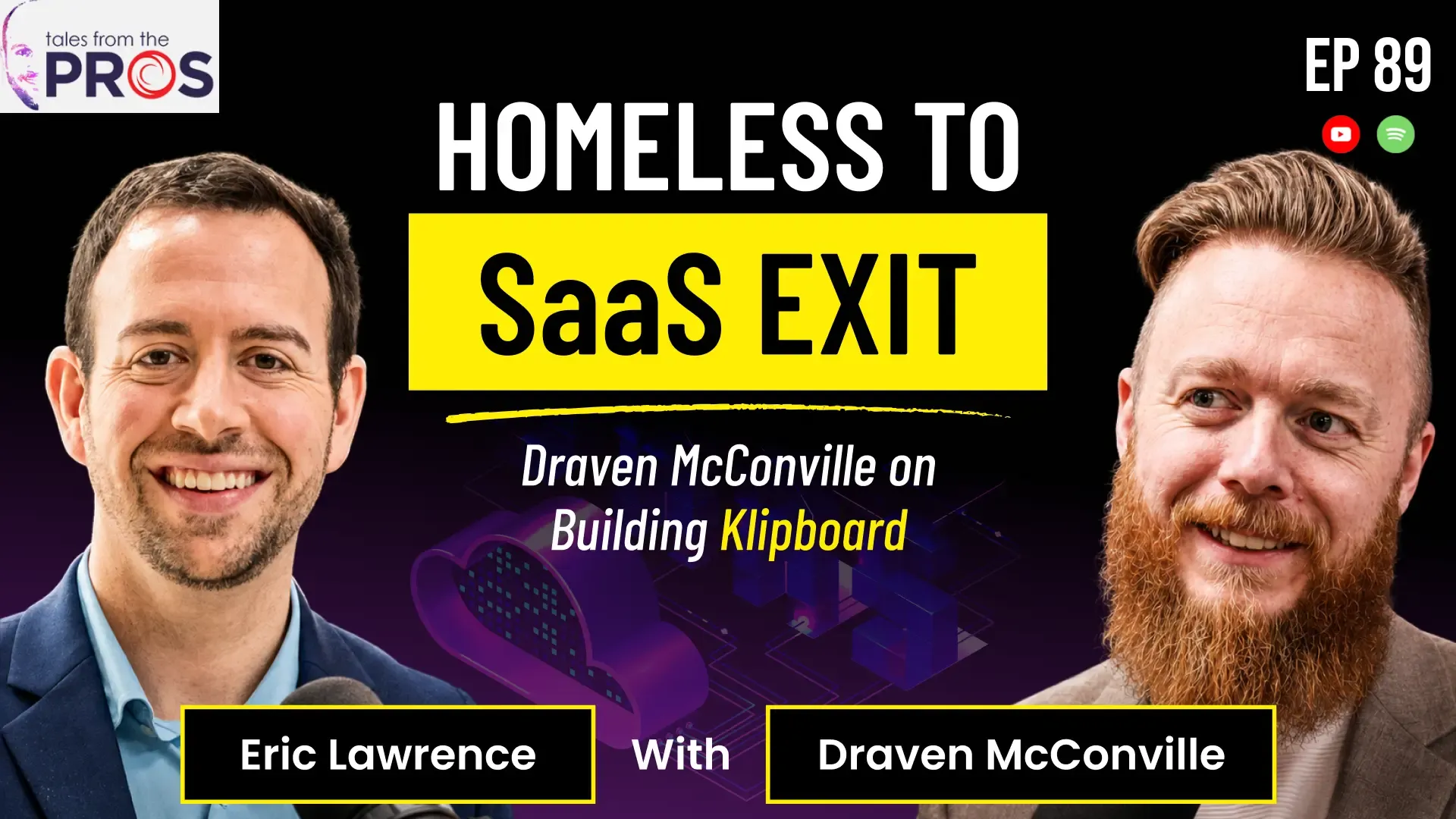
Every once in a while, a founder’s backstory stops you before you even begin talking about software architecture, product roadmaps, or venture metrics.
At 18 years old, Draven McConville was homeless on the streets with nothing but £200 to his name, a single bag of clothes, and a one-way bus ticket. With no safety net, he spent months sleeping rough and more than a year and a half sofa-surfing across friends' apartments with no fixed address.
Over the two decades that followed, Draven worked his way up through frontline operational jobs—from sorting glass bottles into crates at a recycling plant to working inside digital marketing agencies. At 26, he launched his own digital product studio, building custom enterprise software for global brands including Kia Motors, Coca-Cola, and Jaguar Land Rover.
Later, seeing how badly deskless industries struggled with manual paperwork, he channeled those insights into building Klipboard, a field service management SaaS platform. He identified a massive market gap, raised $3M+ in patient capital, scaled the platform globally, and in July 2024, successfully exited to Kerridge Commercial Systems, a billion-dollar global ERP powerhouse that went on to adopt the Klipboard brand across its global operations.
In this episode of Tales from the Pros, Imaginovation Director of Growth Eric Lawrence sits down with Draven to talk through the unvarnished realities of building digital products: how adversity shapes an entrepreneur's tolerance for risk, the discipline required to build software for people who do not sit behind desks, the commercial cost of founder ego, and why high-touch consultative service is making a massive comeback in the age of AI.
1. What Sleeping Rough Teaches You About Risk and Resilience
Homelessness is often romanticized in startup profiles as a dramatic prologue, but the lived experience is disorienting, exhausting, and perilous. For Draven, experiencing homelessness at 18 became the foundational crucible for his career as a builder.
When you have no fixed address and no financial cushion, you learn three things very quickly:
First, you develop an acute situational awareness. You learn how to read a room, understand unspoken human dynamics, and assess risk within seconds. Second, you become largely desensitized to fear. The initial shock of uncertainty never completely vanishes, but over time, your threshold for ambiguity grows substantially higher than that of an average person. Third, you lose all patience for vanity; every interaction has to produce real, tangible clarity.
After getting off the streets, Draven took whatever work was available. He worked grueling bar shifts and labored in a glass recycling facility, manually sorting bottles into wooden crates. Eventually, he broke into marketing agencies, where he immersed himself in commercial strategy and client delivery.
By the time he turned 26, mobile applications were beginning to reshape the technology landscape. While most agencies rushed to build consumer games and novelty apps, Draven recognized that the adaptability he developed on the streets gave him a distinct edge in high-stakes B2B problem-solving. He founded his own custom digital agency, focusing on mission-critical business software.
"When you've slept rough and sofa-surfed for a year and a half, you learn that fear cannot paralyze you," Draven reflects. "To take the entrepreneurial path, you need resilience. You have to be able to take hits, roll with punches, and read human behavior quickly. When I started my first business at 26, that background was what allowed us to walk into rooms with multinational brands and deliver real value."
2. Why "Boring" Software Is Where the Real Value Lives
During the smartphone boom of the early 2010s, mainstream venture capital and media attention fixated on consumer-facing novelties—social photo feeds, gaming apps, and lifestyle utilities.
Draven deliberately pointed his agency in the opposite direction: building unglamorous, mission-critical mobile software for deskless workers and industrial operations.
"Boring is sexy, Eric. And boring is where the money is most times," Draven notes. "Software that performs an essential, mission-critical function for businesses out in the field is extraordinarily valuable. Over the years, we built everything from consumer loyalty apps to heavy-duty mobile software for oil and gas pipelines, crane manufacturing, and mining operations."
Working across heavy industries gave Draven deep visibility into how frontline businesses actually function. Across pipelines, construction sites, and manufacturing plants, he noticed a universal operational pattern: field workers universally despise administrative paperwork, and enterprises bleed revenue because information gets trapped between the field and the back office.
Designing for the Person on the Ground, Not the Executive Suite
A common trap in enterprise custom software is building for the executive who signs the contract rather than the individual who has to use the software on a daily basis.
When Draven’s team was commissioned to build custom digital solutions for Kia Motors, they did not approach the project by asking what "Kia as a brand" wanted. Instead, they spent time inside regional dealerships, observing the specific daily frustrations of local marketing coordinators and service personnel.
By engineering software that solved the micro-pressures of frontline staff, adoption took care of itself. That fundamental principle—that software succeeds or fails based on the human experience of the frontline user—became the bedrock thesis for Draven's next chapter: Klipboard.
3. The Two-Feature MVP: Winning Market Share by Doing Less
When Draven began researching the field service management (FSM) industry—plumbers, HVAC technicians, electrical contractors, and fire safety inspectors—he uncovered a staggering statistic:
52% of field service businesses globally used no dedicated management software. They ran their entire businesses on carbon-copy paper triplicate pads, basic calendar widgets, and informal WhatsApp threads.
For an ambitious software founder, the temptation in a market like that is to build a massive, all-in-one platform with dozens of features: customer portals, automated billing, GPS fleet tracking, parts inventory, and complex reporting dashboards.
Draven resisted that urge completely. He knew that if you hand a complex, multi-tiered enterprise system to a plumber or a field engineer who is used to a physical notepad, they will simply refuse to use it.
Instead, Klipboard launched with an ultra-lean MVP focused on eliminating the two biggest bottlenecks in the entire industry:
- Digital Mobile Forms in the Field: Replacing paper triplicate pads with a clean, mobile-first interface. Technicians could complete job sheets and safety checklists on a tablet or phone, instantly syncing data back to the office without illegible handwriting or lost physical forms.
- Visual Scheduling & Dispatch in the Office: Providing office managers with a simple, drag-and-drop calendar to dispatch jobs, track technician availability, and eliminate the multi-week delays between job completion and customer invoicing.
Frontline Operational Problem:
Lost paper triplicate sheets ──► Manual office rekeying ──► Delayed customer billing
Klipboard MVP Solution:
Mobile digital form in field ──► Real-time cloud sync ──► Instant same-day invoice
By concentrating entirely on forms and scheduling, Klipboard delivered immediate, undeniable value within hours of onboarding. The product did not overwhelm users; it solved their daily headaches.
Years later, after Klipboard expanded into a comprehensive enterprise platform, internal product telemetry confirmed an interesting truth: Forms and Scheduling remained the most heavily utilized, highest-retention features across the company's entire customer base.
4. The Cost of Founder Ego: When "Tasks" Had to Become "Jobs"
One of the most valuable lessons Draven shared on the podcast is how subtle founder biases can stall commercial growth—and why listening to the market must always override internal product theories.
When Klipboard first launched, the engineering team categorized work assignments as "Tasks" inside the application. Draven had a logical architectural reason for this: he envisioned a future product roadmap where large projects would contain multiple sub-tasks.
However, real-world contractors—HVAC technicians, fire safety inspectors, and crane operators—do not talk about "tasks." They talk about "Jobs." Dispatchers assign jobs, technicians complete jobs, and customers pay for jobs.
Because of that single word choice, friction emerged across the entire commercial funnel:
- During sales demos, account executives spent valuable minutes explaining what a "task" was in the software.
- During onboarding, new customers submitted support tickets confused about where their daily work orders lived.
- Prospective buyers left demos feeling the software was built for generic office workers rather than tradespeople.
"It was my own stubbornness, and dare I say, a touch of arrogance," Draven admits. "I thought I knew best based on how our roadmap was structured. But our sales team was pushing back, and support tickets were piling up during onboarding. When I finally swallowed my pride and made a universal find-and-replace across the entire codebase—changing 'Tasks' to 'Jobs'—everything shifted. Sales conversions rose, demo engagement spiked, and onboarding support questions plummeted. It was a humbling reminder: never get rigid about what you think is right. If the market tells you how they speak, adapt immediately."
5. Raising Patient Capital in a World of Hyper-Growth VC
During the SaaS boom of the 2010s, early-stage founders were routinely pressured to raise massive venture rounds and chase "growth-at-all-costs."
Draven recognized that field service management is a compliance-heavy, risk-sensitive sector. Companies in this space handle life safety systems, fire alarms, electrical grids, and commercial plumbing. They do not adopt software on a whim, and pouring millions into paid marketing ads does not magically speed up their internal decision cycles.
To support that reality, Draven chose to raise $3M in patient capital, partnering primarily with angel investors and a family office fund based in Seattle.
Family office capital gave Klipboard two critical advantages:
- A Realistic Multi-Year Runway: The company was not forced to pursue unnatural, hyper-growth targets that lead to fragile unit economics or high customer churn.
- Freedom to Focus on Product Stability: The engineering team had the runway to harden the software architecture for high reliability in remote field environments.
Draven also ran the business with a clear strategic end-state in mind from day one. He monitored industry consolidation trends and positioned Klipboard as an attractive, modern vertical addition for legacy ERP giants.
In July 2024, that discipline culminated in a successful exit when Kerridge Commercial Systems (a $1B+ global ERP provider) acquired Klipboard. In an exceptional nod to the product quality and brand equity Draven’s team established, Kerridge subsequently adopted the Klipboard name globally across its operational divisions.
6. The Post-Exit Void: Handing Over the "Train Set"
Entrepreneurs frequently talk about the journey to an acquisition, but few speak openly about the psychological transition that takes place once the sale closes.
For over a decade, Draven operated in an intense, high-velocity environment—navigating the operational shocks of Brexit in the UK, global supply chain disruptions during COVID-19, British currency volatility, and the daily intensity of managing teams and clients.
When the acquisition finalized and the wire transfer cleared, the sudden silence was disorienting.
"You get the check at the end, and you see the numbers in your bank account, but right behind that comes a very real sense of loss," Draven explains. "What you built is no longer yours. You have to hand the train set over to someone else. Someone else is driving your train, and someone else decides what track it runs on. When you've spent a decade waking up every morning with adrenaline, looking for the next battle to fight, waking up to a quiet inbox is genuinely strange."
After spending a year and a half assisting with the transition, Draven stepped away completely. Now, having taken time to recharge, his entrepreneurial appetite is returning—fueled by what he views as the greatest technological shift of our generation.
7. The Future of SaaS and the Return of Consultative Services in the AI Era
With the explosion of AI coding assistants like Cursor, Claude, and GitHub Copilot, software can now be prototyped faster and cheaper than ever before. This has led some commentators to question whether traditional vertical SaaS models are in danger of obsolescence.
Draven offers a sharp, practical counter-perspective: as the barrier to writing code collapses, the value of software moves away from feature checklists and shifts entirely toward consultative implementation, deep domain workflows, and human trust.
The SaaS Evolution:
Past Era (Pre-2024):
Code was expensive and slow to produce ──► Software features served as the defensive moat
Modern AI Era (2026+):
Code is fast and accessible to everyone ──► Consultative delivery, workflow trust, & domain expertise become the moat
Draven highlights three key shifts that founders and enterprise leaders must prepare for:
-
Every Business Becomes a Tech Business: Technology is no longer an isolated department; it is the operational core of every organization, from logistics to field contracting.
-
The Human Adoption Bottleneck: AI capabilities are evolving exponentially, but human organizations are culturally change-averse. The real constraint on digital transformation is not what the technology can do, but how effectively leaders guide their teams through change.
-
The Boom in Professional Services: Major AI labs and software giants are pouring massive capital into enterprise services and technology consulting divisions because software adoption is never just technical—it is deeply operational and personal.
"Competitors can replicate software features faster than ever today because they have AI tools too," Draven notes. "What they cannot replicate overnight is customer trust, white-glove onboarding, and the deep consultative relationship you build with your clients. If you want to build a durable business in this environment, listen to your users obsessively and deliver unmatched customer service."
Latest Episodes
Subscribe



Meet The Host
Michael Georgiou is the Co-founder at Imaginovation and the podcast host of Tales from the PROS. As an entrepreneur and business leader, he is passionate about sharing stories that inspire innovation and growth.
Eric Lawrence is the Director of Growth at Imaginovation. As co-host of Tales from the PROS, he brings years of experience working directly with clients seeking software and application development solutions. His insights help businesses understand what to look for in a development partner and how to set projects up for success.


One of the best business podcasts! 🚀

I have listened to several business podcasts over the years and I have to say that Tales from the PROS is within my top three favorites. Michael does a GREAT job creating an authentic and real conversation and atmosphere with the amazing guests he has on the show. If you want to learn about the realities of business, insights on how to be successful, the power of storytelling, and how overcome the business struggles that life throws at us, then this podcast is for you. I highly recommend checking it out and be ready to learn and be inspired! 🎙🎯
Amazing insight!
Michael is a great host and I really enjoy listening in on the conversations he has with business leaders. This podcast is great for anyone wanting to borrow ideas for their own business and looking to expand professionally!
An Educational Delight
This podcast presents fascinating insight into the world of business and entrepreneurship. I am in no way, privy to these topics and have found these interviews to be incredibly educational. Michael talks with trailblazers from all walks of the business world and I am here for it!!!
Love “Tales from the PROS”!
Michael Georgiou is a thoughtful and engaging host who chooses such a fascinating group of interviewees for his podcast! All of the thought-leaders, entrepreneurs, and business pros Michael invites on are exemplary in their fields and on the vanguard. I love listening to “Tales from the Pros” for inspiration and also a well- rounded and entertaining session. I highly recommend getting hooked on this podcast!
Mr podicast
Michael’s podcast’s are amazing and very inspiring. As his best friend I’ve seen the great times and the struggles of Michael building his company. He has put sweat and blood into his company and I couldn’t be prouder of him. These podcasts are great to see and anyone would be so lucky to be on it. Mike keep grinding and you are doing amazing things in life brother!!!

Check Out More Episodes
Explore more episodes packed with practical insights, expert perspectives, and real-world lessons you can apply to your business.


Justin Miller revolutionizes the wedding photography industry
 50 Minutes
 Play This Episode
World renowned trance DJ, Jaytech discusses building his own musical community
1 Hour 10 MinutesPlay This Episode
Michael Brenner talks on the content marketing formula for B2B companies
1 Hour 5 MinutesPlay This Episode
Fitness social celebrity Megan Ewoldsen proves how to STRIVE for progress - not perfection
1 HourPlay This Episode