
Listen on:


 Transcript This Audio
Michael Georgiou (00:01.686) Hey everyone, welcome back to Tales from the Pros. I'm your host, Michael Giorgio, co-founder here at Imagine Ovation, joined as always by my co-host and our director of growth, Eric Lawrence. Here is a problem with almost every growing company runs into. The sales team learns one thing from customers. The product team builds towards something else. And the two slowly drift apart until nobody is quite sure what the customer actually wanted.
Our guest here today has built his career on closing that gap. He runs revenue at clutch, the marketplace millions of buyers use to figure out which B2B service-based companies are worth hiring. But he does not stay in his lane. He works shoulder to shoulder with the product and engineering teams because in this world, revenue and product are at the same job. So today we want to get into how he reads the market, how he keeps tech and sales aligned.
How the things customers told him became features that actually shipped and where he thinks all of this is headed as AI changes how companies buy, please welcome today Tim Condon. Tim, glad to have you here, man. Really appreciate it. Hopefully I didn't j hopefully I didn't mess up your last name. It's Tim Condon. All right, cool. Nice, man.
Tim Condon (01:11.138) Yes. Yeah. Yeah. No, that's that's that's right. Yeah, that's right. Yeah, yeah. no, really really glad to be here. Really, really excited for the conversation.
Michael Georgiou (01:21.376) Yeah. No, we know you're a busy guy and I'm sure you're doing so much at clutch and just in life in general. So very, very honored to to have you here and just spend some time with us. We appreciate you very much. Cool, man.
Tim Condon (01:31.778) Yeah, glad to be here.
Eric Lawrence (01:33.474) Yeah. And and Tim, I I think a good place for us to start is to just get a little bit of background on you. You know, you've been at the the Washington Post, and I think most impressively, because we come from the world of software and building products, I know from our own clients and and from many people out there, the toughest thing for people a lot of times is when they ship a product, it's gaining customers. And for Home Snap specifically, if you want to talk a little bit about that, I know that you were able to take that from the ground.
and build it to 80,000 customers, which is is an enormous accomplishment. And how that all kind of led you to where you are at clutch, if you don't mind just giving us that story behind it.
Tim Condon (02:13.388) Yeah, yeah. so there's a lot to unpack. I'll try to keep it out. I'll try to keep that brief. So Washington Post, great organization, really gave me the foundation for understanding what a big company looks like. So that, you know, when I when I s when I went to a smaller company, you sort of it like every small company wants to be a big company, right? and so knowing what that looks like helps you sort of understand what you're working towards. So, you know, Washington Post, my last sort of job there was a new ventures role.
and you know, it was one of these like Skunkworks operations where the the publisher said, I need you to help us figure out like where's this all going? How do we get new new digital revenue streams? really, really fun time. Spent four years. We built up a little deal site back in the day when you know Living Social and and Groupon were growing and and had some great success success successes there. and then I wanted to do I wanted to do it for real. I wanted to do a real deal startup. So I joined a little company called Home Snap.
Michael Georgiou (03:03.807) Yep.
Tim Condon (03:13.252) maybe 15 people at their top at the time. literally we were working out of a condemned building. When I interviewed, there was like holes in the in the wall because they were like getting ready to like turn it into condos. and and I was like, this is this is exactly what I want. Right. and literally we had we had we had no no paying customers. We had no paying no no actual product at that point. just just the app that that that the that the agents could sort of use on their own. Yeah. And so
Michael Georgiou (03:26.239) Yeah.
Michael Georgiou (03:39.232) Interesting. Okay.
Tim Condon (03:42.747) we had a really interesting motion there. We, you know, we had an in with with with MLSs that got us in front of agents. We got the eight and then and then we just worked it as a whole funnel, right? So we had, okay, how many agents are in this MLS? How many of them, you know, did we get to register? How many of them are we get bringing down the funnel to and and the great thing about that, if you're getting back to your product point, was
You know, we had a hundred percent alignment between our product leader and and and myself. and we didn't always agree on the tactics, but we were like laser focused on the goal. And then, you know, he and I would just sort of hash out the details, right? And sometimes the hashing out was, you know, you get a little get a little testy, but I always viewed it as my job, and the same thing here's clutch is I'm selling our product leader the same way I'm selling anybody else, right? I gotta get them to buy into me, right? I gotta do my job to make sure I'm doing my homework.
Michael Georgiou (04:34.112) Mm.
Tim Condon (04:38.092) Right. So that I'm coming prepared to a a conversation, right? I gotta make sure that I'm being honest with him with okay, this is really important. And hey, I'm not gonna use resources for this because it's sort of a nice to have. and so I view it as a as like any other relationship. I like I have to make sure that I'm doing my job to come to the table with you know, with honesty and integrity, because I am selling him on this is what this is what I think we need, right? and if he doesn't buy into me, he's not buying into the idea.
And same thing here at Clutch. I joined here at Clutch. one of the first things I did was I sat down with our product leader and I said, let's, you know, let's talk about your vision, right? Because I don't know, I don't know clutch. I've I'm joining new. and it was really helpful to really, you know, listen first, really get to understand, and then and then really dive in and get to know the customers and understand like, okay, what are the things that can really help the product team you know, with their vision.
Eric Lawrence (05:31.275) Yeah, that's interesting. I I'd like to get your perspective because you've seen both large and very, very small organizations. When you're building something, what do you find's harder between the two?
Michael Georgiou (05:31.958) No.
Tim Condon (05:44.803) You know, one of the things I was really good at the Washington Post and I really hated was breaking down those bureaucratic walls. Right. Like, you know, I I hated it, but I was very good at it, right? I I because you know, I would I would view everything as like a sales conversation. I'm like, okay, how do I get this person to buy into me? How do I and so it's really, really good for getting things done, but it was it was exhausting. And so I wanted to go Yeah, exactly.
Eric Lawrence (05:52.237) Yeah, same here.
Michael Georgiou (06:07.296) Like removing the red tape. Like you try to get rid of the red tape. Make it natural and authentic, just kind of organic. Yeah.
Tim Condon (06:11.744) It it was exhausting. You had to be on all the time, right? And you're constantly running into people who said no, people, you know, but you had tons of resources, right? So that's the trade, right? Like you go to a a place like this and you know, clutch is great, but like it's not the Washington Post. and so you're always, you know, always making you know, horse trading, you know, one initiative for another, trying to say like, it do I really agree? Am I willing to concede on that? so it's a little bit both. I generally prefer the small to mid sized company.
Michael Georgiou (06:18.69) Mm-hmm.
Tim Condon (06:41.134) Yeah, I just feel like you can move so much faster and and that's you know, that's just that's very rewarding for me.
Eric Lawrence (06:45.953) Yeah, in and was there anything that you learned with Home Snap when when you guys were building it up that you think like uniquely positioned you when you moved into clutch?
Tim Condon (06:55.234) Yeah, for sure. I mean, I think one, that was where I really understood how a pro a a high performing product team works, and and how to work with a high performing team. and then, you know, I it's always been my personality, but but this team was a really aggressive about saying, you know what? I like we're gonna test every rule, we're gonna we're gonna challenge every convention, we're gonna push the envelope and just, you know, and and see what happens and that
Michael Georgiou (07:05.473) Mm-hmm.
Tim Condon (07:24.172) You know, that mindset is I think it's just helpful anywhere in a small company because, you know, w you don't have the protection. You know, you might be doing really well. One thing turns at a small company and you're done. And so you have to always be pushing the envelope because you just don't have that same buffer that a big company has.
Michael Georgiou (07:40.992) And I have a question. No, that's interesting. I and I guess we'll stay at Homestead and then kind of move over to clutch a little we'll definitely definitely move over to clutch. That's where you are now and it's it's very interesting what you're doing there as well. But at Homestead and just kind of your previous roles, on the product side, connecting to sales, obviously. did you, Tim, did you kind of have to look at, you know, obviously
you understood the product really just like you you obviously have to understand the product, the ins and outs, everything about it. Otherwise you can't sell it, right? You have to really understand it so well that you have to believe in it and you gotta sell it with passion, right? Passion sells, right? At least for me in my opinion. you know, and and for you, like when you were basically aligning kind of the tech product teams with with kind of your sales and even marketing. did you have to look at a lot of like data, right? When
Tim Condon (08:09.293) Yeah.
Tim Condon (08:18.136) Yeah. Yeah, yeah.
Michael Georgiou (08:34.238) the the product team was building the the platform and they were they were you know building new features, fixing issues, things like that. You were listening to your customers, getting feedback. But at some point, probably probably right, I'm assuming you were like, okay, we're not generating revenue on this yet, guys. Like we need to, we need to really look into the data, look into the buyer journey. Like t give us a little bit of insight on how how you want about that.
Tim Condon (08:51.085) Yeah, yeah.
Tim Condon (08:58.658) Yeah, yeah. You know, so we had so we had we had a program, here's a little story. We had a program where we would and it was actually all self-service, so it's all not even sales, all marketing. and and the idea the idea was we made it really easy at that time for real estate agents to turn their listing into a Facebook ad, right? Just very basic. And and the primary marketing channel was they would get an email when they got a new listing.
Michael Georgiou (09:15.148) Okay.
Tim Condon (09:27.916) And it would basically have a mocked up, you know, vi vision of what that would look like as a Facebook ad, right? Really powerful stuff, right? And the product team did a killer job of making this so compelling, right? and then the product guy, dear friend of mine, love the guy death. We went skiing last year, so there's not, but he got hyper aggressive, right? To the point where he was like, We're gonna send eight emails every time they get a new listing, right? And some of these agents have a lot of listings and
You know, and and it was just sort of like more is more, right? and we were getting complaints about too many emails and this and that. And so, you know, and he was like, No, just who cares? But sometimes it works, so just keep keep pumping more out, right? And so we did was we actually sat down and said, Okay, like we need to actually make this decision with data because there's just it's just all opinions right now, right? and so we sat down and we looked at every single one of those eight emails and we said, What is the actual conversion? What is each email worth to us?
Michael Georgiou (10:00.182) Yeah.
Tim Condon (10:26.796) And is it worth the trade-off of how many is unsubscribed you're gonna get? Right. because once somebody unsubscribes, you're not getting them at all because our whole motion at that point was email. and so we we did, we sat down, we looked at it, and we were like, okay, like I I it was more than I thought. It was like five, six, like maybe like it was basically past six. You're like, okay, maybe you're not really getting much, it's worth a trade. I thought it was gonna be three. So it ended up being that my opinion was wrong. Well, both both of our opinions were different.
And somewhere in the middle was right, right? Based on based on the data. And that actually helped sort of like bridge the gap because we both agreed, like, okay, we'll let the data decide. Like we both have really strong opinions, both very strong personalities. and you know, yes, that that is usually the good neutralizer, right? You just you say, let's just, let's just agree on what data matters and and and then find out what the data says.
Michael Georgiou (11:14.08) Yeah, I know it's so I completely agree. Yeah, it it's it's crazy, right? I mean, we we talk about data all the time, Eric, you know, with within our company for imaginovation and even the the product side for magic task. and you know, it's it's like we all have opinions. And and for me, I'm you know, I'm I I and I'm I've always been an emotional guy. Always like I I just I I've I'm just it's the way I it's the way got the way God made me, man, it's just how I am. I'm I'm emotional.
you know, I I'm I'm passionate and it seems like you are too. You believe in what you do and what you're selling and and you have to, right? and at the same time though, I've I've learned to to to be very objective because you can be so close to something, right? That when you look at it objectively and you let the data do the talking, you try to set it everything up, you know, as well as you can, right, with your whole funnel and everything to try to make sure you're
your source attribution, your conversion tracking, all that stuff's is is in place. you kind of let that tell you the the give you the real clear picture because you can have all these thoughts and opinions and then you just you're gonna go in circles. It's not gonna go the product's not going to go anywhere and you're not gonna make revenue, get new users, you know.
Tim Condon (12:26.796) Yeah, and actually that that brings up a really good point because some t data is can be dangerous too, right? you know, we we we we used to agree before we saw the data, we used to agree what data we would use because otherwise somebody can always go and find some data that supports their opinion, right? so you have to sort of agree up front, like, okay, what is gonna help us make the decision before we know what the data says? and and and you know, do we agree that these are the right pieces of data to look at and do we agree like what the thresholds are?
Michael Georgiou (12:32.272) yeah, great.
Eric Lawrence (12:33.473) Yeah.
Michael Georgiou (12:43.98) So true.
Tim Condon (12:57.258) and that so in that example we did that. but you know, I like there are other times you get tripped, you're like, yeah, you just cherry-picked the data, right? Like that's not cool, right? and so you know, you just and I I don't think necessarily on purpose, but sometimes people just like they see what they want to see, right? And so you have to sort of like take that step back and say conceptually, what do we think is actually gonna tell us the right answer.
Eric Lawrence (13:16.001) Yeah. Tim, I I wanna because I think it's a little bit of a black box for a lot of people when they think about growing a product. I I know a lot of times when somebody releases a product, in their mind they know how the users are are going to take to the product. And I hear from so many people, it's it's gonna sell itself. It's it's like field of dreams. If you build it, they will come. I'm interested to know for Home Snap specifically when you guys launched it.
Michael Georgiou (13:16.094) No, that go ahead, Eric.
Michael Georgiou (13:38.006) Mm-hmm.
Eric Lawrence (13:45.026) Did it take off? Was there a point in time where you had to kind of figure out your own process of, hey, this product needs to be improved? And I need to figure out how to communicate that to the product team to improve it and how that evolution kind of happened to the point where it actually did become very successful.
Tim Condon (14:04.78) Yeah, you know, that's a great that's a great question. So when I joined Home Snap, the reason I joined was they were we they the the the company was in there's about six hundred MLSs across the country and about call it you know one to one point two million real estate agents in those six hundred MLSs at that time. And you had to go through the MLSs, right? They has they sort of held the power. and so I think we were we were in like maybe three or four MLSs.
But you could see that the agents, when they found it, they loved it. Right. There was just super high engagement. There was like, you know, this pass along. but they but they'd stalled it in growth, right? In in these MLSs. And so, you know, I came in and, you know, I was like, okay, I can I can work with a product that people love, right? and I came in and I realized, we really didn't have any permission to email agents to let them know about this product. We'd only ever sent them one email ever. So everything.
here was organic and it stalled because at some point you need to actually like you know add fuel to the fire. And MLSs were a big roadblock. And so what we did was because we we couldn't just go and be like can we email they'd be like no right like we don't you can't just email our members right and so we did we said you know you are offering this to your clients
And we put together an onboarding program, right? Made it a program so that you know so that the MLS just felt like, it's a program, right? And and it had very specific rules, right? And but the rules favored us, like it's what we wanted. and we put guardrails in place so that they felt comfortable, but it went from like night to day, right? We went from they had hit actually a third of the agents in the market were on the product. We got that to 80% in like a year. Like it just took off because they just you just needed to get in front of them, right?
Michael Georgiou (15:27.946) Mm.
Michael Georgiou (15:49.735) Wow. Wow. Yeah.
Tim Condon (15:52.749) And so yeah, the product was awesome, but it doesn't matter if you don't have distribution, right? And so that was that would so to me that was sort of the unlock was killer product, but you gotta make sure you got the tactics right to get it in front of the right users.
Michael Georgiou (16:07.584) And I love what you did there, man. Like, you know, that's so cool. It's really powerful what you said, honestly. Cause, you know, I think when when we talk to, you know, I'll say it with Eric, you know, when we talk to to our clients, right? Cause we're software app development company, right? And when we when we have when we're building a SaaS, like Homestead, for example, and what happens is like the the product side will be will be good. And you know, it's not always perfect. There's always gonna be iterations and
Crap, crap happens, right? It's a pr it's it's software development that's always evolving and growing. but at the same time, you know, you have to get it in front of people. It could be the best product in the world, but if if you don't know how to actually get it the right way in front of people, it's gonna die. It's just you're putting in the wrong environment, or you're not even putting into an environment for it to thrive.
Tim Condon (16:52.974) Doesn't matter. Yeah.
Tim Condon (16:59.404) Yeah. Yeah. Yeah. Yeah. And and no, and and we had the roadblock of we had a real like hindrance, but it ended up ended up being a huge advantage because we got through and we got the MLS to say yes. Any competitor couldn't had couldn't figure out how to get there. And so we'd sort of like crossed over and now we had this like backstop of like everybody else is getting no and we've got a yes, right? so you know it's i it was it was sort of a fun we we we felt we felt pretty smart, right? Like
Eric Lawrence (17:27.181) Yeah. Yeah. So w when you stepped in at clutch, I'm sure totally different dynamic there, totally different service. what was what was kind of your approach when you were stepping in at clutch to figure out, hey, like everything that I've learned at home snap, how can I how can I then kind of take it to to clutch and figure out how to improve things there?
Michael Georgiou (17:27.746) Rascal.
Tim Condon (17:34.722) Yeah. Yeah.
Tim Condon (17:49.155) Yeah. You know, it it was it was actually a really it was a tough transition because at Home Snap I had started at as employee 15 and I and I I was the first CRM admin, I was our first marketing manager, I was our first salesperson, I knew how everything worked, right? I knew all where the data was, I and I came to Clutch. Clutch had been around for, I don't know, 10 years at this point. and I didn't know how anything worked. And I was like, oof, man, this is tough, right? and so
Michael Georgiou (18:06.316) Yeah.
Tim Condon (18:18.188) I really back to your earlier point. I really sat with the data and I said, okay, what what do I know? Like how how does our, you know, like understood our products and that sort of thing. and it was interesting pretty early on, it you know, so so so just just suits you know, level set with clutch. So clutch you know, B2B services marketplace, you know, B2B services buyers don't need a a service typically more than once every six months.
Right. So building a brand with B2B buyers is really, really hard in this space, right? So we never did. We we drafted off of Google, right? The the the the the ethos of the company was be excellent at SEO because when the buyer's looking for a service, they go to Google. And if we're there, they're gonna come to us, right? And so we did that so so well that we actually started hurting ourselves because we were creating individual pages for every sort of
Michael Georgiou (18:53.578) Mm-hmm. Yeah.
Tim Condon (19:15.404) long tail search so that we would be we would win the auction, we'd win the organic auction. But what was happening was our our traffic was getting spread really wide in places that we couldn't monetize. Right. And so so that so as I'm digging in, I'm like, I'm like, wow doing well, but some, but something's changing here. And I can't really tell why the revenue isn't following the traffic. And then it hit me, like, we got all these little little pages that we can't do anything with with all this traffic. Right. And so that
I sat down with our current revenue team and I was like, okay, like we had this sort of sort of like product that was like rolled out a few years ago. It's sort of just it's sort of just meandering along. It's not really growing, but it sort of feels like it could be re retrofit into the into capturing all that long tail traffic. And we did. And the and the product like tripled overnight. and it was, I mean, I think it's it's it's close to, I don't know.
Michael Georgiou (20:05.216) Wow.
Tim Condon (20:09.214) 20% of our revenue now, right? So it was it was not only it was not only triple, there was meaningful portion of our revenue. And it was all about capturing that traffic that you know our marketing team was doing a great job of bringing in, but it they were bringing it in in ways that we couldn't monetize. and and then you know, working with the product team to figure out like, okay, how do we how do we reconfigure this product so that it actually delivers the traffic to our clients, right? That's exactly what our those are everybody wins, right? The clients wanted that, right? They want to pay for those leads, right? We want to get paid for it.
Michael Georgiou (20:16.129) Yeah.
Tim Condon (20:39.22) And we want to be able to win our every every single organic result that we can.
Eric Lawrence (20:43.585) Hmm. That's interesting. You know, from our perspective, because we we are kind of like the buyer here. we we work with clutch and have a really good relationship with them. I think it was a year or two ago, we were looking at our own data and looking at the different sources and saying, hey, what what sort of channels are coming to us that bring us the best sort of fits and the best kind of pro projects that we work on? And clutch always was popping up as one of those where
Michael Georgiou (20:45.055) No.
Michael Georgiou (20:52.278) Yeah. Yeah.
Eric Lawrence (21:12.683) What we noticed was that very legitimate companies would search clutch and find companies that they could trust to to then reach out. And it was almost like that social proof because I think a lot of times with Google, it can be a little bit more difficult. so that's why we got into the game with clutch in the first place, is is because of that. And in, you know, at the end of the day, especially in software and the way that the industry is moving,
Michael Georgiou (21:24.634) yeah.
Eric Lawrence (21:39.936) You're seeing more and more because a lot of the the clients we have worked with in the past were more of your entrepreneurs that that have a bold idea that are going for it. And with kind of the advent of A AI and being able to to kind of just build your own pro throwaway prototype, those people are are starting to kind of go their own route. And really you need to be established with legitimate businesses that can't just vibe code their way into a product. So that's that's at least kind of how we landed with clutch.
Tim Condon (22:09.954) Yeah, yeah, that's great.
Michael Georgiou (22:11.946) Yeah, no, it's a great point, Eric. Yeah, I mean, no, Clutch has been clutch has been awesome, and we've been we've been with you guys for for several years. And and it's it's interesting, even before we kind of technically became a customer, it's like we knew about clutch for a long time. I mean, I've been running running my c this company for 15 years. So I knew clutch long time ago. and you know, i it was cool because it's like w when I would see clutch online.
as as a software development company and we would, you know, we would Google and obviously it's so different saying that now because AI is just kind of jacked up everything it in a good and bad way. It kind of it's a mix. I I don't know what it is, but it's it's kind of a mixed bag. But there's good there's good and bad and you know all that stuff. It's evolving. But you know, yeah it it's interesting because what what what you Tim and and your team have done at Clutch, it's it's it's pretty amazing, man. Like how it's
Tim Condon (22:46.988) Yeah. It's it's a
Michael Georgiou (23:07.926) basically become this premium brand in your in this kind of like B2B listing space, I guess. Is that okay to say that? Service listings, you know, and and yeah, it's it's still it's it is a platform. It's like you guys are a software company, but you you've become this premium brand where where no one really can compete with you because it's like, we saw Imaginovation on clutch, you know, and and they're legit.
Tim Condon (23:17.838) Yeah, yeah, yeah.
Michael Georgiou (23:37.174) You know, and and the way you guys have have optimized your platform and you know, you've listened to your customer, you you've iterated, you've you've made it very valuable to show, you know, to to basically give us and I would say millions of other companies or or whatnot, your customers, just this opportunity to, to grow in business, right? To grow and and to find us online. Cause it's difficult now, especially with AI.
Tim Condon (24:02.444) Yeah. Yeah, and I'll say I'll credit our founder. you know, he he has always said if you build so that the buyer can figure out, you know, who the best companies are, and you just don't compromise on that, then you're gonna have a really good business, right? and it doesn't matter, you know, it doesn't matter that one company, you know, is threatening not to you threatening this, that, that, you know, like there's there are good companies out there and the good companies will rise to the top, right?
And so that's you know, he's always sort of not compromised on that idea that like, yeah, these are our clients, but at the end of the day, the buyer matters most because that's who the clients want. Right. So if you don't build for them, then you're not gonna have you're not gonna have much of a much of a business.
Michael Georgiou (24:44.876) Yeah, no, it's it's it's true. I mean, yeah, the the we always tell we always tell clients this is the well I'll I'll go back a little bit. Like I I think a lot of especially startups, they they get really scared that there's competition. So because there's competition, guys, we're gonna s we don't want to build this anymore. We're like, you know, it guys, competition's actually good. It shows that there's demand in the market. It it
I'm not saying, hey, you're gonna build Google, but if there's some competition, even if it's ten competitors, there's always a space. There's a lot of room. This is a big world. Like there's there's a lot of people that can t take up take a bite.
Tim Condon (25:22.17) So so many dimensions. So many dimensions you can compete on, right? I mean, so many dimensions. So yeah. No, no, no. Competition, you're right. I mean there's very few blue sky opportunities, right? Very few.
Michael Georgiou (25:32.438) Yeah. Yeah. And and I guess, you know, Tim would you know, you being at clutch now and kind of your role there and in leading the the sales and and revenue and and I'm sure you you know you're working with your marketing team, it goes hand in hand, of course. How how are you aligning with the product teams, the the the development teams? How does that relationship, how does that dynamic work and and what's the impact that you see from it from just that alignment, that continuous just communication between them?
Tim Condon (26:01.464) Yeah. Yeah. So so let me start with where I've seen it go wrong because I I you know, you you you see it go wrong in very specific ways, especially between revenue and product. revenue revenue people, we we're we're the worst. I mean, we want everything, we want it now, right? One customer says something, they're right, and and we've gotta the product team's gotta jump, you know, jump through hoops to get it done.
Michael Georgiou (26:23.062) Ha ha ha.
Tim Condon (26:23.878) And it just it's it it's always the tension, right? The product team's like, you can't I can't do everything, right? And and we're like, this customer needs this now, right? and so you know, what what what what I try to do with w communicate to my revenue team is like, look, we gotta pick our battles, right? And sometimes you have to give up something because you you may not be you may feel like it's not the right thing in the short term, but you're not doing it for the short term, you're but doing it to build credit to credibility with with the product team.
Eric Lawrence (26:31.585) Yeah.
Tim Condon (26:50.732) Right. If the product team thinks you're just gonna cry wolf every time, you got nothing, right? But if they if they if they understand that you're listening to their needs, you're understanding what one, what their vision is, two, what resources they have and don't have, and then communicating in those terms, you're just gonna get a lot more done. and so when I sit with our with our product team, you know, it's a it's a back and forth. It's a here's what I'm hearing, right? Tell me what you're hearing.
Michael Georgiou (27:10.294) Mm.
Tim Condon (27:18.66) you because they obviously talk to plenty of buyers and customers themselves. and especially in a very transformational team time like right now, where you know, we are we are turning clutch on its head. I mean, you guys haven't seen it yet, but it is it is a really strong joint effort between, okay, where do we need to go? How do we need to get there? And then how do we make sure we have a business right that actually like generates profits and continues to continues to grow?
And it's really fun. It and but it that wouldn't happen if we hadn't done if I you know if we hadn't done the hard work to sort of build that relationship and build that trust so that you know we're not just the the Yahoos on the side saying like, no, we need more of this, right? so it's it it it's really been it I I I view it as a sales relationship, right? I'm I'm selling this person on buying into me and that that means I gotta listen, I gotta like understand their problems and then and then think about my, you know, think about solutions to their problems in terms of
You know, the things that I need.
Michael Georgiou (28:20.458) Yeah. No, it's it's true, man. Yeah. No, that's cool. Yeah. I it's the you always hear you know, stories just with not just stories. I mean we Eric we go through it with our with our tech team too, sometimes just like like it's like you know, but you you find ways to align and and you you have to. There's you there's no choice. You have to align with between each other because really that the product or the development team and they're they're kind of in sales because everything that they're building, especially with Assassin.
software as a service and all of that, it it's gonna influence the impact on the customer. Right. So you you you have to be aligned. You have they have to build basically what the market wants, right? And keep keep getting feedback. You're the one who's giving that feedback and saying, guys, like, you know, this this product is missing, is missing some pieces here. And we we we really need, you know, if we want to hit this this growth goal or whatever it is, we need to try to build it.
and then you try to set expectations with your customers, I'm assuming, right? And all that good stuff.
Tim Condon (29:22.53) Sometimes, you know, I just I take the customers and let them speak for me, right? Because a lot of times it's easier for a product person to hear it from a customer than than to hear it from me, you know.
Michael Georgiou (29:26.412) That's cool.
Michael Georgiou (29:32.94) Yeah. Yeah, that's true.
Eric Lawrence (29:34.081) You probably hear from them last too.
Tim Condon (29:36.076) Yeah, exactly, right? Well also it it it also makes the customer feel cool, right? Like they feel like they're on the other side. Yeah.
Eric Lawrence (29:41.1) Yeah. Yeah, exactly. Yeah. I I I actually I wanted to ask you about the the AI project brief tool, because I I know that's something new. I'm I'm not sure how much of a hand you had in the the team going to do that, but I've seen it on clutch. I'm interested to get your take on it and why it was created.
Michael Georgiou (29:41.794) They're part of the journey. Yeah.
Tim Condon (30:03.436) Yeah. Yeah. And and honestly, that's that's sort of phase one of of of you know sort of where we see clutch going. So essentially it came down to this. you know, we we are our our existence has mostly been a traffic broker. And what I mean by that is traffic comes to clutch, you know, from Google or other places, and then the essentially the the primary monetizable event is they click out and go to a provider's website.
Right. And and then we lose it and we and and we know nothing. Right. And so we're all completely reliant on feedback from the client on how you know how the conversions happen, that sort of thing. And you know, and then we we thought to ourselves, like, look, we just have so much rich data from reviews over time. We have a really good sense for when when a when a buyer has a problem, we have a lot of data that will help us help them refine their scope.
And then become a much frankly a much better lead, right? Because if they're if they're clicking off and then going to a website and they're clicking around, like who knows what happens then, right? But if it if we can convince them to give us a little information, share back with them. So what happens is the buyer comes in, we ask them a few questions, and then we produce a whole brief, right? And that brief is is essentially built off of our review data that says, hey, people who ask questions like yours.
Typically these are the things that are in their project scope, right? they can edit it, they can change it, right? And then and then we match them with providers that we think are good are a good match. we think we can actually take that a lot further. we think and you know, I don't know if you guys want to talk about like I you know, I think it's it'd be great to talk about like where we think the world is going with B2B buying. so so let me let me let me give you sort of our opinion. So
Michael Georgiou (31:50.293) yeah, yeah. Well we're definitely yeah, definitely. Yeah, that's that's huge.
Tim Condon (31:56.783) if you had asked me this, as a matter of fact, you can probably find a podcast of me saying this probably a year ago. I was like, B2B buying way too complex, like it's gonna be a while before people trust the bots, right? I've done a complete 180 because it's all of a sudden become very apparent to me. The thing that AI does really well is distill really complex problems that have a that require a lot of context, right? And so if you think about the B2B buyer,
Everything is a little bit bespoke, a little unique. There's no there's no c you're not buying software, there's like cookie cutter off the shelf pricing, right? and so what ends up happening is the buyer doesn't know where to go. So where the where are they gonna go? They go they go to AI and they like they can get they can have a lot of big conversation about like what they want and what they should be asking for, right? And so so so we actually think B2B buy services buying is going to be at the leading edge of AI search, not trailing like it has
In almost any other change, right? because of the complexity, because of the you know, usefulness of a tool like this in in in in a situation like that. And so we're operating with the assumption, this won't be true, but we're operating with the assumption that humans will not go to B2B websites to find a provider at some point in the future, right? Call it two years now, that everything will be driven by either a human doing an AI search or an AI agent searching on behalf of.
and so we are building with the idea that if an AI driven search is coming to clutch, right? More more than likely to our MCP server, but could be coming to our our website, we're going to we're gonna deliver back the best information, right? And then our customers, what what what what'll happen there is we will we will build products that say either you're gonna, you know, you're gonna get better visibility, right?
Through specifically clutch or on your own website, and some of those will be clutch products, or we're gonna help you get actual leads through AI searches or AI agent search. and we're building products to say, we want an A, we want an AI agent be able to come to Clutch and get actual proposals back from providers based on what you guys have told us about how you build your proposals, right? And because you can get so much context in an agent-to-agent conversation that this isn't like,
Eric Lawrence (34:02.422) No.
Tim Condon (34:20.834) you know, somebody put three lines in and we're trying to quote them. No, no, no. This is like very detailed scoping, you know, conversations where nothing's gonna be binding, but it's like we can actually get much, much more refined in our recommendations and give providers the app the opportunity to say, yeah, I here's how I build my proposals. Like we can we we can do that in an automated fashion, not not, you know, not just say, well, let's just get on a call and talk about it. No, no, no. We already have so much context at this point for what they're looking to do.
and then of course the conversation's gonna happen and it's got you know, but like the the buyer's gonna be coming in so much smarter to start with, and then to be able to see, these are the providers that are willing to say, yeah, this is how I would work with this project. We think that that's that's the future of B to B buying on the services side.
Michael Georgiou (35:07.306) That's cool. Yeah, no, no, that yeah. I I'm I'm hearing a lot of kind of like what you just said. I I'm hearing a lot of that type of chatter. you know, in in the marketing world. Cause I I oversee same thing with our sales and and marketing. And, you know, we're trying to gauge a read on in the market as a software development company, right? More like custom software development. and yeah, I I I agree. I I think what's happening is
Eric Lawrence (35:07.458) Yeah.
Michael Georgiou (35:36.734) The the digital world is becoming almost like it's like agentic where you have to build trust with these agents, these AI agents, where you know, the information you're providing, right? it needs to be really s so valuable, so good, that they're gonna recommend your the the type of ideal client, your ICP, to it may not be to your website, but in a way where you're still generating revenue. At least I I hope.
Tim Condon (36:03.746) Yeah. Yeah.
Michael Georgiou (36:06.54) There's gonna be some sort of positive from that.
Tim Condon (36:08.716) Yeah, no, no, we we we're very bullish actually on on our role here. you know, we we we view ourselves we were the conduit between Google and providers, right? We're now we're now gonna be the conduit between AI search and and and providers, helping the buyer figure out what the best match is for them. And you're exactly right. The trust signals today are the most important thing, right? And you know, you know, and and you know, we we b we see it with things like reviews on the clutch, like high, high correlation between how often the
Profile gets cited and how many reviews they have and the quality of those reviews. We see it with like designations like clutch verified. Like we go out and verify the company. That's a stamp on the site that has an 8X improvement in AI citations versus somebody who's not certified or verified. So, you know, there's like all of these trust signals. Now some of the a lot of this is probably gonna change over time, right? But but it's clear that AI today is looking for, you know, signals that say this is a good company that we can trust to recommend.
Michael Georgiou (36:53.62) Interesting. Hmm.
Tim Condon (37:08.05) and then it's g it's just gonna get even more and more like down funnel as we as it gets as it gets smarter and smarter and more contextual.
Eric Lawrence (37:16.811) That's interesting because i on the front lines here, I've been noticing like a lot of interesting shifts in buyer behaviors. because you know, we we do custom software and there's a whole process that we go through where somebody may know maybe like 20% of what they actually need. And they they need an expert to sit down and scope it out with them and figure it out. And it's very custom the approach that we take. But
One of the things that I've noticed is for a lot of companies that are coming to us now, they seem to know a little bit better what they're trying to build. And they a lot of times have used AI to help build a scope of work for them. And it becomes a little bit more about, hey, kind of challenging that, really trying to understand what are the bottlenecks from an organization standpoint. Does that line up with what the scope of work is showing for them? But it's it's just interesting to see.
You know, what we had before, which was a lot of clueless buyers, it's now shifting into people being more informed because they don't have to do as much legwork into the investigation.
Tim Condon (38:23.318) And it's just e and the legwork they're doing is way, way more effective, right? no w
Michael Georgiou (38:24.599) Yeah.
Michael Georgiou (38:29.1) There's more resources, more information out there, you know.
Tim Condon (38:31.692) Yeah. And and and I you know, w we are clutch is in a little bit of bubble. We are we are like AI forward, everybody has a license, everybody's expected to use it, you know, as part of their as part of their job. but you know, we do sometimes have ste step back and remind ourselves like, man, we are just on the surface. I you know, I talked to my wife the other day, she's like, I used Chat GPT once. Once. What? So like there's just a whole cohort of people out there that aren't even using it yet, and it is going to Yeah, it's gonna be
Eric Lawrence (38:54.369) Yeah.
Michael Georgiou (38:55.244) Yeah.
Michael Georgiou (38:58.87) My wife too. My wife as well. Same thing.
Tim Condon (39:01.25) Ubiquitous. It is gonna be ubiquitous. So so I you know, what you're seeing, Eric, I i I I tell you it it's the tip of the iceberg. Like it you will you will have people coming to you with full on scopes, right, that where we're where you'll you'll add value, but it'll be different kinds of value going forward, I think.
Michael Georgiou (39:17.792) And and Tim, let me ask you this. Like, you know, this is the thing. Like, so we're seeing a lot, like Eric said on the front lines on this side. And you know, we we've we've s re read things online. This is not my opinion, by the way. This some things that we read, and there's a lot of there's a lot of crap out there. You don't know what to believe. There's a lot of stuff going on, a lot of noise, a lot of clutter. you know, and and you gotta kinda pick and choose what you wanna what you wanna apply and what you wanna believe, and in her terms of how credible it is. But
In in terms of just the the software development space, right, which is is one of the major B2B kind of listings that you guys provide. I know that's also marketing. You offer marketing listings and all that consulting. But in terms of the the software development space for us, you know, where do you think things are are headed? Because I I see some things like they're like, you're not gonna need developers anymore. I I don't believe that.
No, it it I I think that's BS. Honestly, I I think I think right now, you know, it's like it things are we're in this kind of I don't want to say bubble. I hate that it's not bubble, but it's like we're in this just this phase of this new era where people are excited, they're having these dopamine hits and they're like, vibe coding, boo, I can do this myself, but they don't realize how difficult it is. It's so hard to create a really good, good product, like a piece of software.
Tim Condon (40:14.572) Yeah. Yeah.
Tim Condon (40:43.598) Yeah, yeah, yeah. Yeah.
Michael Georgiou (40:44.128) Like what are your thoughts on that? 'Cause you you know better than us, man, in terms of what's happening.
Tim Condon (40:47.822) Counterintuitively, our you know, most of our development traffic has been skyrocketing, right? And our clients feedback has been really like we're really seeing a lot more business than we had in the past. And so I I think I he here's, you know, look, who knows, right? But you know, we we we don't we don't believe B2B services companies are going away, right? With the the dentist office is, you know, yeah, maybe they can throw like something into
Michael Georgiou (40:56.78) That's cool. Okay. Good.
Tim Condon (41:17.068) You know, base 44 and VibeCob, a little website, but they're not, they can't maintain it, right? They're not, you know, they they they're they're they're and if something goes wrong, they can't fix it, right? And so you know what what's gonna happen is I think, you know, companies like yours are gonna get huge benefits out of using these tools, probably gonna shift a little bit to a phrase that you know we talked about around here called outcome-based pricing, right? Whereas instead of time and materials, it's sort of like, hey, you know, we're looking at the outcomes, and some of those outcomes are.
Michael Georgiou (41:25.547) Agreed.
Tim Condon (41:45.657) Build a website, some of those outcomes might be, hey, we actually care about business outcomes. Can you help us, you know, based on that? Right. And that's kind of interesting and exciting. because you guys will have the tools to really sort of help do stuff that you know maybe either wasn't possible or was very, very hard to do in the past, right? But there but lots and lots of companies are still going to need experts who know how to use the tools, right? Because like pe people just aren't gonna do it right now.
Are those people going to be specifically coders? I don't know. Like that job is probably gonna change a lot, right? but the person who can conceptualize what needs to be done is going to probably still be around. and the companies who are good at that are probably gonna be very successful.
Michael Georgiou (42:20.29) Mm-hmm.
Michael Georgiou (42:32.437) Yeah, and yeah, no, it that's very true. And and I think it's also like we're we're human at least in in this space, like human evolution and technology where where, you know, if you leverage these tools and you you build these AI skills, and we all are. I mean, we're we're it's embedded in our culture, it's in your guys' culture, right? Everyone know is learning it and and you know and improving their skills. If you don't do that, that's where it gets scary, right? It's like if if none of us were like
we don't we don't believe in AI. And there's a lot of companies like we talked to some Eric. I mean, you know this is true. We'll talk to some construction companies or whatever, not not putting the industry down, but just some companies and old school blue collars or they don't they don't know. They don't know really much. And you're just like, dude, you have to
Tim Condon (43:15.458) Yeah. Yeah.
Yeah. But but those are the companies that will need companies like yours. They'll they'll get the benefits of it, but only because they're working with a company like you that is an expert and can get and frankly can probably deliver things at less cost over time because it's rules are so much better, you know. Yeah. No, it's it's it's it's exciting. it's it's it's scary, right? Because anything anything completely new and this fast is is is always a little bit scary. but but we are very bullish on on on this business and
Michael Georgiou (43:34.762) Yeah, it's true.
Eric Lawrence (43:36.077) That's a good point.
Tim Condon (43:48.313) You know, we've got a lot of work to do to to sort of make that transition from being primarily the conduit between Google and providers to the conduit between AI search and providers. but we feel very, very comfortable with what we what our role should be, and you know, sort of like a lot of the tactics that we can do to get there. So we're we're excited. I mean, I think it's it's gonna be it's gonna be a crazy world in a in in two years from now.
Eric Lawrence (44:12.769) So Tim, is is there anything that you would recommend for for a business to do in the next, you know, three to five years to to get better noticed by AI?
Michael Georgiou (44:12.884) And and a w go ahead, Eric.
Tim Condon (44:23.052) Yes. so you know Michael, you you you you sort of brought up like any any strong trust signal today is is is is important, right? So you know we we tell people get reviews, right? Make sure you know not just not just on clouds, on all the platforms. Like we are doing it for ourselves on other platforms, right? We're getting reviews, we're put you're making sure our profiles built out because AI isn't just looking at your website.
Right. It's looking at any place where it can find information about you and then synthesizing that to to decide what how you fit. you know, I think look, you know, what like by this will be a little self-serving, but like you should be testing out any of the pro new products that come out there that sort of try to drive reputation. because it it's it's it's a bit of the wild west, but if you don't do it, you almost definitely will not keep up.
And then you and then you know, you gotta decide like, okay, how do I measure this? How do how do I how do I make sure I'm spending my enough money wisely? But ultimately you gotta be in the game, right? And so that's that's that would be my advice.
Michael Georgiou (45:25.718) Yeah. Yeah. And and and to piggyback off what you said as well, Tim, you know, I I think there's gonna be a lot of changes aside from from just the just the kind of direct technology side, like just like, you know, Google or the age agents or or the way the way products are built or or everything in terms of AI and just technology in general, more in the human hum human component is where is like I I feel like it's
AI is also gonna is making us more efficient where we can kind of do more with maybe a little bit less in in some instances, I think, but it's also gonna create a lot of new opportunities. I think it's still very new, right? There's so much happening and everyone's getting adapting and getting used to it. And, you know, and there's fear, but there's excitement and there's just so much noise out there in the world. But it's also gonna allow people to really show their their human potential. And and hopefully, I where I'm thinking, I hope I hope where this this goes is that, you know, that, you know.
People can you know, show show what they're about, you know, and and be able to to to show their abilities to to the world with more resources and you know, and I think that's a good thing. It's gonna open up opportunities.
Tim Condon (46:36.002) Yeah, t I mean technical will not be a a a hindrance, you know, at all anymore. I mean, which is really pretty cool.
Michael Georgiou (46:43.296) Yeah. No, it's good. No, it's it's I'm sure a lot of companies are gonna want to hear that. And yeah, I agree. I agree. I think it's just this kind of this phase and everything, but you just gotta adapt. Everyone just needs to adapt and just keep learning and growing. And you know, and you guys are you guys are doing it, man. You guys are at the forefront in your industry. it's it's awesome.
Tim Condon (47:00.664) Well we're we're excited. I mean we we we think we think it's we we we we owe it to our clients to to to sort of continue to be that, you know, resource to help you know, help 'cause otherwise, what do you got? You're just trying to figure it out, you know, like stumbling through the dark, right?
Michael Georgiou (47:15.562) And let me ask you one one last thing. Just kind of I I didn't have this planned, but I wanna I wanna ask you this. Tim, what do you think about your kind of opinion on Google? There's a lot of stuff going on right now with Google, right? It's like it's very, it's almost like it's I don't want to say monopolized, I don't know, but it's like that they're they have a lot of control. A lot of these big, big, big congl conglomerates, right? Big companies have a lot of control and some businesses have
Lost revenue and stuff 'cause of all the changes and everything. Like, where do you where do you think's going what do you think's happening with with Google, for example? Like
Tim Condon (47:46.691) Yeah. Yeah, it's good it's a good question. I mean, I think it does it does seem like there's sort of a shake out happening, you know, if you think about the big three, right? Google, Anthropic and Chat GPT, and they're sort of finding their places, right? you know, this is the kind of thing that in a normal environment the incumbent gets crushed because they didn't see it coming. They're protecting their own, you know, business model. I'm I'm I'm
You know, cautiously optimistic about Google's position in this space. I mean, you know, if you sort of look at if you sort of look at the resources they have and the commitments they've made, I don't think they're going away anytime soon. But it but they'll have the most competition they've ever had, for sure. Which, you know, hey, that's a good thing, right? We like them without competition has not been a great thing for us.
Eric Lawrence (48:33.441) Yeah.
Eric Lawrence (48:37.485) Yeah, no, no doubt.
Michael Georgiou (48:40.798) No, could yeah, no, that's awesome. Yeah, no, it's good. We were talking about competition earlier. You you need it. You need it to help you to to to stay competitive, to, to do better, right? And that, you know, so the the world is not relying on just, you know, one type of company or whatever it is. You know, it's it's good to spread the love a little bit. But no, this has been awesome, Tim. yeah, we really appreciate you, man. And it's been a great conversation. And I I feel like we can definitely talk you again. There's so much to unlock and and and talk about. Yeah.
Tim Condon (48:56.366) Exactly. Yeah.
Tim Condon (49:07.212) I told you guys that this could this could go for two hours if we let it.
Michael Georgiou (49:10.57) Maybe we'll go for another air hour, Eric. What do you think? no, we'll definitely try to have you back on and and yeah, no, really appreciate you, Tim, and lots of valuable insight in into just your existing company, your your history, your story, where things are headed. I think people can f really find a lot of value. So thank you for for sharing your time with us, man. Yeah.
Eric Lawrence (49:13.047) Yeah.
Tim Condon (49:33.772) Awesome, thanks for having me, guys.
Michael Georgiou (49:35.894) And where can where can everyone find you? The website, any social social social channels?
Tim Condon (49:41.25) Best place is almost definitely LinkedIn. that's you know, that that's that's easily the best place for me. I'm on X at TP Condon. I'm I'm mostly a an observer, not much of a poster. so those are probably those are probably the best two places. Fine.
Michael Georgiou (49:56.898) Cool. Yeah. And everyone check out Clutch as well. Amazing company. And yeah, really appreciate you guys. And you've helped us a lot. So hopefully you know, you're gonna continue to help other companies like us and you're gonna expand as well. So that's that's great, man. Really happy for you guys. So Tim, thank you so much, everyone. thank you so much for listening. We really, really, really appreciate you. And again, my name is Michael Giorgio, host on Tills from the Pros with Eric Lawrence and our guest, Tim Condon.
Tim Condon (50:00.802) Yep. Awesome.
Tim Condon (50:12.654) Yeah.
Michael Georgiou (50:25.654) Thank you everyone so much for listening. Until next time. Thanks, guys.

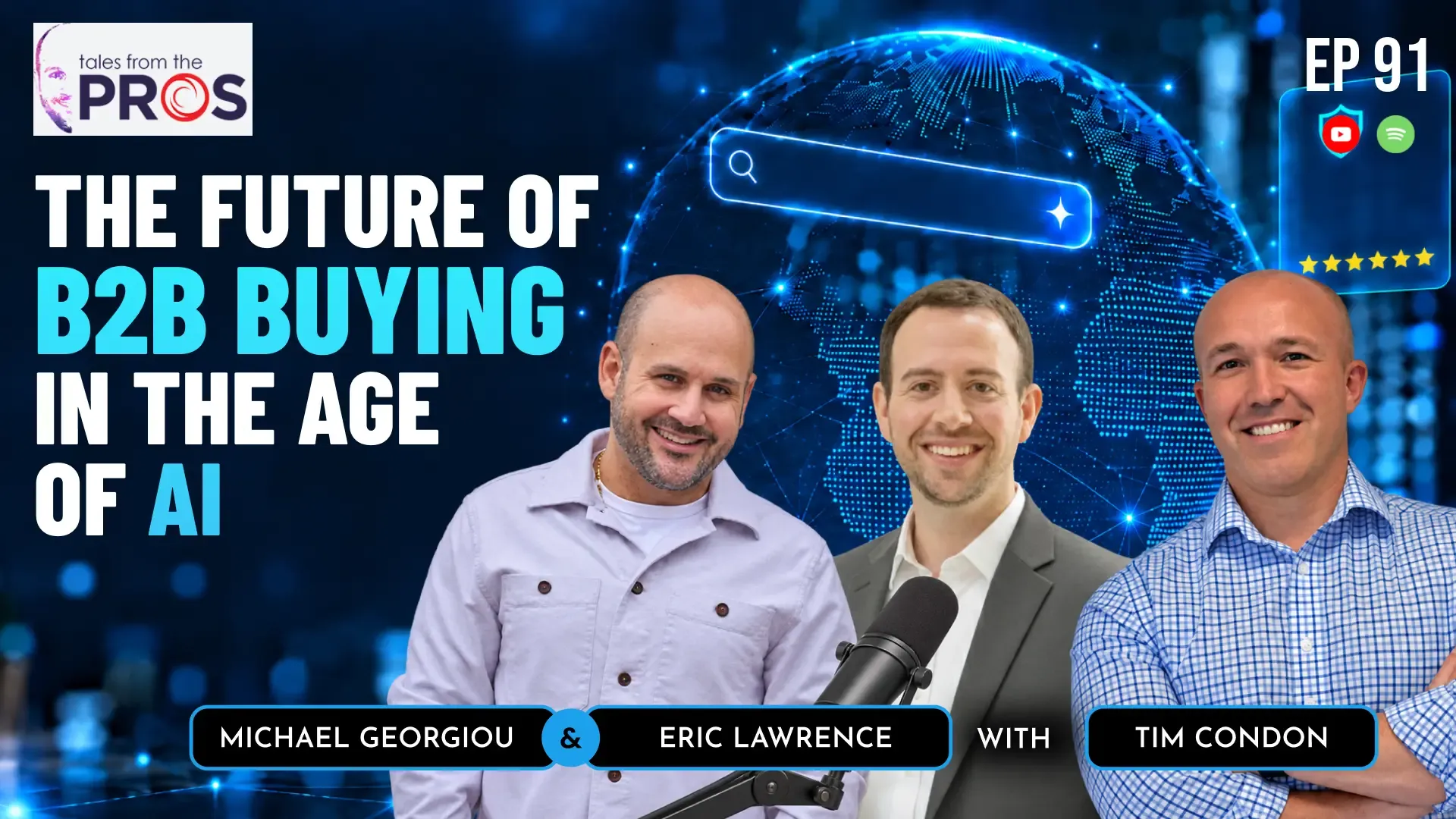
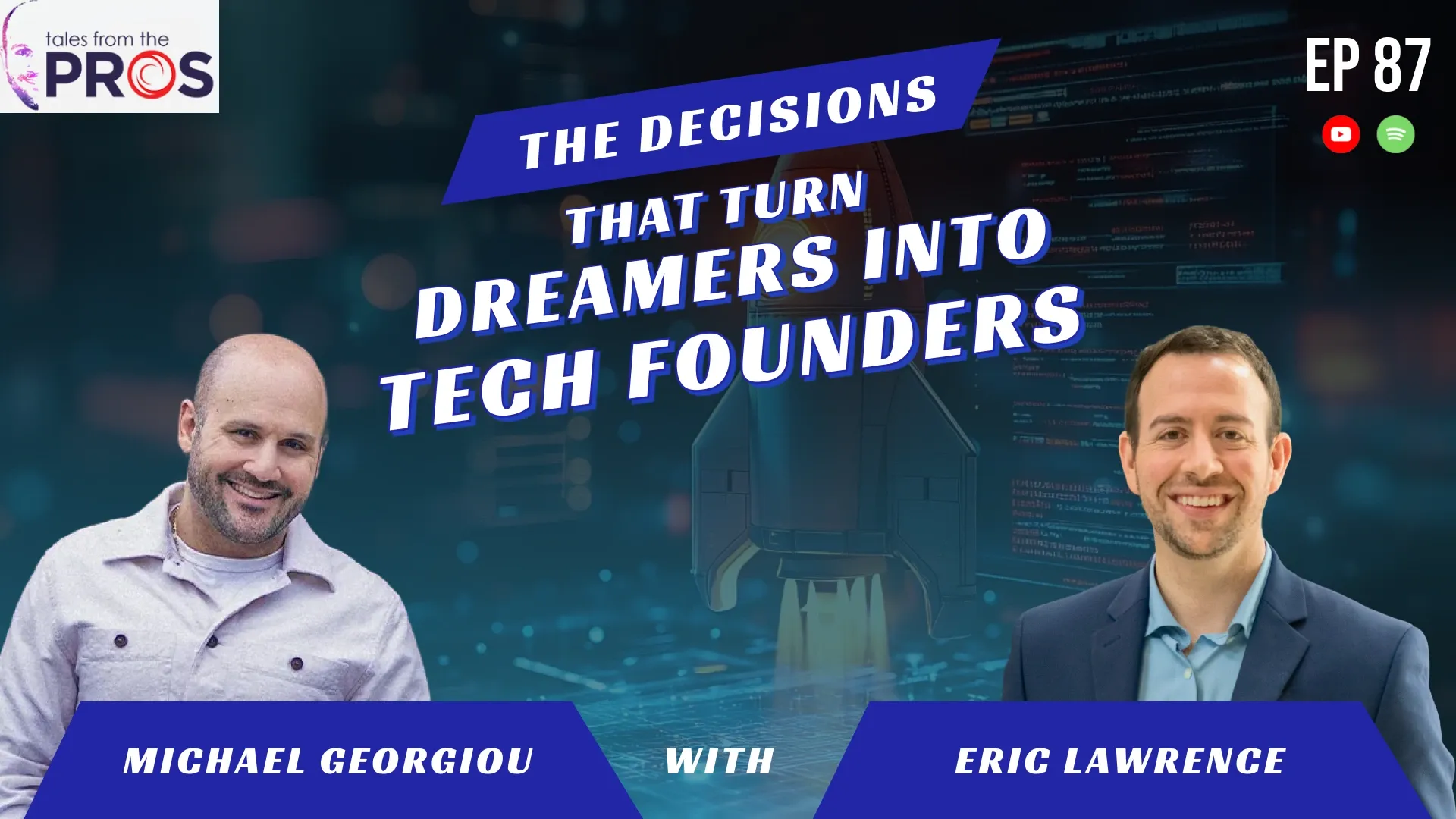
In this episode of Tales from the Pros, Michael Georgiou and Eric Lawrence sit down with Tim Condon, CRO at Clutch, to talk about how B2B buying is changing.
Tim shares what he has learned from growing products, working closely with product and revenue teams, and listening to what customers actually want. He also talks about why good products still need strong distribution and why data matters when teams disagree.
The conversation then shifts to AI. Tim explains how AI search and AI agents could change the way companies find and evaluate service providers. He also shares how Clutch is preparing for a future where buyers may start their search with AI instead of Google or a company website.
If you work in software, B2B services, sales, marketing, or product, this episode gives you a practical look at where buyer behavior may be heading and what businesses can do to stay visible and trusted.
🎯 Highlights You Won’t Want to Miss
- Why product and revenue teams need to stay closely aligned
- How data can help settle competing opinions and priorities
- Why even a great product still needs the right distribution
- How Clutch turned underused traffic into a meaningful revenue stream
- Why AI could reshape the entire B2B buying journey
- How AI agents may eventually help buyers scope projects and evaluate providers
- Why reviews and third-party trust signals matter for AI visibility
- What AI means for the future of software development and B2B services
🎧 Listen and Subscribe
Spotify:
https://open.spotify.com/show/6QkUtrcNllUkqtq1fjlwnZ
Apple Podcasts:
https://podcasts.apple.com/us/podcast/tales-from-the-pros/id1371067192
YouTube:
https://www.youtube.com/@Imaginovation/podcasts
SoundCloud:
https://soundcloud.com/talesfromthepros
💡 Key Takeaways
- Strong product and revenue alignment starts with trust, communication, and shared goals
- Customer feedback is more useful when teams understand which requests truly matter
- Data works best when teams agree on the right metrics before seeing the results
- Great products still need strong distribution to reach the right customers
- AI is making B2B buyers more informed before they ever speak with a provider
- Reviews, verification, and reputation are becoming important signals for AI recommendations
- B2B service companies are unlikely to disappear, but how they deliver and price their expertise may change
- Businesses need to actively build their reputation across the web, not just on their own websites
Tim also notes that Clutch sees a strong relationship between reviews, verification, and how frequently companies are surfaced in AI-driven results.
🗂 Topics We Cover
- Product, sales, and revenue alignment
- Customer feedback and data-driven decision-making
- Product growth and distribution
- B2B marketplaces and buyer behavior
- AI search and AI agents
- Reviews, reputation, and trust signals
- The future of B2B services
- AI and software development
- Outcome-based pricing
- Google, AI search, and the changing discovery landscape
⏱️ Chapters
00:00 — Why product and revenue teams drift apart
01:33 — Tim’s journey from The Washington Post to Homesnap and Clutch
03:42 — Building alignment between product and revenue
08:58 — Using data to make better product decisions
14:04 — Why great products still need distribution
17:49 — Joining Clutch and finding new growth opportunities
24:02 — Building a marketplace around buyer trust
26:01 — How revenue and product teams can work better together
30:03 — Clutch’s AI project brief and the future of B2B buying
35:36 — AI search, trust signals, and changing buyer behavior
40:47 — What AI means for software development companies
44:23 — How businesses can become more visible to AI
47:15 — Google, AI competition, and the future of search
Latest Episodes
Subscribe



Meet The Host
Michael Georgiou is the Co-founder at Imaginovation and the podcast host of Tales from the PROS. As an entrepreneur and business leader, he is passionate about sharing stories that inspire innovation and growth.
Eric Lawrence is the Director of Growth at Imaginovation. As co-host of Tales from the PROS, he brings years of experience working directly with clients seeking software and application development solutions. His insights help businesses understand what to look for in a development partner and how to set projects up for success.


One of the best business podcasts! 🚀

I have listened to several business podcasts over the years and I have to say that Tales from the PROS is within my top three favorites. Michael does a GREAT job creating an authentic and real conversation and atmosphere with the amazing guests he has on the show. If you want to learn about the realities of business, insights on how to be successful, the power of storytelling, and how overcome the business struggles that life throws at us, then this podcast is for you. I highly recommend checking it out and be ready to learn and be inspired! 🎙🎯
Amazing insight!
Michael is a great host and I really enjoy listening in on the conversations he has with business leaders. This podcast is great for anyone wanting to borrow ideas for their own business and looking to expand professionally!
An Educational Delight
This podcast presents fascinating insight into the world of business and entrepreneurship. I am in no way, privy to these topics and have found these interviews to be incredibly educational. Michael talks with trailblazers from all walks of the business world and I am here for it!!!
Love “Tales from the PROS”!
Michael Georgiou is a thoughtful and engaging host who chooses such a fascinating group of interviewees for his podcast! All of the thought-leaders, entrepreneurs, and business pros Michael invites on are exemplary in their fields and on the vanguard. I love listening to “Tales from the Pros” for inspiration and also a well- rounded and entertaining session. I highly recommend getting hooked on this podcast!
Mr podicast
Michael’s podcast’s are amazing and very inspiring. As his best friend I’ve seen the great times and the struggles of Michael building his company. He has put sweat and blood into his company and I couldn’t be prouder of him. These podcasts are great to see and anyone would be so lucky to be on it. Mike keep grinding and you are doing amazing things in life brother!!!

Check Out More Episodes
Explore more episodes packed with practical insights, expert perspectives, and real-world lessons you can apply to your business.


Justin Miller revolutionizes the wedding photography industry
 50 Minutes
 Play This Episode
World renowned trance DJ, Jaytech discusses building his own musical community
1 Hour 10 MinutesPlay This Episode
Michael Brenner talks on the content marketing formula for B2B companies
1 Hour 5 MinutesPlay This Episode
Fitness social celebrity Megan Ewoldsen proves how to STRIVE for progress - not perfection
1 HourPlay This Episode