
Listen on:


 Transcript This Audio
Eric Lawrence (00:02.049) Hi, everybody. Welcome to Tales from the Pros. I'm your host, Eric Lawrence. I'm the director here at Imaginovation. And I'm very excited because today we're welcoming Matt Soltau to the to the podcast. So Matt Soltau he's the global director of strategy and operations at IntelliPaaS So Matt, thanks for thanks for jumping on today.
Matt Soltau (IntelliPaaS) (00:27.646) Eric, appreciate it. Thanks so much for having me on. It's a pleasure.
Eric Lawrence (00:31.244) Yeah, of course. So what we're talking about is the part of AI that nobody wants to deal with, which is the data underneath. So if you think about it, every company right now is trying to figure out how to deploy AI. The problem is most of them are skipping the foundation. So they're basically bolting AI onto broken systems, disconnected tools, and data that they can't actually trust. And then they're wondering why nothing works. So
Big reason why we have you on here is that you've spent nearly a decade connecting siloed systems and marketing data that makes it trustworthy for AI across global enterprises and regulated industries. So, for the people that are listening, if you're ever looking at your tech stack and you've thought this is a mess and I don't know where to start, then really this conversation is for you. So I I am interested to kind of get
your background and and what led you to IntelliPass.
Matt Soltau (IntelliPaaS) (01:32.128) that's a great question. so I've I've always been curious about the things that that that don't exist and how everything comes together, right? So first of all I was born and raised in Germany and then but spent most of my time living overseas, working overseas in so far as six different countries. currently traveling again as well here. and
Well what what I've learned with that is that obviously no two places are the same, but you need to have a lot of different connections in lots of different places in order to make things worthwhile for yourself. Now it turns out the same thing applies in the IT world. So data integration really comes in connecting lots of different systems with another. So IntelliPaaS is a data integration company at its heart. but we obviously with that enable a lot of AI use cases as well. And
Yeah, that's exactly the part that nobody wants to talk about because
Eric Lawrence (02:30.081) Of course.
Matt Soltau (IntelliPaaS) (02:30.505) That's the that's the you know, it's it's not the sexy thing, right? So everybody looks at the shiny stuff and that's yet another AI application that can do amazing things, don't get me wrong, but things often get stuck in silos very often. And much more now the entire tech stack significantly expands quite a bit at the moment. It's already very significant for enterprises, very much expanding now by sort of having micro apps on top of that as well.
well that really rely on data and yeah for for that they need reliable data integration.
Eric Lawrence (03:07.989) Yeah, absolutely. And you know, it's it's interesting because you're starting to see a lot of companies start to realize that like the the cost of what they're spending on AI is is bigger than the impact. And I'm I'm interested to get your take with, you know, the vast majority of AI pilots that deliver zero business impact, what you're seeing is actually killing these projects.
Matt Soltau (IntelliPaaS) (03:32.863) Yeah, look, I mean th how can I put this? The the the graveyard, AI graveyard, is ultimately full of projects that actually didn't fail at the model, but failed at the pipe that feed it. Because pilots often collapse before they make it outside of their sandbox.
The reality is in a sandbox environment, it's like a laboratory. Everything's pretty defined and confirmed. The outputs are confirmed, etcetera. But then once you release that into the wild world, the real data that is then being relied on is often dirty, it's duplicated, it's untraced, and that often becomes the killer for it. So I'll give you an example. We're working with an insurance company in Singapore. I'm in Singapore here right now, it's getting quite late. But
they've had a particular well ultimately they try to deploy an AI chatbot to
Advise their team real time on the phone with incoming customer inquiries. Following scenario: You're calling your insurance company. That insurance company has real people on the phone, but they may not be fully trained in everything, right? Because it's quite a few different insurance topics that they have to cover. So now transcript runs in the background, and then the AI shows in real time what the agent.
Is supposed to be telling the customer. Sounds pretty good in principle, worked really well in the sandbox environment, ultimately felt in production. Why? Not because the model itself was bad or the idea was bad, etc. Like great idea, everyone can get trained immediately, but then the data quality.
Matt Soltau (IntelliPaaS) (05:25.0) That didn't scale beyond the sandbox environment. So that's where it fell over. And in the end, we see stories like this all the time, where you've got on the one side a fantastic idea that gets tested, works really well. The moment it gets taken out, the scope immediately expands on it too. And that is the part, and look, you know, we were talking about dogs earlier here as well. it's AI is no different than training your puppy.
Eric Lawrence (05:44.642) Yeah.
Matt Soltau (IntelliPaaS) (05:53.407) So initially you've got your new puppy dog that is trained to maybe find its way around the house. After that, you take it outside, then you go to the local park, eventually you take it to a shopping center. But these are baby steps to go from one to the next to the next to the next. And what we often see is that people go from
your puppy that's at home to immediately you're taking it on a on on a worldwide trip type of stuff and that that's when things fall over.
Eric Lawrence (06:24.042) It's interesting because yeah, we, you know, when we're working with clients, there's usually kind of two tracks. there's either the startup business when they build their first application and they want to have AI in there, where it's, hey, you may need to just take a model that's already out there. You know, you have your Claude, you have your chat GPT, and you run it. And what we do is we take the our own AI model and then we train it behind the scenes.
And then as they gain in users and as they gain in data, ideally, you start training that model to get to the point where it can outperform the base model that we have. And that's when we kind of make that transition and we swap it. And you can speak a little bit more towards like, hey, we have something proprietary here. It's it's you know really effective. It understands what it's trying to do. Or the the flip side is you're an existing business and you want to integrate AI into what you have. And then you're kind of at the mercy at that point of.
You you may need to have to trust your data or you have to figure out the data that you have is is it worth trusting?
Matt Soltau (IntelliPaaS) (07:26.82) you must trust your data, but the the the other part on top of this here is d do you actually have access to the right data? Because you may do. But it may not be available to the systems that actually need it. So if you don't
Then you ultimately end up in another data silo situation. So AI models are no different to us as humans needing water. They just need data. So we need water in order to think clearly, and we need water in real time, you know, good quality, etc. Now
Eric Lawrence (08:02.7) Yeah, so go ahead.
Matt Soltau (IntelliPaaS) (08:06.058) Yeah, and it just AI needs that as data, right? So if if you don't have the right data, then AI hallucinates. If we don't have access to clean water, we start hallucinating. So y th th there's there's the analogy here. so often the best data for AI is literally on the servers that nobody dares touching, because that's where that's literally where the digital gold sits.
Eric Lawrence (08:31.672) That's a good point. And I I am interested to know because you work with a lot of COOs, you you work with a lot of founders that may not live in the technical weeds. If you could paint a picture for our listeners of like what what does a messy data stack actually look like as a part of daily operations?
Matt Soltau (IntelliPaaS) (08:54.78) The the messy data stack is really just the one that's not mapped and that doesn't live on people's radar. So, you know, back back to the back to the server that nobody dares touching, you know, that that's the one with the sticky tape on it do not turn off. so it that that's really the Picasso that lives in your dusty attic, but that has no stairs to it. So y you don't even know it's there.
It's about building the stairs. No one can reach it, right? Or no one has tried to reach it. No one is maybe sometimes afraid to actually touch it. So i manual workarounds come as a result of it, you know. and it th that has ripple effects, s slow month end clauses, you know, conflicting dashboards, all that sort of stuff. AI has a fantastic opportunity for us here to make a lot of sense of a lot of complicated data.
However, the underlying data structure needs to be there because otherwise you're adding Smarts to just one part of your organization, but it's completely blind to something very obvious that you or the AI in the end is simply not aware of.
And what we need to very much focus on, and what companies really need, is they need a data officer that focuses purely on ultimately collaboration. Everybody has collaboration on their agenda. You go to any boardroom, everybody says, yes, we need to collaborate more. Now, in the end, if you don't actually allow the data to flow freely, and yes, you put guardrails in place and so on, no doubt.
However, if you don't allow that data to flow freely, and often it's literally just missing underlying infrastructure, that's really all it is. If you don't have that, you ultimately are building very clever AI silos that are very potent, very powerful, become more powerful, but ultimately
Matt Soltau (IntelliPaaS) (11:03.708) are very narrowly focused on just one part rather than having the wider spectrum that can really result in well the real innovations. So that these are the Picasso's upstairs. There's no the there are no stairs. So let's build these stairs.
Eric Lawrence (11:18.558) Yeah. That's that's interesting. Matt, do you do you ever see are there symptoms that these owners or you know companies are feeling when the data or the data is siloed? because I I think for some of them they they might think, hey, you know, we're not perfect. I think a lot of companies are under the mindset of like, look, we're we get it, we're not perfect, but I think we're doing a pretty good job. What what sort of symptoms
Matt Soltau (IntelliPaaS) (11:41.056) Of course.
Eric Lawrence (11:47.276) do you typically see where you say, actually, there's a lot of work that needs to be done.
Matt Soltau (IntelliPaaS) (11:53.357) You'd be surprised how many operations teams are running on spreadsheets to reconcile two systems. If you find yourself there, that's certainly your symptom. And I guess the disease, if we're talking about symptoms here, would be integration debt. So if reports take multiple days to produce, if there's multiple iterations.
d you know, change of numbers depending task or the numbers change depending on who you ask. That often happens as well. Finance and operations not being connected, etc. That that's certainly when you've got a problem here. Now there's an organization in Hong Kong that we're working with
Amazing organization. Nonetheless, they've got exactly that issue. So here in this particular case, we're actually talking about IT service management data and also data that comes out of the yeah, customer service kind of like calling agents, right? So all sorts of yeah, customer service related data. But the long and short here is there are various different reports that need to be pulled on a regular basis.
And yeah, guess what? They're being pulled manually at the moment. So that's the part we're addressing right now. But what's happening is right now five different systems, information is coming out, that gets manually put into various different spreadsheets. And here's another PowerPoint documentation, etc. At the end of the day, leadership and other sort of interest groups are getting updated on it.
Fairly standard process, if you think about it, obviously not very efficient in modern terms. But you know, this is exactly where the integration debt is there because there is no real-time integration into what we're now building for them as well, is ultimately a connection into an AI agent. So, what's going to happen in the future is that information gets
Matt Soltau (IntelliPaaS) (13:58.753) You know, on a scheduled basis gets pulled, the reports get created, but important, you need to have a human in the loop as well that can ultimately make sense of the data. And that helps ultimately train the AI agent, etc. And what you then have is a fully functioning model that in its own environment you can rely on. So I guess the take-home from here is if you're still having lots of manual spreadsheets and so on in the team.
Eric Lawrence (14:08.11) Mm-hmm.
Matt Soltau (IntelliPaaS) (14:27.348) Just count them. Count the number of manual spreadsheets the team uses to ultimately bridge multiple different systems that really should be talking to each other automatically. And yeah, each of these ultimately have quantified.
Eric Lawrence (14:38.624) Interesting.
Matt Soltau (IntelliPaaS) (14:45.396) You know, risk ultimately associated with them as well, because you're manually downloading something. Somebody manually has to be transforming data. And it, you know, sometimes it's not as easy as just downloading the three different reports and putting them all into Claude and hoping for an outcome. Often that works, but in some cases it doesn't. It depends on the structure of the data, the complexity of it, etc. Often that needs to be fed.
Eric Lawrence (15:03.883) Yeah, sure.
Matt Soltau (IntelliPaaS) (15:12.534) so I guess that's where companies like you come in, that's where companies like us come in when it comes to you know building the data layer underneath it. But from our point of view, it's we you just want to make sure, regardless if you want to scale your business, if you want to make sure that everything in the future will be or can be AI ready, you want to make sure the plumbing is there. Because if you're looking at your house right now and you want to install a new
ice making fridge or something. Anything that's, you know, cool, modern, connected to the internet. You would not be looking at running garden hoses through the middle of your house in order to connect to it. You would be tapping into the existing
infrastructure which ultimately is your fresh water system that lives at home and you're ultimately just connecting to this. N like there's no argument about that. Everybody does that. However, when it comes to the technical side of it, only because we don't see the hoses running through the middle of the organization, that is ultimately a point to point connection, one point connected to another.
That results in a massive spaghetti architecture. of and now imagine a bowl of spaghetti with lots of endpoints. One endpoint here of the spaghetti, one another. You're looking at everything here, you've got, you know,
All these applications trying to connect with another, that that really results in further additional integration debt, and that's why you've got all the data solos. It's too hard to manage, it's too hard to deploy, and everybody again also siloed issue, only looks at their problem in isolation. Therefore, you need to have somebody in the organization really looking at it from 50,000 level you know feet level.
Matt Soltau (IntelliPaaS) (17:01.896) seeing how can we make sure that this grid is not just scalable today but also in the future, because the data load is only going to increase and that by multiple tenfolds.
Eric Lawrence (17:13.164) Yeah. I know from experience when you're talking with people that have been running systems that have been going on for for years, if not decades, a very real fear that people have is if I want to be using something like AI, like how much of our current system are we going to have to scrap, just kind of tear out to your point, like when you're talking about plumbing, like am I gonna have to basically re replace my entire foundation in order to make these additions?
From your experience, is that the case?
Matt Soltau (IntelliPaaS) (17:48.609) Well it depends on what you want to achieve for yourself as well, right? So it's you know, on the one side, many tech vendors are often trying to find models to lock you into something, so that that's worth addressing if you can. but at the same time there's nothing bad by building good partnerships with your IT vendors as well.
And in the end you just gotta ask yourself, where is my data? Do I have reliable access to it? And in the end, is that under and you know that assessment may change over time, but is this a scalable environment given our current understanding?
Now that understanding may shift in the next two mu years, it may shift in the next six months, depending on what else happens in the in the world and also where the organization is heading. Now, in the end, we're right now there's a concept called best of breed applications. So you want to procure the applications that are best, the best fit for one particular niche. So it's kind of like the opposite of what we had previously. We said you buy the big system,
I know, SAP famously for this, and everything is in it, and you know, like you get everything from finance to inventory to HR to and plus all the modules you may or may not need. So fantastic organization works extremely well. We've got many customers using it. But there's a lot of modules that are often not being used to its full potential because actually there is another system that only focuses on one part and that might be inventory handling.
Now we're already in that and as a result of it, these number of endpoints, the unique applications that are ultimately being connected to that, they've spiraled, and especially in large organizations, enterprises, these are several hundred in many cases.
Matt Soltau (IntelliPaaS) (19:49.355) Now that needs to be managed, right? So that's why you've got big tech budgets and people ultimately behind this managing this. But back to the spaghetti bowl, if you need to want to connect all of that together, well, and you've got you know one hundred different applications.
and you're keen on connecting all of them with another, well that's you know one hundred times ninety-nine connections so suddenly you're looking at roughly ten thousand connections, nine thousand nine hundred. So
Individual connections. You don't want that. What you want is a platform ultimately in the middle that helps you move the data. So that's happens to be our business, but at the end of the day, you want to make sure that the plumbing is there in a way that it's scalable in the future. And now the next thing here that significantly reduces the amount of lock-in potential that you might have.
from one vendor or another. We've got a lot of customers in Germany. in fact many of them are in the automotive space over there. very recognizable brands from sports park companies all the way to the those that are supplying the parts. Now the best integrated ones are the ones that are saying okay a vendor creates
Value in their specific environment and it's then connected to the rest of the ecosystem. Perfect. If that vendor suddenly says we're increasing our prices by 30%, and often that's the case, trying to get a locker in, you know, initial offer price, nice and cheap, in the hopes that it becomes too difficult, pain to change ultimately.
Matt Soltau (IntelliPaaS) (21:42.741) So we've had a vendor, especially the one supplying automotive parts, who's on a regular basis reviewing all their vendors, saying, Look, you know, you are fulfilling this type of need here, yes, but because you're connected via the integration platform, we are actually not really dependent on you as much, and it's much easier for us to replace you and just route the data to a different endpoint.
So that has significant benefits outside of any like there's no AI involved here whatsoever. But on top of that, that's infrastructure immediately makes you AI ready. And not just in one particular environment, but across the organization, literally by pressing a click of the button, be or in our case, dragging and dropping a line, and then ultimately the data flows, because that that's how our platform works.
Eric Lawrence (22:23.49) Yeah.
Eric Lawrence (22:37.452) That's interesting. Yeah. I feel there are a lot of companies that have a tough time with siloed information. there's you know, there's a lot of different things going on from one side to the other. They they need that intelligence layer, because that's that's where they can kind of make the make sense of everything. So I I am interested to know from your experience, what industries right now seem to be ahead of the curve on this.
And and which ones are you constantly seeing like, hey, like if I hear from somebody like that, they're they're usually a a very high innovator within their space.
Matt Soltau (IntelliPaaS) (23:19.372) I I I I don't I don't see any particular industry being ahead of it. usually the ones that have i it it comes down to innovation structure, I think for the most part. so what do you
The the the less red tape you've got for the sake of having red tape, the more innovative you're going to be as an organization. The less you stand in your own way of success. And I guess that's not new, but that very much gets amplified right now, when we've got, you know various new endpoints coming in, bespoke new applications that really ha have a lot of potential.
so it it's it's not about being the the first to rush something into the market, it's being the the ones it's it's being the one to be most strategic about it. And this goes back to the sandbox part. It's nice and easy and good to test something in a sandbox environment.
validate it there and then think it's going to immediately scale across the rest of the organization. That is where integrate that that is where that that's where projects fail, right? And Gartner in fact I think it was Gartner anyways one of the management consultant companies they predicted that by the end of this year over 60 billion dollars in AI investments are ultimately going down the drain.
Eric Lawrence (24:45.475) Yeah.
Matt Soltau (IntelliPaaS) (25:01.974) for the simple and in only reason of data not being readily available in order to help it scale, to help these AI projects scale to the next stage.
And that's a lot of potential that's ultimately lost.
Eric Lawrence (25:20.322) That is a lot. When you think about it, you know, there's a lot of argument over with AI issues, is it the data? Is it the model? From your experience, it it sounds like it's mostly the data that's that's holding things back.
Matt Soltau (IntelliPaaS) (25:37.701) from our perspective look I might be biased a little bit on that because that's you know our core business, right? So again we do data integration. we want to make sure that we break up data silos. but again we we another conversation in Hong Kong I just had a couple of weeks ago, there was th there there was a a gentleman saying ultimately in his own words
We are perfectly happy being siloed because there's an element of comfort that comes with that. So on the one side, it's being AI ready. On the other side, it's actually is there the mental readiness for that? Interestingly, we've recently launched the AI readiness index. you can find this on on our website actually, uhintelipass.io.
And perhaps we can link to it. But ultimately in this AI readiness index, lots of different questions have been asked. So there's a rapid test and then there's also one that goes a little in quite a bit more detail. We've developed that together with a consulting partner of ours, the code qualitative. And ultimately two types of questions are coming up. The one is how ready is your data?
You know, is it compliant? Do you actually know where the data comes from? All the traceability, et cetera, et cetera. The second thing though is, and that's a second module almost, that's part of that readiness test that we that we developed, is are you mentally or is your organization mentally ready for it?
Do you have people blocking the ideas? Because if you've got, and these people do exist, and often that's not because of bad intent, but that's also because of comfort levels are different with different people in the organization. So you can have the best infrastructure if you don't have the mental readiness of the team and everyone's on the same page with it, and especially with international organizations that have a lot of different people, different
Matt Soltau (IntelliPaaS) (27:42.629) ideas about it. So I said at the beginning of the call, I happen to be from Germany originally. Germany across the board has it's got to be very, very careful not to significantly y lose sight of of the big goal here. So in a couple of years, if Germany as an isolated example here right now is not very heavily getting on board with this, and this is not just
regulation. This is people really getting behind that as well, across the organization, across all levels actually, outside of the boardrooms. You can have the best ideas, they're gonna die in its tracks.
Eric Lawrence (28:26.431) Interesting. That cultural difference is it's it's fascinating because I know in the US the general temperament is there's a lot of excitement behind AI. but there's also a lot of fear of the unknown and worry about what if this gets in the wrong hands? What if government controls it in a way that isn't in the best interest of of humanity itself? What what's been
Matt Soltau (IntelliPaaS) (28:39.627) Yeah.
Eric Lawrence (28:54.997) from your perspective i in Germany, the the overall sentiment towards AI.
Matt Soltau (IntelliPaaS) (29:02.044) so in in Germany there's overall skepticism. So I mean, you know, w we we operate globally, so be beyond Germany, luckily there's other countries that are that that are dealing with it better, for example. So mind you, the organizations we're dealing with and working with, th they are
obviously a lot more ahead of the curve as maybe some others. And s you know the the customers you're working with, Eric as well. I mean that's they obviously want to invest in in technology and into the future. So
Eric Lawrence (29:39.511) Course.
Matt Soltau (IntelliPaaS) (29:39.757) I guess we can be lucky from that point of view that you know collectively we have customers in the right mindset. but especially when it comes to scaling something and if you're looking at the country or countries as a whole, that's that's where things can can change a little bit. So Germany overall is is is skeptical to anything. and that anyways, that's probably a podcast on itself.
Eric Lawrence (30:06.894) I'm sure.
Matt Soltau (IntelliPaaS) (30:07.104) But i in the end there is the German Germans specifically, just to wrap this up, are highly skeptical of what happens with their data. So, you know, beyond GDPR by the way. And as a result of that, there's skepticism to
know, I'm putting something into ChatGPT and something comes out, and yes, that's amazing. But at the same time, what could this do to, and you mentioned it earlier, to my job, for example, etc. So what people need to start I mean, th there's always good and bad ways of using anything. you know, there's I mean p pick nuclear energy, for example, or nuclear. Fan fantastic in the right setting, terrible in the wrong setting. So now and
the AI has the potential to be extremely valuable to humanity, and it also has the potential in the wrong hands to be extremely destructive, probably even more than what i you know, a nuclear meltdown could cause, but in a different way, much more, you know.
creeping slow way, etc. Now, beyond that, these are risks that we need to talk about, and these are risks that ultimately need to be regulated as well. The important part with this is guardrails need to be in place to protect organizations, to protect individuals, etc. And this is where I feel some of the established players even are not doing enough and can be bypassed too easily. We've actually addressed that on the platform as well.
is that if certain prompts like prompt injections for example or any sort of other ways on how you can get to answers that you shouldn't be getting to you can stop that.
Matt Soltau (IntelliPaaS) (32:05.726) simply by we well we've got guardrails in place that that can achieve that. Because what you don't want is somebody going onto your website using your chatbot to use a graphic example, typing in something that really shouldn't come up with. And initially it may not tell it, t tell you the answer, but because you found some sort of workaround it don't know, you know.
Told you certain assembly plans or whatever else it is that that you don't want to be in a situation like that. In internal chatbots as well, you want to make sure that no one knows about sensitive information. So the type of prompt coming in often needs to be able to go and be processed by different
Eric Lawrence (32:38.765) Right.
Matt Soltau (IntelliPaaS) (32:53.268) AI models altogether. So that is something we can control with the platform as well. That if a prompt comes in and it is an HR request, for example, that for example should not be processed on an public on a public AI server that is sensitive enough in its nature and must be processed only internally on an internally running server. Or if somebody is putting in customer information into its own LLS.
You want to make sure it's illegal to put personal identifiable information into a into an LLM. Many people disregard that, but not just it's bad business practice, but on top of that, many AI laws around the world simply prohibit it. You know, one of the most one of the strictest ones actually in the world is the one out of Korea.
The Korean AI laws are even beyond what the European Union's got. That probably is also another top podcast on itself. But i this type of regulation is coming up more and more. It's becoming more demanded by many of you know, ultimately the the population altogether. but
It really just comes out of technology and AI advancing so quickly and any form of regulation, no matter what it is, will always lag behind. Innovation will always be ahead, regulation will come behind. Where countries need to be careful is not to over-regulate in a way that they ultimately hinder or prevent their own competitive advantage on the global market.
Eric Lawrence (34:41.23) It's a delicate balance, right? With AI advancing so quickly, it feels like regulation's always gonna be lagging behind. And next thing you know
Matt Soltau (IntelliPaaS) (34:43.957) It's it's tough.
Eric Lawrence (34:53.76) You know, there there could be a catastrophic situation. So it is it is a lot to kinda handle.
Matt Soltau (IntelliPaaS) (34:59.944) I it it is, but again if certain guardrails are in place, because you know, e every organization should have at least the policy of making sure that no non gu guarded AI models are being used, which means don't use the free version of ChatGPT at work.
Eric Lawrence (35:27.278) Yeah.
Matt Soltau (IntelliPaaS) (35:29.448) So and it sounds so obvious, right? But this happens more often than not. And
Shadow IT is ultimately the topic behind this year. It's very difficult to get a proper grasp on that because on the one side you kind of want to encourage it, on the other side, you don't. So at least not in the wrong environment, right? So therefore, making sure that you can enable it. I I think everybody now wants it. there's various yeah, various statistics around employees really want to use it.
But they're afraid of doing so, and as a result, they're kind of doing a hush hush. And that's really where the data leaks occur. The thing is at the moment, okay, we're getting a nice response and you're getting you're getting your report done quicker and your boss is happy. Okay, fantastic. The problem is we don't know what happens with that data, because ultimately, especially with free accounts, you pay with your data. Maybe that's the one thing the Germans got right here, is having that skepticism.
Eric Lawrence (36:29.71) I think you guys are on to something with that. So, Matt, just as a a final thought, because I know you you mentioned on your site there's the AI readiness assessment that you have. If you are recommending to somebody 90 day plan to get AI ready for your business, what does that look like? Big picture.
Matt Soltau (IntelliPaaS) (36:53.748) you want to map you want to connect you want to govern and really in that order because you need to map the landscape very often CIOs actually don't know the exact detail of their of their entire tech landscape so that's really you know where does the data originate where does it travel
which endpoints does it touch? that that really like you need to map that in month one. you also then need to make sure that you connect everything in a clean environment, right? So you want to make sure that you you certainly solve the most painful and disconnected systems because that's also your way to pressure test whether that underlying model actually works.
So, and then you want to make sure that guardrails, we spoke about them earlier, that really a governance layer is in place, not in a restricted way for argument's sake, but in a way that you are protecting yourself. So, and that is you want to make sure that you govern before you scale. You want to put access rules in place. You want to make sure that you know where the data comes from, where it travels to, you know, etc. Kind of you want to break down this spaghetti. That's kind of what it is. So
Yeah, map, connect, govern, and I I guess you can yeah, probably ask yourself w which phase you're actually in, right? I mean, I don't know how how how often that becomes a topic in in boardroom discussions. but most teams I would say really discover that they're in month two, which is connecting everything without
Well kind of by forgetting that they need to map it first. So don't skip month one, mapping. Then you wanna connect, then you wanna govern, from there you wanna scale.
Eric Lawrence (39:00.088) That makes sense. Well, Matt, this has been a great conversation. Where can people find you and learn more about IntelliPass?
Matt Soltau (IntelliPaaS) (39:08.8) Yeah, thanks, Eric. Pleasure has been mine. Thanks for taking the time. yeah, where can yeah, where can you find us? So, first of all, intellipass.io, intellipa s dot io. you can check out the AI readiness assessment as well. So again, that's AI ready dot intellipass, or we pronounce it intellipass.io. Otherwise you can find me on LinkedIn. So Matt Zaltou. Zoltau is spelt with an S and yeah, it's
Eric Lawrence (39:12.642) Yeah, for sure.
Matt Soltau (IntelliPaaS) (39:38.944) Been great to be on, Eric. Appreciate your time and yeah, hopefully there are one or two takeaways for for your audience as well. It's been a lot of fun.
Eric Lawrence (39:46.99) I'm I'm certain there will be. And and Matt, yeah, again, really appreciate you being on this. I think it's going to be eye-opening for a lot of the listeners just to start to to really think because again, AI, it's the shiny thing. Everybody's looking to do it, but nobody really wants to think about the dirty work of making sense of the data, making sure that the infrastructure is in the right place before they really make that big investment.
Well, awesome. Matt, again, thank you. And this has been another episode of Tales from the Pros. Thank you for listening in, and we will see you next time.

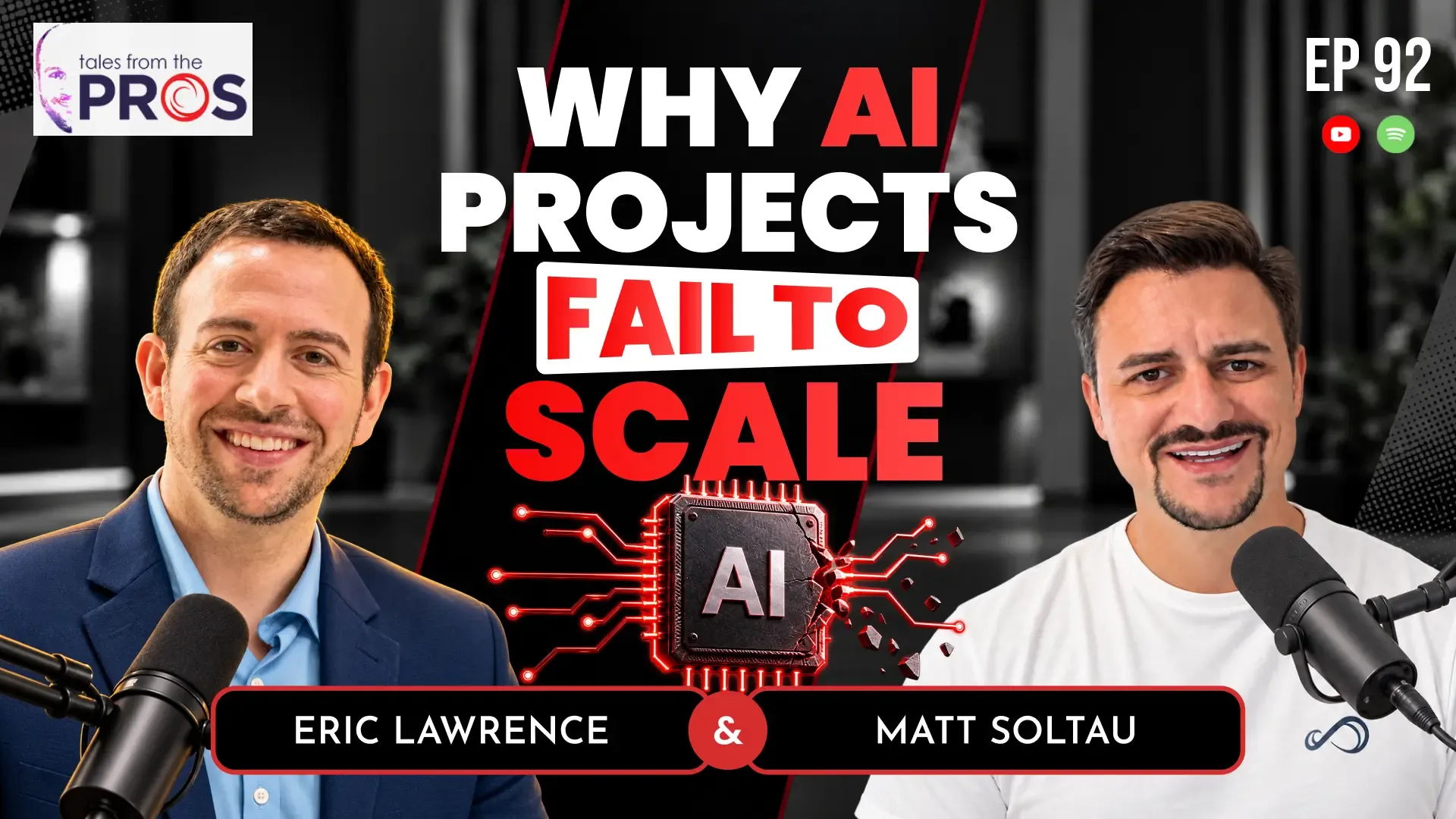
In this episode of Tales from the Pros, Eric Lawrence sits down with Matt Soltau, Global Director of Strategy and Operations at IntelliPaaS, to discuss why so many AI projects struggle to move beyond the pilot stage.
Matt explains why even promising AI projects can fail when they're introduced into real business environments. The problem often isn't the AI model itself. It's the disconnected systems, unreliable data, and outdated infrastructure behind it.
They also discuss what data silos look like in everyday business operations, why companies accumulate integration debt, and how organizations can prepare their existing systems for AI without replacing everything.
If you're planning to implement AI or struggling to scale an existing project, this conversation offers practical advice on building a reliable data foundation, managing risks, and getting your organization AI-ready.
🎯 Highlights You Won’t Want to Miss
- Why successful AI pilots often fail when deployed in real business environments
- How poor data quality and disconnected systems affect AI performance
- What messy data infrastructure looks like in everyday business operations
- How manual spreadsheets and conflicting reports reveal deeper integration problems
- Why data integration matters when scaling enterprise AI projects
- How organizational culture and employee readiness affect AI adoption
- Why data governance, privacy, and security need attention before scaling AI
- Matt's practical 90-day approach to preparing a business for AI
🎧 Listen and Subscribe
Spotify:
https://open.spotify.com/show/6QkUtrcNllUkqtq1fjlwnZ
Apple Podcasts:
https://podcasts.apple.com/us/podcast/tales-from-the-pros/id1371067192
YouTube:
https://www.youtube.com/@Imaginovation/podcasts
SoundCloud:
https://soundcloud.com/talesfromthepros
💡 Key Takeaways
- AI projects can perform well in controlled tests but struggle when exposed to real-world business data
- Clean, accessible, and trustworthy data is essential for reliable AI performance
- Disconnected systems create integration debt that becomes harder to manage as businesses grow
- Companies don't necessarily need to replace their existing software to become AI-ready
- A connected data infrastructure can make it easier to change vendors and introduce new technologies
- AI readiness depends on both technical infrastructure and an organization's willingness to adopt change
- Proper governance and access controls help businesses use AI while protecting sensitive information
- A practical starting point for AI readiness is to map your data, connect your systems, and establish governance before scaling
🗂 Topics We Cover
- Why AI projects fail to scale
- AI pilots vs. real-world deployment
- Data quality and trustworthy AI
- Data silos and integration debt
- Enterprise data integration
- Legacy systems and scalable infrastructure
- Vendor lock-in and system connectivity
- Organizational AI readiness
- AI governance, privacy, and security
- Building a 90-day AI readiness roadmap
⏱️ Chapters
00:00 — Why AI needs trustworthy data
02:30 — The problem with disconnected systems
03:07 — Why AI pilots fail in production
06:24 — AI implementation and access to business data
08:31 — What a messy data stack looks like
11:18 — Warning signs of data silos and integration debt
15:12 — Building scalable data infrastructure
17:13 — Legacy systems, vendor relationships, and data integration
22:37 — What separates innovative organizations from the rest
25:20 — Why organizational readiness matters for AI
30:07 — AI regulation, data privacy, and security
34:59 — Managing shadow AI and protecting sensitive data
36:29 — A 90-day AI readiness plan: Map, Connect, Govern
Latest Episodes
Subscribe



Meet The Host
Michael Georgiou is the Co-founder at Imaginovation and the podcast host of Tales from the PROS. As an entrepreneur and business leader, he is passionate about sharing stories that inspire innovation and growth.
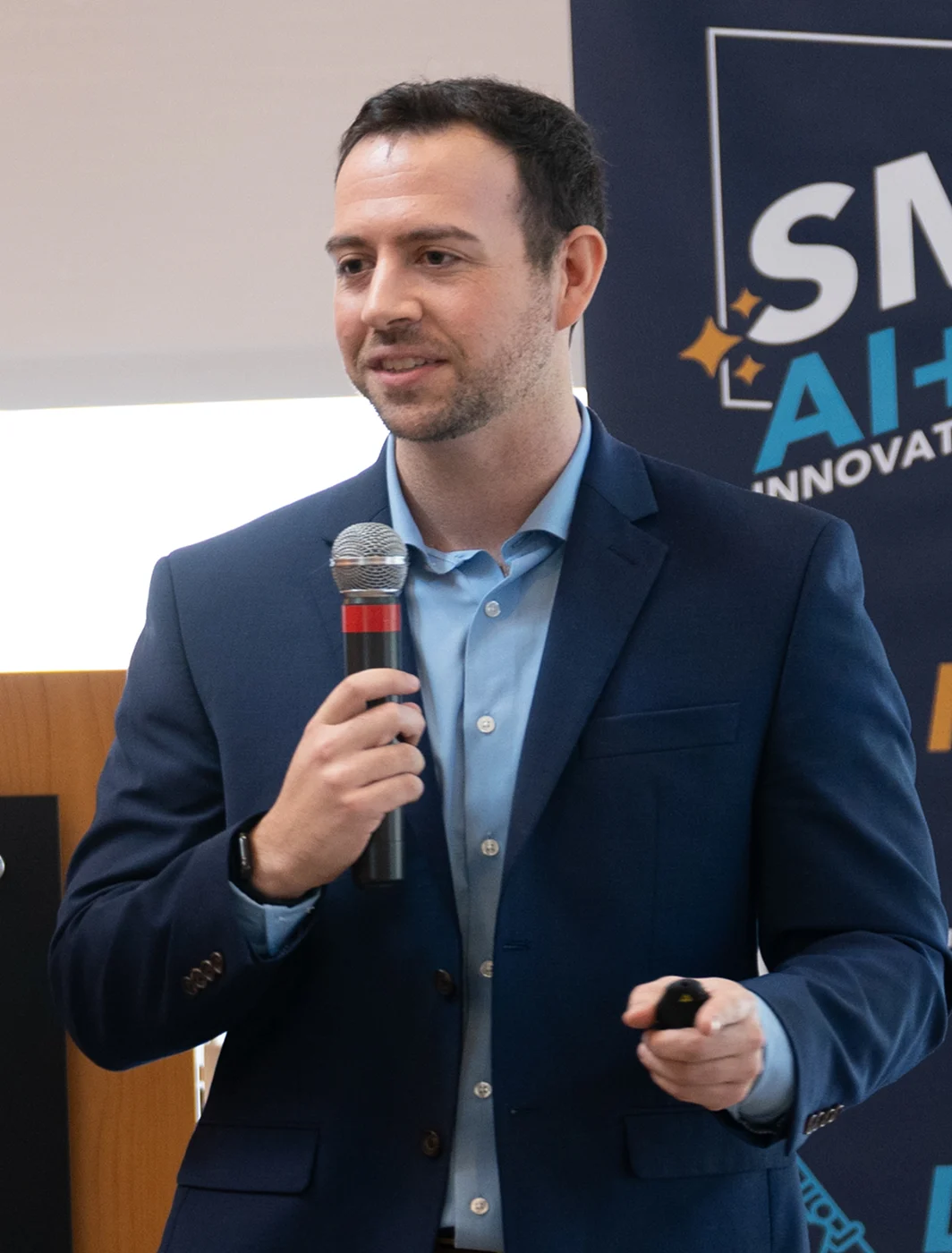
Eric Lawrence is the Director of Growth at Imaginovation. As co-host of Tales from the PROS, he brings years of experience working directly with clients seeking software and application development solutions. His insights help businesses understand what to look for in a development partner and how to set projects up for success.


One of the best business podcasts! 🚀

I have listened to several business podcasts over the years and I have to say that Tales from the PROS is within my top three favorites. Michael does a GREAT job creating an authentic and real conversation and atmosphere with the amazing guests he has on the show. If you want to learn about the realities of business, insights on how to be successful, the power of storytelling, and how overcome the business struggles that life throws at us, then this podcast is for you. I highly recommend checking it out and be ready to learn and be inspired! 🎙🎯
Amazing insight!
Michael is a great host and I really enjoy listening in on the conversations he has with business leaders. This podcast is great for anyone wanting to borrow ideas for their own business and looking to expand professionally!
An Educational Delight
This podcast presents fascinating insight into the world of business and entrepreneurship. I am in no way, privy to these topics and have found these interviews to be incredibly educational. Michael talks with trailblazers from all walks of the business world and I am here for it!!!
Love “Tales from the PROS”!
Michael Georgiou is a thoughtful and engaging host who chooses such a fascinating group of interviewees for his podcast! All of the thought-leaders, entrepreneurs, and business pros Michael invites on are exemplary in their fields and on the vanguard. I love listening to “Tales from the Pros” for inspiration and also a well- rounded and entertaining session. I highly recommend getting hooked on this podcast!
Mr podicast
Michael’s podcast’s are amazing and very inspiring. As his best friend I’ve seen the great times and the struggles of Michael building his company. He has put sweat and blood into his company and I couldn’t be prouder of him. These podcasts are great to see and anyone would be so lucky to be on it. Mike keep grinding and you are doing amazing things in life brother!!!

Check Out More Episodes
Explore more episodes packed with practical insights, expert perspectives, and real-world lessons you can apply to your business.


Justin Miller revolutionizes the wedding photography industry
 50 Minutes
 Play This Episode

World renowned trance DJ, Jaytech discusses building his own musical community
1 Hour 10 MinutesPlay This Episode
Michael Brenner talks on the content marketing formula for B2B companies
1 Hour 5 MinutesPlay This Episode
Fitness social celebrity Megan Ewoldsen proves how to STRIVE for progress - not perfection
1 HourPlay This Episode