



Get a personalized assessment of your operational efficiency and accelerate growth for your business.
Developing the first mobile app for your business can be an exciting endeavor.
Google Android and Apple iOS are two of the most popular mobile app development choices. According to the latest report published by Statista, both operating systems possess 99 percent of the total global market share.
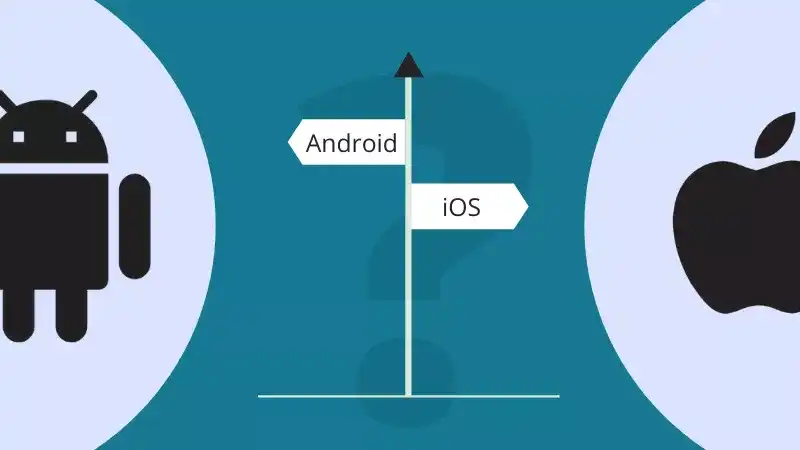
So, how do you choose between Android and iOS?
Google Android leads the mobile operating systems worldwide by device volume, commanding roughly 70% of the global market share—making it an obvious choice for broad reach. Meanwhile, Apple iOS commands premium markets and generates significantly higher monetization per user.
Let’s discuss the differences between iOS and Android. We will evaluate the pros and cons of choosing either OS. By the end of the post, you will know which OS is a better fit for your first project.
Android vs. iOS: Which one Should You Develop First for Your Business?
Apple released the initial version of iOS in 2007, maintaining a tight annual release cycle that drives rapid user adoption across its devices.
Google launched Android in 2008, establishing an open-source ecosystem embraced by dozens of smartphone manufacturers worldwide.
1. What Does Market Insights Say?
The market insights tell us that while there are more Android smartphone users and more Android apps available, the iOS apps fare better in terms of monetization.
Let’s have a look.
Smartphone Units Sold
According to the Pew Research Center Mobile Technology Fact Sheet, more than 90% of American adults now own a smartphone, making mobile applications the primary touchpoint for consumer engagement and digital commerce in the United States. While Android commands the largest share of global unit shipments across diverse international markets, the U.S. market exhibits a near-even split where Apple's iOS ecosystem maintains an exceptionally loyal and engaged North American user base.
App Catalog and Volume
The Google Play Store offers the largest volume of applications globally, hosting millions of apps for diverse Android devices. In comparison, Apple’s App Store maintains a curated catalog of apps built specifically for the iOS ecosystem.
App Downloads vs. Revenue
Android apps consistently lead in total download volume worldwide, driven by the global diversity of Android-powered smartphones across emerging and established markets.
However, iOS consistently outperforms Android in consumer spending and monetization. App Store users routinely account for nearly double the consumer spend of Google Play users through subscriptions, premium downloads, and in-app transactions.
2. How Complex is App Development?
Let’s check the various advantages and disadvantages of Android and iOS app development.
Android:
| Advantages | Disadvantages |
| Open System: Some essential features that are restricted in iOS are usually open in Android. This gives flexibility to the Android app developers that are not experienced by iOS app developers. | Fragmentation leading to more development time: Many Android devices are available nowadays with varying screen sizes, resolutions, etc. More time is thus needed to adjust the app’s features for devices. |
| Design: Google provides design guidelines to create an easy and pleasing interface. | Testing: Testing multiple Android versions on Multiple Android devices requires more time and thus increases app development complexity. |
| Fragmentation: One responsive app can be run on an extensive number of different devices. | App development can be costly: More time in development and testing would mean higher Android App price. |
| Ease in publishing apps: Once the app is ready, the Android PacKage (APK) is uploaded easily and is ready for download by users within a few hours only. |
iOS:
| Advantages | Disadvantages |
| Revenue for the business: Apple users tend to spend more money on app purchases than Android users. Therefore, revenue generation for businesses won’t be an issue. | iOS App release isn’t as easy as Android app release: App Store has stricter review guidelines. The app store can reject a new app due to security issues, poor performance, and a lack of valuable content. Also, real-life testing of the app after submission usually takes a few days. So, the process takes longer than for Google Play Store Android apps. |
| Limited no. of devices: iOS is to be used only on the Apple devices. | Low on flexibility: iOS platforms have many restrictions; therefore, the apps are difficult to customize. |
| Design: Apple usually provides developers with a detailed style guide for the app User Interface. This leads to quick and timely app development. |
3. Comparing the App Development Costs
A mobile app lifecycle usually consists of development, *deployment,* and maintenance.
Talking only about the app development cost right now – the difference in development cost between an iOS app and an Android app is not easy to estimate because there are various factors one needs to consider.
These factors range from:
- Platforms (iOS, Android, Windows)
- Type of app (Native, Web, Hybrid)
- The app-development timeline.
- Hardware used for the process.
- Design (Basic, Custom)
- Number of pages
- Features and infrastructures
(Check out our detailed blog to learn more about the mobile app development costs.)
While the Android apps might have a higher development cost because of the long development time, the Android Studio application that is used for app development can be installed on any standard PC, which does not usually incur an additional cost.
On the other hand, iOS apps are developed using Xcode, which works only on the Mac. This can be an additional cost because the investment in buying a Mac, as well as an iPhone or iPad, can significantly add to the cost of development. Otherwise, the development time is less. Therefore, it leads to less time and cost for development and testing.
4. Android vs. iOS Apps Testing
Android:
You can download Android apps from multiple sources, the Google Play Store and some other websites too. There is a large number of Android devices available in the market. Hence, the testing process usually takes longer.
The complexity of the testing process can also increase because of the availability of a large number of Android devices by different manufacturers – that have varying designs and functionalities.
- Android is Google’s open-source OS and uses mostly Linux OS. Open-source platforms are generally less secure. Sometimes, some updates can get blocked by mobile network operators.
- Depending on the different devices and their manufacturers, Android updates take longer to be available.
- Varying screen sizes and layouts increase the chances of bugs and errors
iOS:
iOS apps are available for download from a single source only – Apple’s App Store. Testing an iOS app would take relatively less time than a significantly smaller number of iOS devices.
- iOS is developed by a single manufacturer – Apple. Therefore, testing doesn’t become complicated.
- It is a closed-source operating system, making it stable but with many restrictions.
- iOS users can install the available updates on all iOS devices in a single go, as there is only one manufacturer.
There are fewer chances of bugs and errors due to the limited number of devices with resolutions and screen sizes as compared to Android devices
5. Android vs. iOS Apps Publishing
iOS apps may seem faster to design, but Apple has a strict and lengthy app approval process before it publishes any new app to the store. A fee of $99 is paid annually to the Apple app store to publish the app.
It is relatively easier to upload Android apps on the Google Play Store. A one-time registration fee of $25 must be paid for it.
Talking about the apps’ updates and modifications – It takes longer to make modifications and updates on an iOS app as every change needs to go through a long and stringent approval process.
On Android, once published, the app is available on the store within a few hours, and one can perform beta testing or update the app easily and quickly.
6. Apps Monetization
Making money is an essential purpose of any mobile application.
Your mobile apps can help you make money by:
- Subscriptions
- In-app purchases
- Advertisements
- Pay per download
Let’s take a look at how both OS fare in these aspects.
Apple
Are you going to charge your users for downloading the app?
If yes, then go in for the iOS app first.
Industry data reveals that the overwhelming majority of mobile apps are free to download, with in-app purchases and subscriptions dominating monetization. However, the Apple App Store has historically seen a higher proportion of paid upfront downloads compared to Google Play.
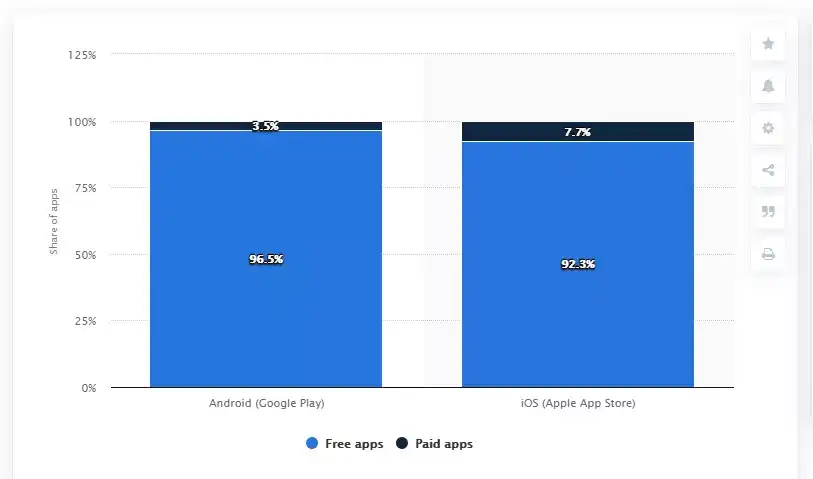
So, if you plan to charge your users for downloads, the Apple App Store is the place to do it. That’s because iOS users are accustomed to seeing more paid apps and less free apps when searching for apps to download.
Whereas Android users usually do not see as many apps that require payment to download. So, if they see your paid app, they might consider finding another one with similar functions and is free.
Please remember that if you plan to charge Apple users for downloading your app, it can be an expensive strategy. You will have a much higher customer acquisition price than if you offer your app for free.
Your users will be much more engaged. If they’re willing to pay for it, that means they probably won’t abandon it.
Android
Android must be considered if you plan to make use of advertisements and in-app purchases for monetization.
This can generate less money per purchase, but since Android users dominate the market, it will be many users per purchase.
Android users are not as engaged since they’re not investing anything into the download.
7. Data Privacy and Security
For Android apps, data privacy & security can be an issue. The controls on app access to users' data are not as strict as on the iOS app.
iOS is the most secure platform and, thus, best protects user privacy.
8. Customization
App customization is more difficult in iOS than in Android apps.
What Should You Choose as Your First App– Android or iOS?
Android
- Android users dominate the market, and thus, Android has a broader reach. So, if you want your app to reach a wider audience, go in for Android.
- If you have a limited budget for user acquisition, Android typically offers lower cost-per-install (CPI) rates compared to iOS across global markets.
- If you have a regular PC and you don’t want to incur additional investment in Apple devices for iOS app development, go in for Android.
- If you have a great strategy for mobile ads, developing on Android first could benefit you.
- Start with the Android first if your app needs a lot of customization.
- An Android app has a shorter wait time for publishing. Choose Android if this is an issue.
iOS
- The US is one of the largest iPhone markets worldwide, and iPhone is especially popular with younger users: 87% of US teens own an iPhone, according to Piper Sandler's fall 2025 survey. If your primary target audience matches these criteria, iOS can be your first choice.
- Select iOS if you want a higher revenue per user.
- iOS development is a good idea for your company if you can make consistent updates for your app to keep up with Apple’s latest software requirements.
- Go in for iOS if the privacy and security of the user’s data is a priority.
- If you already have the MAC hardware for app development, choose iOS.
- If you opt for a less complex development process with less time and reduced malware risk, then go in for iOS.
- iOS will give a better user experience.
The Third Option – Hybrid
You can also choose a hybrid app solution for your business.
Hybrid development allows you to develop on both OS at the same time.
Turn Your Ideas into Successful Digital Reality with Imaginovation
Remember, both iOS and Android OS are popular mobile app platforms. What you must choose for your business largely depends on your requirements, budget, and preferences.
Still confused?
Do get in touch with us to discuss your project requirements. We will help you select the right option for your business.
We are an award-winning web and mobile app development company with vast experience in crafting remarkable digital success stories for diverse companies.
Let’s talk.