




Get a personalized assessment of your operational efficiency and accelerate growth for your business.
Generative AI in finance has rapidly transformed the financial services industry. It has revolutionized various aspects of operations, customer interactions, and decision-making processes by leveraging advanced machine learning techniques.
Generative AI models can now produce highly sophisticated predictions, automate complex tasks, and generate new data patterns that were previously unattainable. The financial services sector, encompassing banking, insurance, investment, and real estate, has been at the forefront of this technological adoption.
The industry is now witnessing an unprecedented shift towards more innovative and data-driven approaches. From automated trading systems to personalized financial advice, generative AI is offering solutions that not only enhance productivity but also provide significant cost savings.
Financial institutions utilizing these AI models can detect fraudulent activities, manage risks more effectively, and offer tailored customer experiences. The integration of generative AI is expected to deepen, driving further innovation and transformation. In the next part, we will look at the key applications of generative AI in the finance industry and its benefits.
This article covers the applications — where generative AI is being used across financial services and what each one does. If you have already chosen a use case and need the implementation path (data access, evaluation, controls, vendor selection and rollout), start with our guide to getting started with generative AI in financial services instead.
Key Applications of Generative AI in Financial Services
Generative AI has several key applications in financial services that have enhanced efficiency, decision-making, and customer experience. Here are some notable areas where generative AI is making a significant impact:
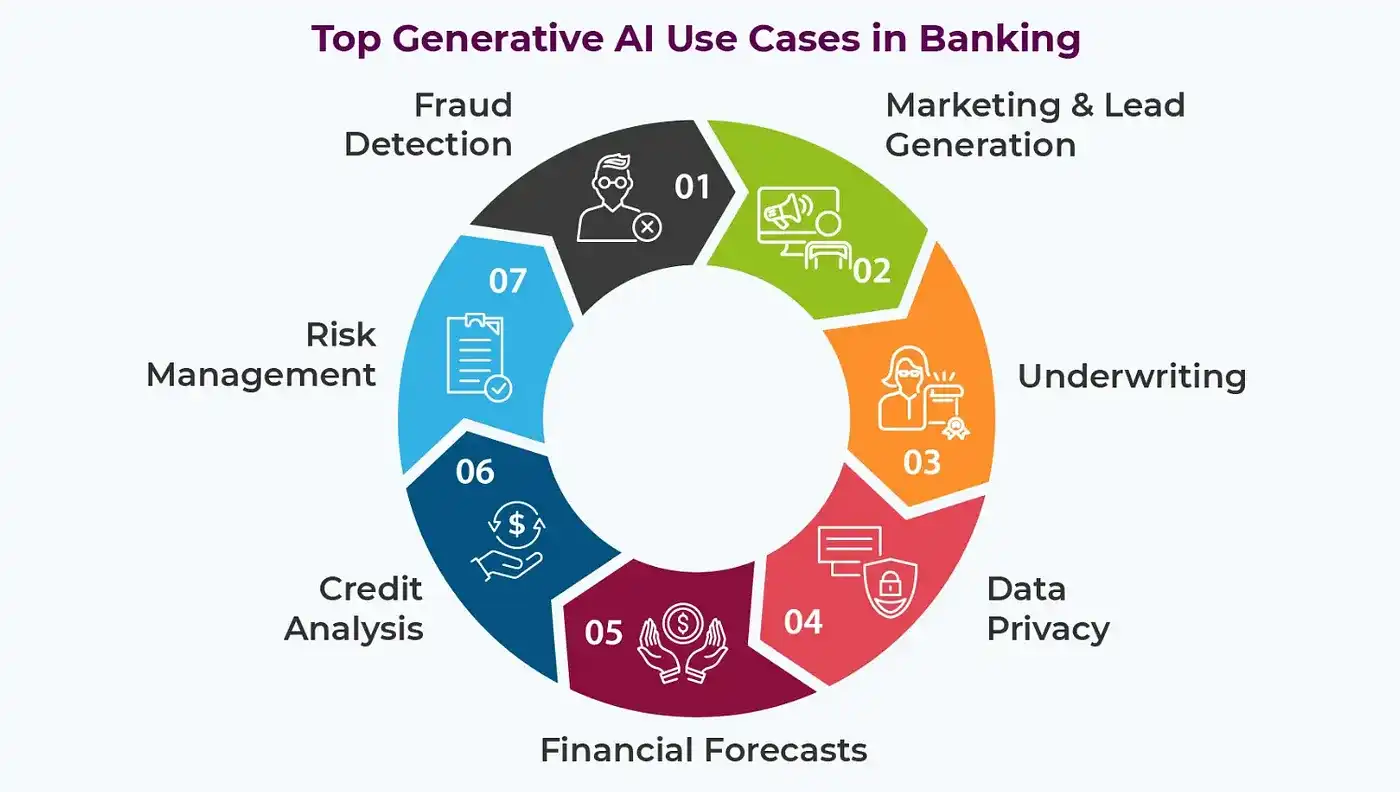
Illustrative overview of AI use cases across banking functions.
1. Fraud Detection and Prevention
The financial and banking services industry often finds it challenging to detect fraud, in the light of highly sophisticated fraudulent activities. A report by McAfee, a security company, found that cybercrime costs the global economy up to $600 billion, which is close to 0.8% of the global GDP.
Artificial intelligence introduces powerful tools which can help prevent financial fraud. Synthetic data, particularly, ensures generative AI refines its detection algorithms enabling it to enhance efficiency in fraud detection and prevention. It also helps minimize manual fraud review and stay ahead of fraudulent activities.
The models have been formulated using historical data hence able to recognize deviations from normal behavior.
2. Risk Management
Generative AI enhances a bank’s or insurance company’s ability to assess risk, particularly credit risk, enhancing their ability to approve loans. The models use synthetic data to automate the analysis of borrowers’ financial historical and current data, helping experts:
- Identify potential credit risk and assess it effectively
- Make more informed decisions in loan approval processes
- Minimize reliance on manual processes which is prone to errors and time-consuming
3. Customer Service and Support
The financial landscape is highly competitive thus, providing personalized customer experiences is a great differentiator for a financial service company or bank.
A report by McKinsey found that consumers are more responsive to personalized communication from E-commerce businesses and generative AI technologies have made this possible using customer data.
The models analyze customers’ information extensively, enabling AI algorithms generate bespoke recommendations tailored to their circumstances.
Some banks use AI-powered chatbots and virtual assistants to handle customer inquiries, while others use them to provide financial advice, and assist with account management.
The benefits of offering personalized customer experiences go beyond enhancing customer satisfaction. Financial institutions can now create more meaningful connections with clients, cultivating customer loyalty.
Also Read: How to Integrate ChatGPT in Business Applications
4. Personalized Financial Services
Did you know that most customers prioritize personalization to the financial product a bank or financial institution offers? A study by Deloitte found that the future of financial institutions is in their ability to hyper-personalize products to customers’ needs.
AI in banking enables banks to offer financial products tailored to customers’ needs. The tools analyze customer data and preferences making it easy to suggest financial products, e.g., personalized savings plans, investment strategies, and customized loan options customers may be interested in. This personalization cultivates customer loyalty and enhances customer satisfaction.
5. Regulatory Compliance
AI can help institutions stay compliant with regulatory requirements. The models generate reports, monitor transactions for compliance breaches, and automate documentation processes.
Generative AI finance also provides a controlled environment for compliance testing, enabling a financial institution to evaluate their processes, systems, and controls. This way financial institutions can improve accuracy and efficacy of regulatory reporting and compliance testing.
6. Portfolio Optimization
Traditional trading strategies leverage technical and fundamental analysis to identify suitable investment strategies. This method is often time-consuming and limited to its ability to adapt to the evolving market conditions.
Generative AI models overcome these limitations as they adjust investment strategies in real-time. They provide a more adaptive approach to investment decision-making and trading by simulating different asset allocation strategies and market conditions and showing their outcomes.
As such, an investor can optimize investment portfolios and balance risk and return based on client objectives, historical market data and patterns.
7. Loan Underwriting
Generative AI can streamline the loan underwriting process by analyzing borrower data, predicting default risks, and suggesting optimal loan terms. It makes the underwriting process accurate and efficient, minimizing operational costs and providing a smooth experience for borrowers.
AI models generate elaborate datasets of the borrower’s characteristics and risk factors, facilitating accurate and robust machine-learning for the loan underwriting process. As a result, loan underwriters save time and make more precise decisions when underwriting loans.
8. Financial Forecasting
AI models can generate economic and financial forecasts, helping institutions plan for future market conditions and economic cycles. The models are designed to process vast amounts of data (structured and unstructured) from different sources and integrate them into coherent datasets for analysis and decision-making.
The models also make it easy for experts to identify patterns which traditional models would miss. Hidden correlations and non-linear relationships become more apparent facilitating more precise decision-making.
Generative AI models also help simulate financial scenarios using synthetic data. This information helps analysts explore what-if scenarios and evaluate risks or opportunities that lie there in. For example, AI can generate potential market conditions under different economic policies or global events.
Benefits of Generative AI for Financial Institutions
Generative AI is transforming the financial industry by enabling more intelligent, efficient, and customer-centric operations. Its ability to process and analyze vast amounts of data in real-time provides significant advantages in a highly competitive and regulated environment.
Cost Reduction
Automation of routine tasks reduces the need for large human workforces, cutting down on operational costs. Also, AI’s ability to streamline processes and improve accuracy lead to fewer errors and reworks, further reducing costs.
Enhanced Decision Making
Employing financial services AI enables financial institutions to sift through data, analyze and summarize it. This way they can extract valuable insights more accurately and swiftly than before.
Moreover, with AI financial models enable the institutions to analyze vast amounts of data, a task which is often time-consuming and prone to errors if relying on human effort.
Similarly, AI’s ability to simulate scenarios eases decision-making tremendously. Generative AI can model various financial scenarios and outcomes, helping financial experts make strategic plans.
Optimize Trading Strategies
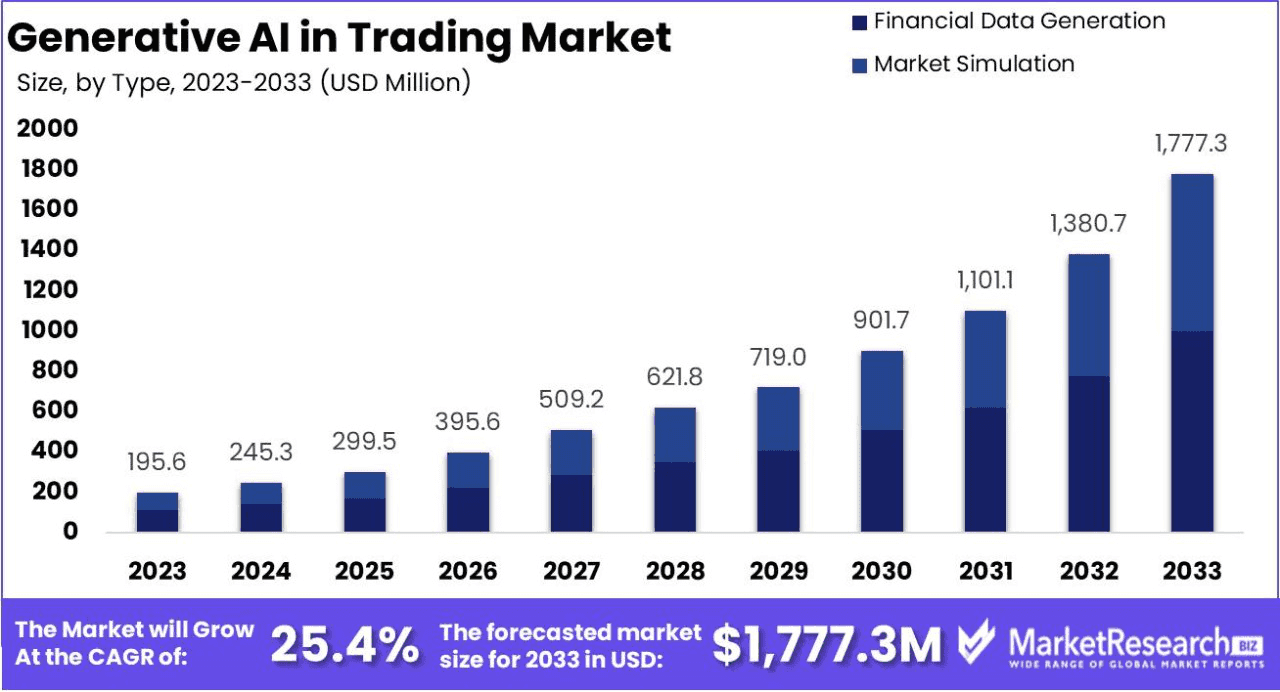
Illustrative — market-sizing projections for AI in trading vary widely between sources.
In trading, AI models can analyze market data and execute trades at optimal times to maximize returns. That’s why generative AI in trading is projected to experience exponential growth in the next 10 years. Algorithms can react to market changes much faster than human traders, improving the efficiency and profitability of trading operations.
Operational Efficiency
Financial AI models automate repetitive and time-consuming tasks such as data entry, compliance checks, and report generation, reducing operational costs and minimizing human error. This way bank staff and financial analysts offer more value to customers.
Also, by automating tasks and improving accuracy in the speed of operations, AI models reduce operational costs significantly. Companies save on labor costs and resource utilization, and make fewer errors.
Improved Customer Service
AI-powered virtual assistants and chatbots can respond to repetitive customer inquiries improving customer satisfaction and allowing customer representatives to deal with more complex customer complaints.
Also, AI’s ability to analyze customer data helps the chatbots to recommend personalized financial products and services. This not only enhances customer experience but also improves the efficiency of marketing and sales efforts by targeting the right customers with the right products.
Improved Cybersecurity Measures
Generative AI algorithms can be used in cybersecurity to generate data that mimics cybersecurity threats such as unauthorized access attempts, malware, and phishing attempts. These data can be deployed to detect malicious activities that human analysts might miss out on.
The algorithms generate synthetic data which can improve financial data by adding examples of anomalies to detect cybersecurity threats. This makes it easy for gen AI modes to learn patterns and deal with the threats.
This means security experts can train gen AI models to identify fake emails better, reducing the chance if making mistakes and improving the fight against complex cybersecurity attacks.
One Use Case in Detail: A Policy-Grounded Customer Service Assistant
Rather than survey what might happen next, here is one of the applications above taken all the way down to what it requires — because the requirements are the same shape for most of the others.
The use case: an assistant that answers front-line agents' questions about products, fees and procedures by retrieving the bank's own policy documents, then drafting a reply the agent edits and sends. It does not speak to customers directly and it does not give advice.
The data it needs
- The current policy and procedure library, with version dates — stale policy is the main failure mode here
- Product and fee schedules, per jurisdiction where they differ
- A defined boundary: no customer PII in the prompt unless there is a specific, approved reason and a contract that permits it
- A retention decision covering prompts, outputs and vendor-side logs, agreed with your data protection team before launch
How you evaluate it
- Assemble 100–200 real agent questions with correct answers verified by the policy owners
- Grade on two axes separately: is the answer correct, and is it grounded in a document the assistant can cite? An answer that is right for the wrong reason will not stay right
- Measure the refusal rate as well as the accuracy rate — a system that refuses appropriately when policy is silent is working as designed
- Re-run the set whenever policy changes, the model version changes, or the retrieval index is rebuilt
The controls that regulators and your second line will ask about
- Citations on every answer, linking to the source paragraph, so an agent can check before acting
- Human in the loop — the agent sends, not the model
- An audit trail of question, retrieved sources, generated answer and what was actually sent
- Model risk governance: documented purpose, limitations, testing evidence and a named owner, consistent with your existing model risk framework
- Change control on the policy index, so the assistant cannot quote a withdrawn procedure
- Consumer-outcome monitoring: track complaints and escalations on interactions where the assistant was used, against a control group
What makes this one a sensible first project: the output is checkable against a source document, the failure is cheap because a human reviews before anything reaches a customer, and the benefit — handling time, consistency of answers, onboarding time for new agents — is measurable within a quarter.
Regulatory expectations for AI in financial services are still developing and differ by jurisdiction. Nothing here is legal or compliance advice; work the specific controls through with your compliance function before deployment.
Transform Your Financial Services with Imaginovation's AI Solutions
Generative AI is revolutionizing the financial services sector by driving innovation, enhancing efficiency, and delivering superior customer experiences. It also plays a crucial role in robust risk management and compliance. As AI technologies evolve, their integration into financial services will lead to even more significant transformations within the industry.
Imaginovation is dedicated to helping you integrate AI solutions into your financial systems to unlock all the benefits this technology offers. We not only customize AI solutions to fit your specific needs but also seamlessly integrate both legacy and cutting-edge AI models for smooth financial operations.
We prioritize stringent security measures when implementing AI solutions to protect against data loss, fraud, and cyber attacks. Schedule an appointment with one of our experts to explore the scope of AI integration into your financial system and understand the potential benefits.