




Get a personalized assessment of your operational efficiency and accelerate growth for your business.
Augmented reality (AR) is no longer just for gaming. It’s changing healthcare in U.S. hospitals, clinics, and operating rooms. What used to be clunky headsets and futuristic demos is now much more advanced.
Modern AR systems use AI. They can see anatomy in real-time. They can also automatically align images. They can predict surgical paths. And they can adjust to what the doctor is doing.
The headset is how AR is delivered. The AI makes it useful for doctors.
Are you a healthcare leader? Are you wondering how AR can help your organization? Now is the time to learn. We have gathered the most important AR uses in healthcare today. We focus on what is actually working in the U.S. We also highlight how AI is making it possible.
Let’s explore.
Augmented Reality in Healthcare: Critical Insights
The AR healthcare market is growing. It's no longer just experimental.
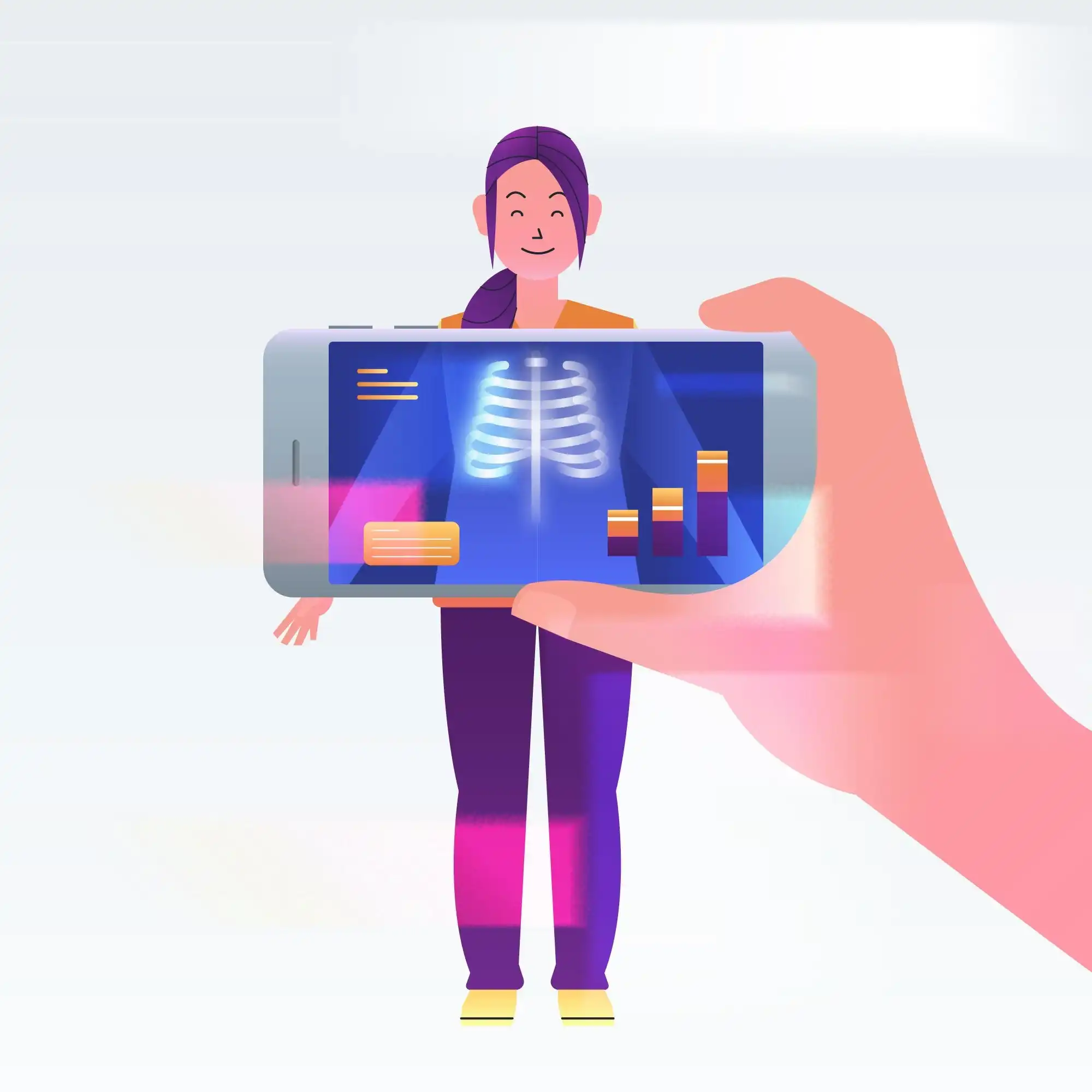
Augmedics' xvision Spine System is a prime example.
It's an FDA-cleared AR surgical navigation platform. It has been used for over 13,000 patient cases. This includes placing more than 71,500 pedicle screws. This system is now available in 26 U.S. states.
Clinical accuracy data for AR is now available.
A 2025 review looked at studies on AR-assisted spine surgery. It found pedicle screw placement accuracy between 93% and 100%. This was across different platforms. AR often reduced the need for fluoroscopy. It also improved surgeon comfort. AR navigation is now as good as, or better than, traditional methods.
The FDA views AR as an important medical technology.
Augmedics received FDA clearance for its X2 surgical AR headset just last year. Medivis also got clearance for AR-guided cranial neurosurgery. These clearances show AR is becoming a standard of care for certain procedures.
The industry sees AR as a significant investment.
PwC predicts AR will add $1.09 trillion to global GDP by 2030. Healthcare is a major driver of this growth. Deloitte's 2026 Global Health Care Outlook also supports this. Health system executives are increasing digital and AI investments. North America led the global health AI market in 2024. (Deloitte Source)
These market trends are clear. The key question is how your healthcare organization can benefit from AR.
Let's explore this further.
Opportunities for Augmented Reality in Healthcare
AR is enhancing patient care in concrete, measurable ways. The most direct impact is on diagnostic and surgical accuracy, giving clinicians real-time access to patient data, anatomical overlays, and decision support exactly where and when they need it.
Here are the three biggest opportunity areas worth understanding.
1. Augmented Surgery
Imagine surgeons visualizing a patient's bones and internal organs without making an incision. With AR, that's not a thought experiment. It's how an increasing number of procedures begin.
Surgeons can pull MRI and CT data into an AR headset and overlay patient-specific anatomy onto the body before the first cut. The view shows muscles, bones, vasculature, and pre-planned surgical trajectories, all locked in real time to the patient's actual position on the table.
The result: more accurate, lower-risk procedures, with less time spent glancing at external monitors.
What's driving the recent leap forward is AI.
Modern surgical AR platforms use computer vision and deep learning to automatically segment anatomy from preoperative imaging, register it to the patient on the table, and flag critical structures the surgeon needs to avoid.
A 2025 systematic review found that AI-driven step recognition during minimally invasive surgery reached 93% accuracy compared to manual human annotation.
That's the layer of intelligence that turns AR from a passive overlay into active guidance.
Scenario:
Two recent FDA milestones illustrate how fast AR surgical platforms are maturing in the U.S.:
a. Augmedics' xvision Spine System is the first FDA-cleared AR surgical navigation platform, with thousands of spine procedures performed across U.S. hospitals.
In November 2025, the company received FDA 510(k) clearance for its next-generation X2 headset, purpose-built for the operating room with double the field of view of its predecessor.
b. Medivis became the first company to receive FDA clearance for AR-guided cranial neurosurgery in December 2025, allowing surgeons to overlay patient imaging directly onto the operative field.
2. Augmented Diagnosis
Patients often struggle to describe their symptoms accurately, and that gap can lead directly to misdiagnosis.
AR closes the gap by giving patients and clinicians a shared visual reference, making it easier to pinpoint what's actually going on.
AI takes it a step further, analyzing imaging data and patient inputs in real time to surface the most likely diagnoses while the AR overlay shows the clinician exactly where to look.
Scenario:
A patient comes in for an IV. Instead of guessing where the vein is, a nurse uses an AccuVein handheld scanner to project a real-time map of the patient's vasculature onto their skin, turning a routine pain point into a first-stick success.
3. Augmented Practice
Mistakes in real-life surgery aren't survivable for the patient or recoverable for the trainee. Yet hands-on practice is non-negotiable in medical education. AR fills that gap.
Students can now perform realistic procedures repeatedly, in a safe environment, before they ever touch a patient.
U.S. medical schools and residency programs are increasingly building AR into their curricula. Students can overlay anatomy data onto a 3D human skeleton, walk through pre-loaded surgical scenarios, and rehearse complex cases until the muscle memory is there.
AI is now part of that loop too, with platforms like Osso VR using machine learning to score trainee performance, identify weak spots, and personalize the next training session based on what each student actually struggled with.
The opportunities are real, and they're getting more accessible every quarter. The next step is figuring out which use cases fit your specific operational reality.
Practical Use Cases of AR in Healthcare
U.S. physicians are using AR effectively during interventional procedures, including CT and MRI visualization. The technology is showing up in medical education, patient communication, and emergency response in increasingly meaningful ways.
Here are nine concrete use cases of AR improving the patient medical experience right now.
1. Mobile AR Apps Are Helping Bystanders Find Defibrillators in Cardiac Emergencies
When someone collapses from sudden cardiac arrest, every minute without defibrillation cuts survival odds by about 10%.
The single biggest barrier to bystander response is not knowing where the nearest AED is.
The PulsePoint AED app, built by the PulsePoint Foundation in partnership with public safety agencies across the U.S., maps the National Emergency AED Registry (NEAR) so anyone can locate the nearest automated external defibrillator in seconds.
The companion PulsePoint Respond app alerts CPR-trained users when a cardiac emergency happens nearby, simultaneously dispatching them and pointing them to the closest AED.
Last year, PulsePoint and ZOLL launched the "Anyone Can Register" initiative, a national push to expand NEAR coverage so AED locations across the country are known and surfaced during cardiac emergencies.
With more than 350,000 out-of-hospital cardiac arrests in the U.S. each year, apps like these compress the bystander response window from minutes to seconds.
2. Virtual Collaboration Between Physicians With AR
Geography used to dictate who could be in the room during a procedure. AR has flipped that.
Platforms like Proximie let a remote specialist virtually scrub in, seeing the operative field through cameras and headsets, annotating directly onto the live video feed, and guiding the on-site team through complex steps.
The same approach is being used for tele-mentoring residents in rural and community hospitals, and for multi-disciplinary tumor boards where pathologists, radiologists, and surgeons review the same 3D imaging in a shared AR space.
For underserved hospitals that can't keep specialty surgeons on staff full time, this isn't a nice-to-have. It's a way to deliver care that simply wasn't available before.
3. AR Headsets Bringing Specialists Into the Operating Room From Anywhere
Dr. Eric Rosenberg of SightMD in New York became the first surgeon in the world to perform cataract surgery using Apple Vision Pro.
He's since completed hundreds of additional procedures using ScopeXR, a mixed-reality platform he co-developed that streams a live 3D feed from the surgical microscope directly into the headset, with diagnostic data and pre-operative measurements appearing as overlays in the same view.
The same platform supports real-time remote collaboration. A senior surgeon at one hospital can virtually join a procedure happening anywhere in the country and see exactly what the operating surgeon sees.
Sharp HealthCare in San Diego launched the first IRB-approved prospective clinical study of Vision Pro in cataract surgery in April 2026, moving the technology from anecdotal use toward structured clinical evidence.
For residents tackling their first complex cases, or for surgeons facing unexpected complications mid-procedure, AR headsets effectively democratize access to expertise, turning every operating room into a connected one.
4. AR + AI Are Reshaping the Operating Room
AI is now embedded in the AR layer itself, handling tasks that used to slow surgeons down or require dedicated technicians.
Take Medivis.
Its FDA-cleared SurgicalAR platform uses computer vision to automatically align preoperative CT and MRI scans to the patient's actual position on the table, a registration step that previously added several minutes to AR-guided procedure setup.
The surgeon walks in, the system maps the anatomy in real time, and the planned trajectories appear locked to the patient's body.
Augmedics' xvision platform takes a similar approach for spine surgery: pedicle screw trajectories appear directly in the surgeon's field of view, eliminating the need to glance away at external monitors.
Augmedics has published consistent 97–100% pedicle screw placement accuracy across multiple peer-reviewed studies, and a 2025 narrative review in Cureus corroborated 93–100% accuracy across AR-assisted spine platforms more broadly.
That kind of performance has driven adoption across U.S. hospitals from academic medical centers to community spine practices.
5. AR Helps Patients Describe Their Symptoms Better
Accurate diagnosis depends on accurate symptom reporting, and patients often struggle to put what they're experiencing into words. AR closes that gap by letting them show what they see and feel.
In ophthalmology, apps like EyeDecide use the device camera to simulate how specific conditions like cataracts, age-related macular degeneration, and glaucoma distort vision.
A patient can hand the phone to a family member to demonstrate exactly what their world looks like, and a clinician can use the same simulation to show patients how a condition is likely to progress.
A new generation of AI-powered patient assessment tools is taking this further. Apps now use the phone camera plus computer vision to detect subtle visual abnormalities, classify skin lesions, or screen for diabetic retinopathy, then present the findings as an AR overlay during the patient consultation.
The patient sees what the clinician sees, and the conversation moves from abstract description to shared visual evidence.
That kind of visceral demonstration tends to drive behavior change. When patients see, in their own field of view, what untreated diabetic retinopathy will do to their sight in five years, lifestyle conversations land differently.
6. AR Helps Nurses Find Veins on the First Stick
Most IV starts miss the vein on the first attempt, a problem that gets significantly worse with pediatric, geriatric, and oncology patients whose veins are harder to locate. AR vein visualization has become one of the most widely adopted clinical AR tools in U.S. hospitals.
AccuVein uses a handheld scanner that projects a real-time map of the patient's veins directly onto their skin. The technology has been clinically shown to increase first-stick success rates significantly, particularly in pediatric and oncology settings.
Recent developments have pushed AR vein-finding from a standalone tool toward a default capability in emergency and OR settings:
- March 2024: AccuVein launched an AI-enhanced version of the device with integrated real-time analytics.
- 2025: AccuVein announced a collaboration with Siemens Healthineers to integrate near-infrared vein visualization into Siemens' interventional imaging platforms.
7. Pharma Companies Are Using AR for Patient Education and Drug Information
Drug inserts and patient leaflets are notoriously dense, and patients who can't decode them are less likely to take medications correctly. Several U.S. pharmaceutical companies are using AR to make that information land.
Patients can scan a medication's packaging with a phone and watch a 3D animation of how the drug actually works inside the body: where it absorbs, what it targets, and why dosing timing matters.
Pfizer, Bayer, and other major pharma brands have piloted AR-based patient education campaigns and clinical trial recruitment experiences in the U.S. market.
The same underlying capability is being applied across the pharma value chain:
- Patient education: 3D mechanism-of-action animations linked to medication packaging or pharmacy apps.
- Sales enablement: Medical reps use AR to walk clinicians through how a drug works during sales calls.
- Lab operations: R&D teams overlay protocols and reference data directly onto bench experiments.
- Clinical trial recruitment: AR-based explainers help potential participants understand what a trial involves before they enroll.
8. AR Headsets Are Reshaping How Medical Students Learn Anatomy
Case Western Reserve University and the Cleveland Clinic pioneered AR anatomy education with HoloAnatomy, built originally for Microsoft HoloLens.
The app lets students walk around a holographic human body, peeling back layers from skin to skeleton, isolating individual systems, and rotating structures in three dimensions. That kind of learning is impossible with flat textbook illustrations.
Microsoft discontinued HoloLens 2 in October 2024, but the underlying instructional approach has migrated to newer hardware. Programs across U.S. medical schools now run AR anatomy modules on platforms like:
- Apple Vision Pro for high-fidelity stereoscopic anatomy visualization.
- Magic Leap 2 for hands-free clinical and surgical training simulations.
- Tablet-based AR for cost-effective, scalable deployment to larger student cohorts.
These newer platforms make holographic dissection more accessible and considerably more affordable.
AI is also becoming a meaningful layer here, with adaptive learning algorithms that adjust the complexity of anatomy modules based on student performance, AI tutors that answer questions in natural language while a student is exploring a 3D model, and automated assessments that flag knowledge gaps before they become exam failures.
The shift signals a broader trend: AR-based anatomy is no longer tied to a single headset, which means it's finally scaling beyond elite institutions.
9. AR Apps Make Anatomy and Procedures Accessible to Patients and Kids
Anatomy education isn't just for medical students.
AR is increasingly used in pediatric clinics and patient education across the U.S. to help kids understand what's happening inside their bodies, and to help adult patients visualize procedures before they consent.
Apps like Complete Anatomy from Elsevier, and Human Anatomy Atlas from Visible Body, both widely used in U.S. healthcare and academic settings, let patients and students explore the human body in 3D AR right from a phone or tablet.
Children's hospitals are using similar AR tools to walk young patients through what an MRI or surgery will look and feel like, which has been shown to reduce procedure-related anxiety.
When a seven-year-old can rotate a 3D model of their own heart on the kitchen table the night before surgery, the experience stops being abstract, and that translates directly to better outcomes.
The examples above only scratch the surface of what AR is doing in healthcare today. The technology will keep generating value for organizations that move on it deliberately. The question isn't whether AR fits into your operations, but where it fits first.
If figuring that out feels overwhelming, working with an experienced development partner like Imaginovation can shorten the path from idea to working pilot.
Plan Your Augmented Reality in Healthcare Journey
Getting AR into your systems takes more than buying headsets.
The organizations doing this well are the ones that map AR to specific clinical or operational pain points first, then pick the technology that fits, not the other way around.
Here's a practical sequence to follow:
1. Identify the highest-value use cases. Get your team aligned on which clinical or operational problems AR could realistically solve in the next 12 months.
2. Evaluate the AI layer, not just the hardware. The clinical value of modern AR is largely driven by what AI is doing underneath, including anatomy recognition, registration, decision support, and adaptive learning. Ask vendors for peer-reviewed accuracy data and how their models were trained and validated.
3. Audit integration requirements. Map out how AR would interact with your existing EHR, imaging, and clinical workflow tools before evaluating any vendor.
4. Plan for staff training. Hardware that sits in a drawer doesn't deliver ROI. Budget for proper onboarding and ongoing support.
5. Pilot small, measure rigorously. Start with a single department, a single use case, and clear success metrics. Scale only what works.
A word of caution:
AR adoption brings real data security obligations, and AI integration adds another regulatory layer. Headsets capture video, audio, and biometric data, cloud-based AR platforms transmit it, and AI models trained on patient data raise their own compliance questions.
Any deployment in a U.S. care setting needs a HIPAA-compliant architecture from day one, including:
- Vendor business associate agreements (BAAs) in place before any pilot begins.
- Encryption in transit and at rest for all patient data.
- Strict controls on what data ever leaves the device.
- Audit trails for every AR session that touches PHI.
- AI model governance, including FDA clearance status for AI-driven clinical decisions and clear documentation of training data provenance.
Treat security as a first-order design requirement, not a phase-two checklist.
AR in healthcare is no longer a moonshot. It's a practical advantage for organizations willing to do the work.
Craft a Meaningful Augmented Reality Journey with Imaginovation
If you want to craft a meaningful AR journey that can improve patient medical experiences or elevate user engagement, we can help.
Explore our expertise in Augmented Reality Mobile App Development to see how we can bring your vision to life.
We are an award-winning web and mobile app development company with vast experience in crafting remarkable digital success stories for diverse companies.