



Get a personalized assessment of your operational efficiency and accelerate growth for your business.
Few things frustrate business leaders more than watching growth expose the cracks in their systems. Imagine teams expanding, your customers growing, data surging, but suddenly, integrations aren't keeping up.
To add to the agony, you find dashboards failing, workflows slowing, and systems that once worked seamlessly stop talking to each other.
All of these add to the hidden cost of scale.
Here's the thing: off-the-shelf APIs and generic integrations were never built for enterprise complexity. That’s why leading organizations invest in custom API development, which is purpose-built to address scalability.
Custom APIs are designed with scalability in mind, and it's no wonder they can easily connect critical business platforms. In fact, business leaders can watch their data volumes and user demand grow while remaining assured of agility.
When you're unsure of the next steps, partnering with expert API development services can help.
The right vendor will support you in integrating smartly and helping you gain a competitive advantage. Tag along to understand how to develop custom APIs strategically to scale.
Let's dive in.
The Breaking Points That Trigger the Need for Custom API Development
As organizations grow, they reach a point where the existing system or third-party APIs can no longer scale with growth or complexity.
The most common breaking points include:
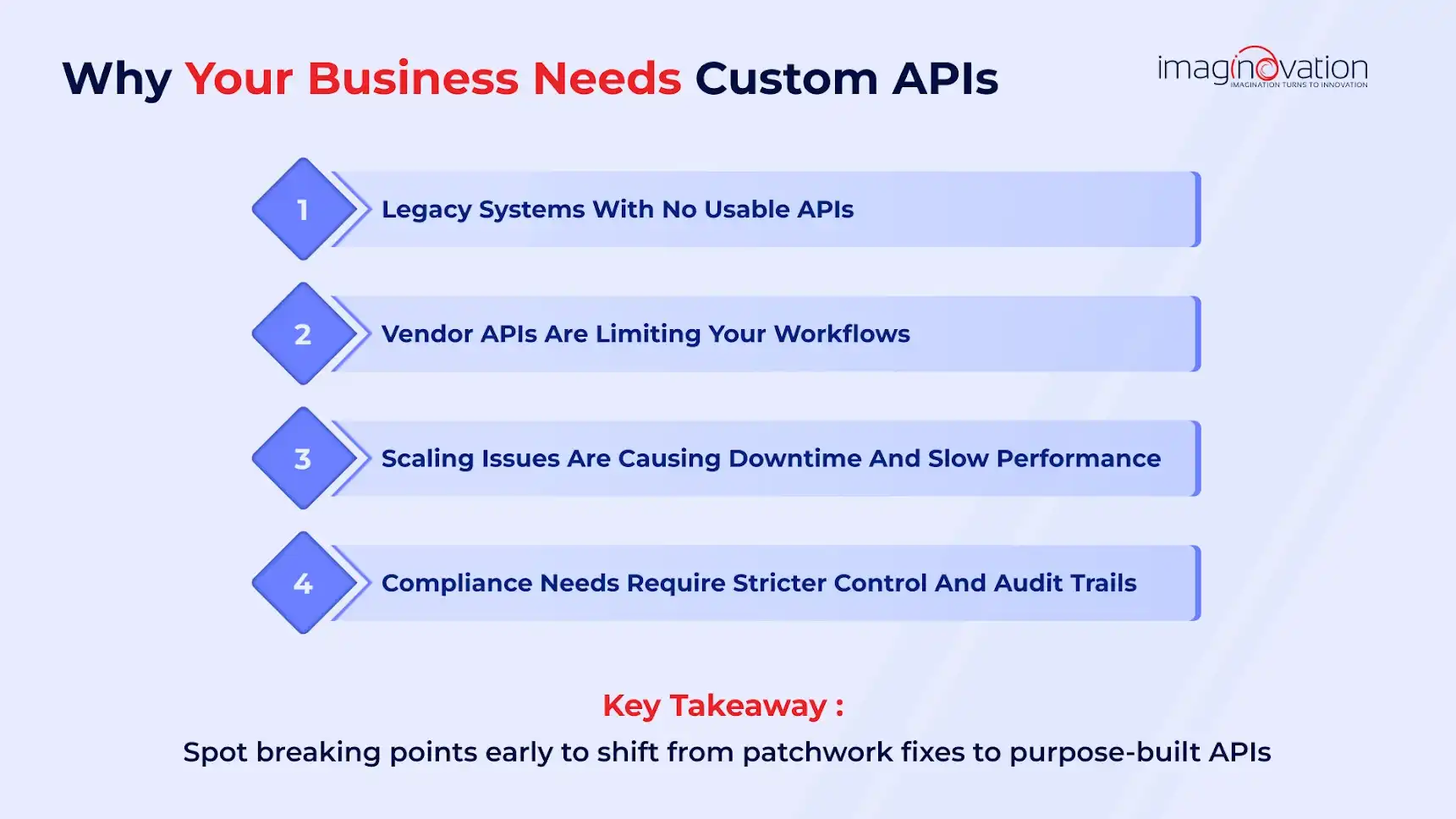
- Legacy systems without usable APIs: Organizations working on older platforms don't have modern interfaces. In such scenarios, teams typically work on manual workarounds or resort to brittle integrations.
- Vendor APIs that limit differentiation: At times, APIs fail to support proprietary workflows or business logic, resulting in innovation slowing down.
- Scaling bottlenecks: There are signs that you can look out for that the integration layer isn't built for scale, such as frequent downtime. You will also find performance getting sluggish or queries failing under load.
- Compliance and control needs: In regulated sectors such as healthcare, finance, and government, APIs need to ensure data protection, audit trails, and custom rules by design.
Key Takeaway: Early identification of these breaking points is vital because it will help leaders move away from any patchwork integrations to purpose-built APIs. These steps support speed, control, and long-term scalability.
Pete Peranzo, Co-founder of Imaginovation, emphasizes that relying solely on vendor-provided APIs may not meet the scalable and flexible needs of expanding businesses.
He highlights that custom APIs are crucial for creating tailored integrations that align with a company's specific workflows and data structures.
Pete compares custom APIs to a “custom suit,” indicating they are built precisely to fit a business’s unique requirements and can adapt as the business grows, unlike generic, off-the-shelf solutions.
This approach allows businesses to future-proof their systems and ensure seamless scalability.
Strategy #1: Design APIs for Flexibility (Modular and Future-Proof)
Why it matters: In businesses, you may want scalable systems. However, one must remember that they are not built by chance; they're designed for evolution.
Key practices:
- Microservices over monoliths: The good part of modular APIs is that using them can help reduce risk and downtime by scaling specific components independently.
- Version smartly: Use URI or header-based versioning for maintaining backward compatibility and avoiding breaking existing integrations.
- Think extensibility: Design for the development hooks of the future, be it for AI, IoT, or mobile applications. A well-designed API today should plug into tomorrow's ecosystem with ease.
Value: Equips leaders to make architecture choices that minimize technical debt and keep innovation friction-free.
In this context, Pete shares the perspective that building APIs with future flexibility in mind can be achieved by designing systems that incorporate AI and prompting capabilities.
Specifically, he suggests that instead of relying solely on fixed algorithms, integrating AI and large language models (LLMs) allows systems to be more adaptable and self-upgrading over time.
Pete also suggests that building APIs with the capability to incorporate AI and machine learning is a key strategy to keep systems flexible and future-proof. He emphasizes that designing systems to allow prompting an AI (like a "brain") to analyze data and provide insights enables the system to adapt as AI models improve over time.
This approach moves away from rigid, human-coded algorithms to more dynamic, self-upgrading systems, ensuring they remain adaptable as business needs evolve.
Strategy #2: Build for Performance and Volume from Day One
Why it matters: Every business leader wants to boost performance; however, one must not treat it as a tech metric, but instead treat it as a business safeguard.
Key practices:
- Plan for scale: When it comes to handling high volumes, it is great to incorporate load balancing, caching, and asynchronous processing.
- Design for peaks: There will be traffic surges, and one must be prepared and design systems for such spikes, be it retail sales or quarter-end transactions.
- Learn from success: One of the keys to success for events like Black Friday is scalable APIs that have kept businesses running smoothly.
Value: Helps leaders view performance as critical to customer trust, revenue continuity, and not just IT uptime.
Strategy #3: Embed Security and Compliance into the API Layer
Why it matters: The last thing that you'd want is APIs becoming the weakest link in compliance. In such scenarios, one needs to consider building security right from the start.
Key practices:
- Secure access: When it comes to authentication and authorization, they are vital, and there are proven frameworks that one may consider using. For example, use the secure gatekeeper OAuth and digital pass JWT for authentication and authorization.
- Work around compliance: One must align with standards, such as HIPAA for audit trails, PCI for encryption, and GDPR for data access logs.
- Stay audit-ready: Consider including both simplified compliance reviews and monitoring and logging API activity to curb breaches.
Value: It will help to make security and compliance a foundation for safe, scalable growth, and not an afterthought.
Strategy #4: Establish API Governance and Lifecycle Management
Why it matters: APIs have the tendency to multiply fast without governance, which can lead to "API sprawl" and integration chaos.
Key practices:
- Define ownership: It is a wonderful practice to assign clear accountability for every API.
- Standardize processes: It is great to maintain control, and for that, it is vital to set approval, consider documentation, and also take care of the change management policies.
- Plan the lifecycle: Yet another aspect is to manage versioning, take care of updates, and handle deprecation to ensure smooth evolution.
Value: Positions governance as a strategic control mechanism, and, in turn, prevents API chaos before it impacts performance, security, or compliance.
Strategy #5: Invest in Monitoring, Observability, and Self-Healing
Why it matters: Silent API failures can impact your business operations. Moreover, they can quietly drain revenue and damage the customer experience.
Key practices:
- Get visibility: It is vital to catch issues early, and it is a great idea to use dashboards and track errors. It will also help to set up real-time alerts.
- Understand fast: With the help of observability tools, it is easy to understand the root cause and not just the symptom.
- Recover automatically: When there are issues, it can help to enable self-healing, which can help the system to automatically try again after a short delay. Yet another aspect is keeping services available with failover systems.
Value: Leaders develop confidence in uptime and resilience. The key practices help them turn potential downtime into seamless continuity.
Strategy #6: Align API Development With Business Growth Goals
Why it matters: APIs are more than backend tools. Today, they are your strategic assets that can power growth and innovation.
Key practices:
- Create revenue streams: Businesses can earn money through APIs by allowing their partners and customers to access select data or services via APIs for a fee or a commercial arrangement. Thus, APIs become products that generate new revenue, as if you were selling a service.
- Fuel innovation: APIs offer speed to create or even improve a business's products. Thus, one can benefit from faster product launches and real-time analytics.
- Connect strategy to execution: APIs should be viewed as strategic business tools, and where they can be discussed in boardrooms as enablers of market expansion, not just IT delivery.
Value: Positions APIs as business growth levers, and transform them from technical plumbing into strategic infrastructure.
Lessons From the Field: Case-Driven Insights
Real-life stories are not only inspiring but also full of learning. Businesses must learn from the insights that show how strategic API design transforms operations and what happens when it doesn't.
- Retail: One of the leading retailers planned to scale its omni-channel operations using custom APIs. It helped in unifying the inventory, logistics, and customer data to deliver consistent CX across channels.
- Healthcare: Realize HIPAA at scale, based on automation of data governance and securely interchanging data between healthcare providers.
- Fintech: Due to well-architected APIs with robust governance, a fintech startup realized real-time, high-volume transactions without having to sacrifice security.
When It Goes Wrong: Some organizations make the folly of treating APIs as quick fixes rather than strategic assets. These firms often end up facing cost overruns, downtime, and poor customer experiences as integration demands grow.
Value: These are concrete, relatable takeaways that help business leaders map lessons to their own context and make smarter, more scalable API decisions.
Pete explains that they have developed systems with API capabilities that significantly enhanced scalability. Specifically, he mentions a project where they built an API framework for a client, allowing them to generate and deploy multiple websites across many stores.
This system facilitated large-scale expansion, enabling the client to roll out websites efficiently across numerous locations, thereby improving scalability and supporting business growth.
He shares a real-world example from [SML Group Limited (SML)](https://imaginovation.net/case-study/sml/) that demonstrates how custom API-enabled development can unlock business growth. SML, a global branding and technology services provider, needed an internal platform that allowed its admin team to dynamically create web pages tied to QR codes on clothing tags, pulling real-time data from multiple external services.
Partnering with Imaginovation, SML developed a custom, API-driven platform that enabled QR-code generation, dynamic template creation, and seamless data integrations, all rigorously stress-tested for scalability and performance.
The results were transformative. Manual page creation time was reduced by 60%, while template deployment efficiency improved by 45%, enabling faster rollouts of new product pages and services across retail brands.
By making the platform modular, flexible, and data-driven, SML scaled content operations with greater speed and lower cost, turning what began as a tactical build into a strategic growth engine that accelerated time-to-market and empowered long-term scalability.
Key Takeaway: Strategic, well-designed APIs drive scalable growth and innovation, turning routine integrations into an enduring business advantage.
Wrapping Up: From Tactical Builds to Strategic Assets
APIs today are no longer about system integration; they have turned into strategic enablers of scale and innovation. Thus, true success is embedding scalability and compliance into every API initiative from the very start.
For business leaders, APIs aren't IT deliverables; they're growth multipliers that power ecosystem expansion, while improving customer value.
At Imaginovation, we help organizations design, build, and scale APIs that go beyond integration. Thus, creating connected systems that deliver measurable business impact.
Our team of experts handles everything from strategy to architecture, such that every API becomes a long-term, strategic asset.
If you're looking for someone with deep technical expertise to turn your APIs into sustainable engines of growth and innovation, let's talk.