




To estimate the cost of building a website or an app, use our app cost calculator tool.

To find the right AI development company, you need to evaluate four key factors:
- Proven experience delivering enterprise AI solutions
- Security and regulatory compliance readiness
- Scalable system architecture
- Ability to deliver measurable ROI
This decision goes beyond hiring AI developers. As an enterprise decision maker, you need a company that can design, build, and operationalize AI systems in complex environments. The AI solutions they deliver must integrate smoothly with your existing infrastructure, meet compliance requirements, and scale reliably in production.
In this article, we take a practical, in-depth look at how to evaluate and select an AI development company for enterprise AI projects, starting with what actually matters when making the decision.
How Do You Define Your AI Project Goals and Requirements?
Enterprises define effective AI goals by starting with real business constraints, not abstract use cases. That means identifying where productivity breaks down, where automation stalls, and where accuracy limits prevent ROI.
Clear, documented goals help eliminate poor partner fits early and prevent wasted time during vendor evaluation.
1. Set Measurable AI Outcomes
AI goals must be tied to concrete business results. Without clear metrics, it becomes easy for vendors to overpromise and hard to measure success.
Examples of measurable outcomes include:
- Productivity: Reduce manual effort by 40 to 60 percent
- Automation: Automate up to 80 percent of repeat tasks with error rates below 5 percent
- Accuracy: Achieve 95 percent or higher accuracy for predictions or classifications
Vague goals tend to attract inexperienced vendors who focus on demos instead of delivery.
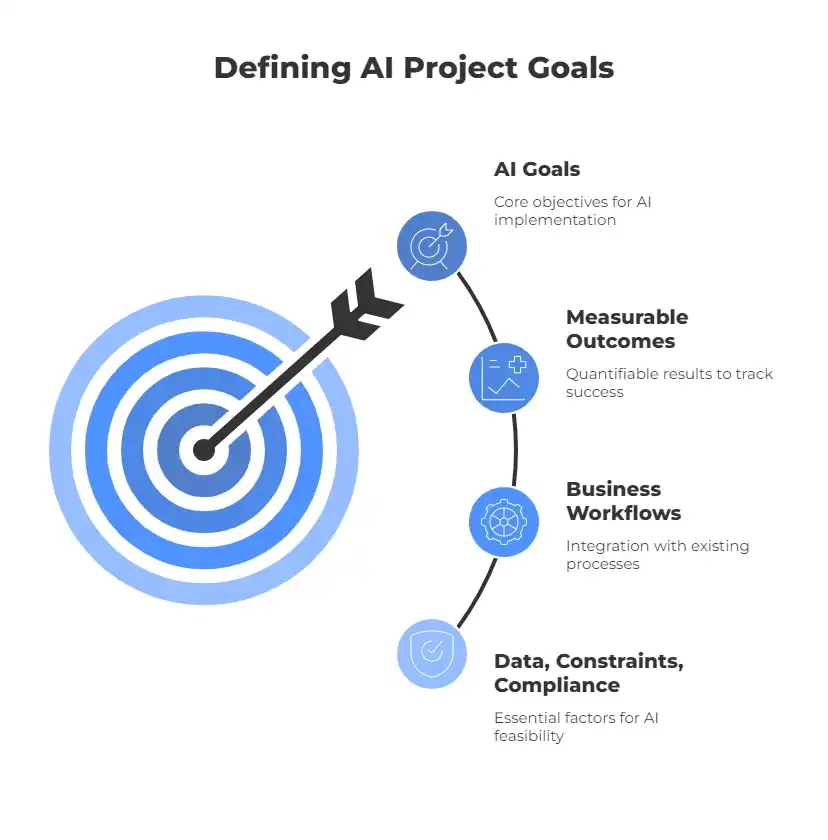
2. Align AI Goals with Business Workflows
Many AI initiatives fail because they ignore how work actually happens inside the organization.
Before engaging a vendor:
- Select a specific workflow, such as customer onboarding or claims processing
- Identify decision points where human intervention is required
- Confirm the AI solution can integrate with existing CRM, ERP, or internal APIs
Without workflow alignment, AI systems introduce technical debt and rarely deliver value at launch.
3. Define Data, Constraints, and Compliance Requirements
AI feasibility depends heavily on data quality and operational constraints.
Key areas to clarify upfront:
- Data: Dataset size, data cleanliness, and whether data is internally generated or externally sourced
- Constraints: Budget limits, delivery timelines, and dependencies on legacy systems
- Compliance: Regulatory requirements such as GDPR, HIPAA, or SOC 2, including audit logging and governance needs
Clear requirements eliminate a large percentage of unsuitable vendors before evaluation even begins.
Key Takeaway
Strong AI projects start with a single, shared document that defines outcomes, workflows, data, and compliance rules. Teams that skip this step often struggle to move beyond pilot projects or scale AI into production.
How Should Enterprises Shortlist AI Companies With Proven Experience In Their Industry?
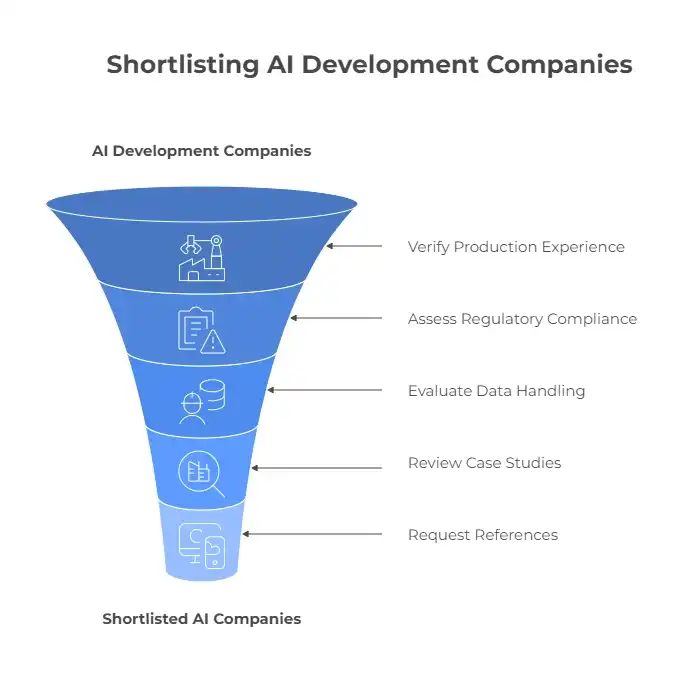
Enterprises should shortlist AI development companies based on verifiable production experience in their industry, not generic AI capability. The goal is to reduce delivery risk by prioritizing vendors who have already deployed AI systems under similar regulatory, data, and operational constraints.
Industry experience matters because AI systems behave very differently once they move from proof of concept to production.
If a vendor has not deployed AI systems in your industry before, you will pay for that learning curve in delays, rework, and compliance fixes.
Why Industry-Specific Experience Matters
Industry-aligned AI partners reduce risk in three critical areas:
- Regulatory compliance:
Healthcare AI must support HIPAA requirements, audit trails, and data governance. Financial services AI must meet SOC 2, PCI DSS, and model interpretability standards. Vendors with prior experience in the same industry typically design compliance into the system architecture from the start. - Industry-specific data handling:
Each industry operates on different data standards and patterns, such as DICOM imaging in healthcare, sensor and IoT data in manufacturing, or seasonality-driven demand models in retail. Vendors unfamiliar with these data realities often underestimate implementation complexity. - Speed to production:
Experienced vendors bring pre-built pipelines, validation processes, and deployment patterns that shorten development timelines and reduce rework.
How to Validate Industry Expertise (Not Just Claims)
You should validate evidence, not marketing language.
Use the following filters when evaluating vendors:
- Review case studies that demonstrate production deployments, not pilots or demos
- Assess whether the vendor’s prior work aligns with your data types, workflows, and regulatory environment
- Request references from enterprise clients operating under similar constraints
As Pete Peranzo, Co-founder of Imaginovation, notes from enterprise client engagements, AI vendors perform best when they can demonstrate prior production deployments, repeatable delivery patterns, and verifiable enterprise references.
Where to Find Industry-Tested AI Development Companies
Enterprises can identify qualified AI partners through multiple sources, but no single source is sufficient on its own:
- Analyst reports from Gartner, Forrester, and IDC
- Industry platforms such as Clutch and GoodFirms
- Professional networks, peer referrals, and industry-specific research communities
The key is consistency. Enterprises should apply the same evaluation criteria across all sources, focusing on relevant case studies, technical depth, industry-aligned teams, and credible client references.
Bottom Line
Enterprises that shortlist AI development companies based on proven industry experience and production evidence, rather than generic AI claims, significantly reduce delivery risk and increase the likelihood of successful AI adoption at scale.
How Should Enterprises Evaluate a Vendor’s Technical Expertise Across the AI Development Stack?
Once you have shortlisted vendors with relevant industry experience, the next step is technical due diligence. The goal here is simple: separate vendors who can demo AI from vendors who can run AI in production.
Most enterprise AI failures do not happen because models are inaccurate. They fail because systems cannot integrate, scale, be monitored, or be governed after deployment.
Step 1: Verify Production Experience Across Core AI Capabilities
Only count the capabilities a vendor has already delivered in production, not in pilots or proofs of concept.
Use the following checks:
- LLMs and NLP
Has the vendor deployed LLM-based systems in production with documented approaches to fine-tuning, prompt management, evaluation metrics, latency control, and cost optimization? - Computer Vision
Has the vendor delivered object detection, image classification, or video analysis systems operating under real-world conditions such as noisy data, edge cases, and performance constraints? - Predictive Machine Learning
Can the vendor show evidence of feature engineering, model selection, interpretability, and inference performance at enterprise scale? - Knowledge-Based Systems and RAG
Has the vendor implemented retrieval-augmented generation systems using vector databases, with clear strategies for chunking, embedding selection, retrieval tuning, and hallucination control?
If a capability cannot be tied to a live system or production metrics, it should not influence your evaluation.
Step 2: Assess MLOps and Data Engineering Maturity
Strong models do not compensate for weak operational foundations. Production AI requires mature MLOps and data engineering.
Minimum expectations include:
- Model versioning, drift detection, retraining workflows, and rollback strategies
- Monitoring for latency, cost, accuracy, and safety constraints
- Reliable ETL pipelines, data validation processes, and privacy controls
Vendors who downplay data engineering or monitoring are high risk. Weak operational foundations are a leading cause of failed enterprise AI deployments.
Step 3: Demand Evidence, Not Assertions
Technical depth should be demonstrated through artifacts, not claims.
Ask vendors to provide:
- Architecture diagrams showing data flow, model serving, and integrations
- Deployment workflows, including failure handling and rollback plans
- Model performance metrics and monitoring strategies
- Documentation of trade-offs made due to data quality, compliance, or system constraints
Be cautious of vendors who provide polished slides but cannot explain the reasoning behind architectural decisions.
Red Flags That Should Disqualify Vendors
Treat the following as warning signs:
- Guaranteed timelines or outcomes before reviewing your data and systems
- Claims of “full-stack AI expertise” without production evidence
- Inability to explain how models are monitored, retrained, or retired
- Overreliance on demos that do not reflect real operating conditions
Vendors that ignore system complexity are signaling inexperience, not confidence.
Key Takeaway
Enterprise AI success depends less on model sophistication and more on operational maturity. Vendors that can demonstrate production-ready systems, disciplined MLOps practices, and sound data engineering are far more likely to deliver AI that works beyond the pilot stage.
How Should Enterprises Assess a Vendor’s AI Product Delivery Process?
A vendor’s AI delivery process determines whether an AI initiative reaches production or stalls after experimentation. Enterprises should assess delivery processes to understand how vendors move work from discovery to deployment and how they support AI systems after launch.
A strong delivery process is not defined by frameworks or terminology. It is defined by repeatable execution, clear ownership, and the ability to handle failure and change without derailing the project.
What to Look for in an AI Delivery Process
Enterprises should expect vendors to clearly explain how they handle each stage of delivery:
- Discovery
Stakeholder alignment, data assessment, feasibility analysis, and clearly defined success metrics. Vendors should be able to explain how they identify risks before development begins. - Iterative Development
Structured experimentation with baselines, evaluation metrics, and regular feedback. The process should allow failed experiments to be stopped early without wasting time or budget. - Deployment
Integration planning, production readiness checks, and rollback procedures. Deployment should be treated as an engineering responsibility, not a handoff. - Ongoing Operations
Performance monitoring, drift detection, retraining planning, and issue resolution after deployment.
Vendors who cannot clearly describe these stages often struggle to deliver AI systems beyond pilots.
How to Evaluate Execution and Support
To assess whether the delivery process is real and not theoretical, enterprises should verify:
- A walkthrough of the vendor’s delivery process using a completed project
- How the team handles scope changes, blocked dependencies, and failed experiments
- Whether communication, documentation, and progress tracking are clearly defined
- How post-deployment support is structured, including monitoring and maintenance
AI systems require ongoing attention. Vendors should treat support and operations as part of delivery, not as optional services.
Key Takeaway
Enterprises should assess AI vendors based on their ability to execute consistently across the full delivery lifecycle. A clear, practical delivery process reduces project risk, improves time to production, and ensures AI systems continue to deliver value after launch.
How Should Enterprises Check Security, Compliance, and Ethical AI Standards?
Security, compliance, and ethical controls are non-negotiable for enterprise AI. Vendors must design these safeguards into their systems from the start. Gaps in this area are difficult to fix later and often disqualify vendors outright.
What to Verify Before Shortlisting Further
Enterprises should validate the following areas with evidence, not assurances:
- Security and compliance foundations
Confirm relevant certifications such as SOC 2, HIPAA, GDPR compliance, or other industry-specific requirements. Certifications should be current and independently audited. - Data protection and access controls
Verify end-to-end encryption, role-based access, and proper handling of PII and PHI during both training and inference. Vendors should be able to explain who can access what data and why. - Auditability and traceability
Ensure the system maintains detailed logs, audit trails, and versioned histories of data, models, and decisions. Lack of traceability is a red flag in regulated environments. - AI governance and accountability
Assess whether the vendor has defined ownership, approval workflows, and escalation paths for AI-related decisions, including how issues are handled when models behave unexpectedly.
Evaluating Ethical AI Practices
Ethical AI is not a policy statement. It is a set of operational controls.
- Confirm how the vendor tests for bias and unfair outcomes
- Review how human-in-the-loop reviews are implemented for high-impact decisions
- Ensure model behavior aligns with your regulatory, privacy, and industry obligations
Vendors that cannot explain these practices clearly should not be trusted with enterprise-grade AI systems.
Key Takeaway
Enterprises should prioritize AI vendors that embed security, compliance, and ethical safeguards directly into system design and operations. These controls protect sensitive data, reduce regulatory risk, and establish long-term trust.
How Should Enterprises Analyze Pricing Models and Expected ROI?
AI vendors who are reliable offer transparency in pricing and have clarity in ROI. Enterprises must focus on such vendors who don't focus solely on contract value.
Common Pricing Models
| Pricing Model | Best Use Case | Key Benefit |
|---|---|---|
| Fixed-price | Well-defined, low-risk projects | Predictable budget and clear deliverables. |
| Milestone-based | Projects where you want to balance flexibility with accountability. | Payments tied to delivery checkpoints, reducing risk. |
| Retainer / time-and-materials | Exploratory, research-heavy, or evolving-requirement projects. | Flexibility to adapt the scope as you learn. |
| Outcome-based | Use cases with clear, measurable business KPIs and strong vendor confidence. | Align vendor incentives with your business results. |
How Should Vendors Estimate Long-term Value?
Reliable AI partners assess business impact beyond implementation costs, articulating expected productivity gains, cost reductions, or revenue improvements tied to specific use cases.
Look for vendors who discuss deployment timelines, adoption curves, and performance benchmarks. Avoid those focused exclusively on technical capabilities without connecting them to business outcomes.
What Comprises the Total Cost of Ownership?
Below is a simple table summarizing key components of TCO for enterprise AI systems:
| Cost category | What it includes |
|---|---|
| Development fees | Initial build, customization, and configuration of the AI system. |
| Infrastructure costs | Cloud compute, storage, API usage, and scaling for production workloads. |
| Monitoring and operations | Performance tracking, alerting, dashboards, and incident response. |
| Retraining and updates | Model refreshes, data pipeline adjustments, and version upgrades. |
| Integration expenses | Connecting the AI system to existing applications, data warehouses, and APIs. |
| Support and maintenance | Ongoing vendor engagement, troubleshooting, optimization, and SLAs. |
Production‑ready vendors provide transparent TCO estimates with realistic assumptions and help enterprises plan budgets for multi‑year operations, not just the first‑year implementation.
What Do Client Feedback, References, and Social Proof Really Reveal?
Client feedback provides insight into how AI vendors perform under real enterprise constraints. Consistent, detailed social proof reveals delivery maturity, technical depth, and reliability over long-term engagements.
This is where claims made earlier in the evaluation process are either confirmed or contradicted.
What to Evaluate
Focus on substance, not sentiment:
- Platforms and relevance
Review feedback on enterprise-focused platforms and any industry-specific review sources relevant to your use case. - Depth of testimonials
Look for references to AI accuracy, system reliability, delivery quality, data governance, and security practices. Generic praise without specifics has limited value. - Outcome orientation
Prioritize evidence of measurable results such as cost reduction, revenue impact, risk mitigation, or compliance improvements tied to specific AI capabilities. - Reference validation
Serious vendors are willing to connect you with past or existing enterprise clients, ideally operating in similar industries or complexity levels. - Relationship longevity
Repeat engagements, multi-year contracts, and expansion from pilots to enterprise-wide programs signal trust and delivery consistency.
Social proof should reduce uncertainty. If it raises new questions, treat that as a signal.
Conclusion: Next Steps for Selecting the Right AI Partner
Selecting the right AI development company is an elimination exercise, not a popularity contest. The goal is to remove vendors that cannot deliver AI reliably under enterprise constraints.
The next step is to convert the criteria in this article into a simple scorecard, weigh what matters most to your organization, and evaluate each vendor using evidence, not demos or promises.
If you need support building that scorecard or applying it to your shortlist, Imaginovation can help. Let's talk.