




Get a personalized assessment of your operational efficiency and accelerate growth for your business.
Integrating Robotic Process Automation is becoming a cornerstone in the modern manufacturing landscape, offering efficiencies that were previously unattainable.
Are you a decision-maker eager to innovate in the manufacturing sphere? RPA presents opportunities that are vast and transformative.
In this article, we delve into the substantial benefits of RPA, providing compelling use cases and examples to underline its pivotal role in contemporary manufacturing.
Curious to know how RPA can be a game-changer in manufacturing? Let's explore its potential together.
What is Robotic Process Automation?
RPA is the use of a software solution to automate manual processes. It eliminates the need for people to perform repetitive tasks. How? By using software that executes the same set of steps in the task. RPA tool mimics the path a human worker would follow to finish the task.
The ability of RPA as a software bot to automate certain repetitive, predictable, and rule-based processes traditionally handled by humans makes it a sought-after technology. It minimizes human errors and boosts business efficiency and productivity.
RPA is a mature category rather than an emerging one — the analyst forecasts that used to be quoted here (Gartner on 2022 enterprise adoption, Forrester on 2025 market size) have now passed their own horizons, and market size was never the interesting number anyway. What matters is narrower and easier to check: whether your back-office processes are rule-based, high-volume, and running on systems that will not give you an API.
Software Robots Are Not Industrial Robots
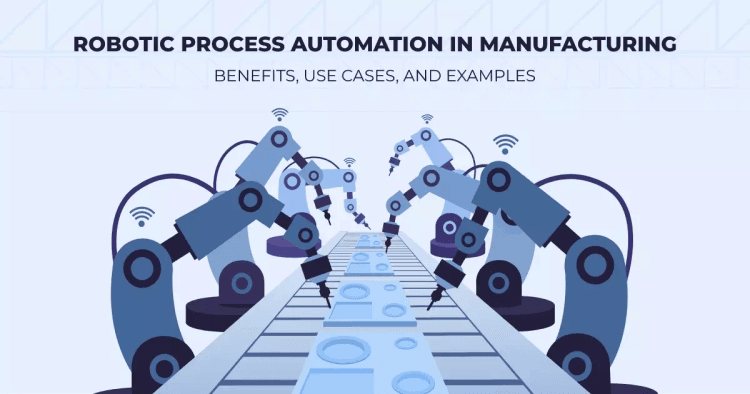
Worth stating plainly, because the shared word causes real confusion in manufacturing settings: RPA bots are software. They operate screens, files and APIs on office systems — ERP, MES front ends, email, spreadsheets, supplier portals. They do not move, actuate or control anything on the shop floor.
Machine control belongs to PLCs, SCADA and industrial control systems, and those are engineered, commissioned and safety-certified under an entirely different regime. Anyone proposing to put screen automation in the path of physical production equipment is proposing something you should refuse. RPA's place in a plant is the back office and the systems layer above it, which is precisely where most manufacturers' manual effort actually sits.
For the shop-floor side of the picture — sensors, machine data and connected equipment — see our guides to AI in manufacturing and digital transformation in manufacturing. This article stays on the office side of that line.
RPA and the manufacturing sector
The manufacturing industry has been using physical robots to assemble, test, and package merchandise for many years. They have been very helpful in streamlining the assembly lines, but the industry struggles to automate back-office processes.
To overcome these pain points, manufacturers are turning to RPA.
Adoption surveys in this space are worth reading with care — the widely repeated figures come from vendor and reseller round-ups, and they tend to count a single departmental pilot as adoption. The pattern they get right is that RPA lands in finance and supply-chain administration first, because that is where the repetitive, rule-bound, multi-system work lives.
By integrating it with other technologies such as Artificial Intelligence and Machine Learning, RPA is getting smarter.

Key Benefits of RPA in the Manufacturing Industry
Manufacturing companies are heavily dependent on reliable processes. They must consistently keep up with an ever-increasing demand for faster and more efficient production.
But their ability to achieve speed and efficiency is impacted by enormous effort and human errors due to the high volume of repetitive tasks and processes.
Implementing RPA in different manufacturing functions can bring some significant benefits in such cases. They are:
1. Significant Cost Saving
Implementing RPA in manufacturing involves a one-time cost for the setup. However, you can expect long-term cost savings in terms of:
- Costs needed for manual labor.
- Costs needed for healthcare and insurance of staff doing manual labor.
- Costs are used for maintenance and upkeep.
- Administration cost.
- Uninterrupted work, without any restrictions.
Imagine the cost savings when your company can enhance its productivity by performing 24/7 operations with RPA bots.
According to a Capgemini report, implementing RPA typically results in up to 20 percent cost savings.
2. Improved Efficiency
RPA helps manufacturing companies in enhancing efficiency by reducing the number of human errors.
With RPA implemented to manage administrative tasks, your workforce can focus on higher-value operations.
This way, you can better utilize your budget, resources, and time while boosting your company's overall productivity without delays or downtime.
3. Reduced Wastage and Errors
As manufacturers, we keep seeking ways to cut down waste in production.
The RPA bots are great at fixing manufacturing hurdles like manual lapses, inventory wastage, and process wastage.
The rule-based execution of RPA solutions brings down occurrences of errors and increases accuracy. Subsequently, wastage in all forms is reduced too.
4. Mitigate Labor Shortage
When you're looking for staff to fill positions, finding skilled manpower to perform certain processes might also take time, effort, and money.
However, a one-time investment in RPA can lower this dependence on manpower, eliminate delays, and increase business efficiency.
5. Improved Back Office Operations
With RPA in place, manufacturers can dismiss their conventional systems, which are prone to errors.
Back office operations such as purchase order creation, inventory management, and customer or vendor communication can improve drastically with bots.
And, you’ll get to work with more reliable digital processes that are accurate and efficient.
Top 6 RPA Use Cases and Examples in Manufacturing
With RPA, one witnesses a shift from physical to software robots. Let’s discuss this in detail with six real-world use cases of RPA in the Manufacturing industry.
1. Invoice Processing

The invoice processing procedure in manufacturing calls for coordination between multiple people. These people are required to execute several invoices checking and approving procedures.
Since invoices may be available in different formats and languages, it increases the complexity of the process.
In addition, the coordinated efforts between employees hold possibilities of manual errors, which further increase due to the monotony of the task.
All of this can result in a weak focus of the employee.
An RPA deployment in activities like invoice processing can be extremely helpful in collating, organizing, and making good use of the data, eliminating inefficiency and faults in the process.
The software bots can quickly skim through the data available in forms, input the data accurately in appropriate fields, and send out the data for authorization.
Moreover, RPA software bots can automate invoice processing by:
- Pulling out specific data from invoices using OCR
- Converting the pulled-out data into a structured format
- Check invoices against orders placed
- Cross-check for any duplicates
- Updating invoice records in the company’s ERP.
2. Purchase Order Creation
Have you observed how daunting the manual process for purchase order creation is? Especially so if your company is dealing with multiple product categories.
Besides, there are thousands of vendors to deal with. Staff needs to generate thousands of purchase orders regularly. So creating a PO manually isn't easy. Not to forget about the errors it would generate.
RPA can automate the entire PO creation process, enabling accurate and fast results.
For example, bots can pull out data from independent systems, seek email approval from concerned departments, and smoothly process the PO generation request.
3. Inventory Management
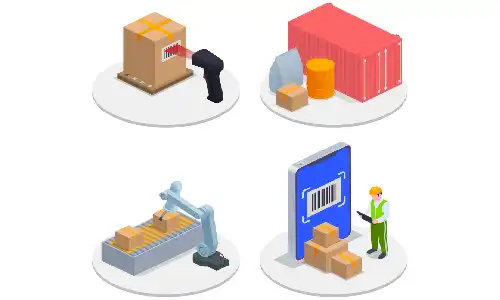
Inventory management involves everything from stock auditing to tracking assets flow from the factory to the PoS (Point of Sales).
Inventory management in the manufacturing industry has a tremendous amount of paperwork.
RPA-based automation furnishes inventory managers with real-time information about the inventory levels to monitor these and make better decisions based on historical data.
This greatly improves operational efficiency, reduces costs, and enhances communication.
RPA bots can automate the following processes in inventory management:
- Monitoring inventory levels
- Orders placement
- Receipts generation
- Deliveries tracking
- Responding to quotations and other queries emails
4. Automation of Administrative Tasks
Administrative tasks are pretty laborious. If employees are set free from such tasks, they can focus on other tasks that may be more critical. The manufacturing industry sees RPA as a magic wand as it automates:
- Recording and documentation of meeting minutes and action items
- Recording daily attendance
- Responding to FAQ e-mails
- Scheduling meetings and sending reminders
- Predicting computer problems
- Creating and filing invoices
5. Data Migration
Manufacturing businesses can thrive with regular and effective upgrades (for systems, procedures, and technology).
To ensure consistency in business procedures and continuous incorporation of new and better processes, you would require moving data from old to new systems.
There’s a possibility of human errors if we perform this task manually. Such errors will prove to be immense and costly in the long run.
RPA software streamlines the migration process from paper to a full-fledged digital system.
Since bots can handle data maintained in legacy systems in multiple formats, RPA can speed up the migration process while reducing the chances of error during data migration. In addition, RPA lowers the cost of data migration.
RPA tracks the complete migration process, identifies data inconsistencies and faulty datasets, and rectifies these errors in real-time.
6. Bill of Materials (BOM)
BOM is a crucial document in the manufacturing industry. It consists of an overall record of materials and components needed to create a new item or product. The document is maintained to provide employees with all the data they would need in the future during the upgrade or creation of new products.
It contains the record of raw materials, sub-assemblies, intermediate assemblies, key components, parts, and the quantities of each component required to manufacture the end product.
RPA bots are programmed to fetch data of specific products or elements and replicate human steps it would need to generate a bill of materials. As a result, it ensures that a new product is built fast and without errors.
Also Read: Implementing Business Process Automation: Best Practices and Potential Roadblocks
A Back-Office Workflow, Before and After
Take supplier invoice reconciliation in a plant that runs an ERP, a separate receiving system, and a shared mailbox. Nothing on this page touches production equipment; every step is office systems.
Before
A clerk opens the shared mailbox, downloads the invoice PDF, and keys the header into the ERP. They search the ERP for the purchase order, open the receiving system in a second window to confirm the goods actually arrived, and compare three sets of figures by eye. Mismatches go into a spreadsheet that is reviewed on Fridays. Month-end is a scramble because the spreadsheet is the only record of what is outstanding.
After
A bot picks up new mail on a schedule, extracts the invoice fields, looks up the PO in the ERP and the receipt in the receiving system, and performs the three-way match. Matches inside tolerance are posted and queued for payment. Everything else goes to a structured exception queue with the reason attached, rather than to a spreadsheet. The clerk now works the exception queue instead of doing data entry, and month-end reporting comes from the queue rather than from someone's memory.
What has actually changed: the clerk's job moved from transcription to judgement, the outstanding-items list became a system of record instead of a spreadsheet, and the process now produces an audit trail. Note what has not changed — the underlying systems, which is exactly why RPA was the right tool here.
Before selecting a process at all, it is worth running the broader check in our automation readiness guide — the most common reason an RPA project disappoints is that the process underneath it was never stable enough to automate.
Designing the Exceptions
The exception design is the project. A bot that only handles the happy path creates a second manual process nobody planned for.
- Extraction confidence below threshold: route to a human with the document and extracted fields side by side.
- PO not found, or quantity/price outside tolerance: hold, notify the buyer, never pay.
- Supplier bank details differ from the master record: hard stop, human verification by call-back. This is the fraud path and it is not negotiable.
- Target system unavailable or timing out: retry on a backoff, then park the item and alert. Never let a bot "assume success".
- Screen or layout changed: fail loudly and stop. A bot that keeps clicking through a changed interface is worse than one that halts.
Every exception needs a named owner and a service level. An exception queue nobody works is where these projects quietly fail.
Credentials, Audit Trail and Recovery
Three operational questions decide whether your auditors and your IT team will accept the bot.
Credentials. The bot gets its own service account, owned by the company, with permissions scoped to exactly what it does — never a named employee's login. Credentials live in a vault, are rotated on a schedule, and the rotation is tested. Using a person's account means you cannot tell the bot's actions from theirs in an audit, and it breaks the day they change their password or leave.
Audit trail. Log every transaction with a timestamp, the input document, the decision taken, the values compared, and the identity of the account that acted. For regulated or SOX-relevant processes the bot's log must be at least as good as the paper trail it replaced — in practice it is usually better, which is a selling point with your finance leadership.
Recovery. Decide in advance what happens to a part-completed transaction when the bot dies mid-run: whether steps are idempotent, whether a duplicate post is possible, who gets paged, and how you restart without double-paying a supplier. Test this with the systems actually running, not on paper.
Bot Maintenance Is a Permanent Cost
The uncomfortable truth about RPA: it is deliberately brittle by design, because it works on top of interfaces rather than through them. Screen automation breaks when a vendor changes a layout, when the ERP is patched, when a browser updates, or when a supplier redesigns their portal.
Budget for it as a running cost, not a warranty claim:
- An owner who is notified when a bot fails, and has time allocated to fix it
- A regression check after every upgrade to any system in the chain
- Version control and a test environment for bot definitions — the same discipline you would apply to any other production code
- A periodic review asking whether each bot is still worth running
RPA or an API?
If the system you are automating exposes a usable API, integrate with the API. It is more robust, it does not break when the interface changes, and it is cheaper to maintain.
RPA earns its place precisely where that option is absent: a legacy MES with no integration surface, a vendor whose API tier costs more than the process is worth, a supplier portal you do not control, or a process spanning four systems that will never be replatformed. Choosing RPA should be a conscious answer to "why not an API?", and the answer is often good. It should not be the default.
The ROI Assumptions to Write Down
Make every one of these explicit in the business case, because each is a place the numbers are usually too optimistic:
- Volume and handling time, measured rather than estimated — ask the team to time it for a week
- Straight-through rate: what fraction genuinely completes without human touch. Plan for 70–85% in year one, not 95%
- Exception handling time, which is often longer per item than the original manual work, because the hard cases are all that is left
- Licence costs per bot or per run, including orchestration, and what happens when you add the second and third process
- Maintenance, as a standing allocation of developer time per bot per year
- Whether the saved hours are removed or redeployed — both are legitimate outcomes, but only one of them shows up in the budget, and your CFO will ask
Where the payback usually comes from, in our experience, is not headcount at all: fewer duplicate payments, fewer penalties for late processing, faster month-end close, and an audit trail that stops costing people days to reconstruct.
Build Powerful RPA solutions with Imaginovation
It is the most appropriate time to adopt this innovative automation technology if you are a manufacturing company. Think automation beyond your core processes. Implement Robotic Process Automation and enjoy its various benefits.
Invest in an innovative RPA solution and stay competitive.
Imaginovation has extensive experience in building robust RPA solutions.
Contact us we will help you overcome challenges and build an amazing RPA solution.
Imaginovation is an award-winning web and mobile app development company with vast experience crafting remarkable digital success stories for diverse companies. Let's talk.