





Get a personalized assessment of your operational efficiency and accelerate growth for your business.
Your MVP launch went well. But now, is growth starting to stall?
You’re not alone. Many startups stay too long in MVP building mode, relying on quick fixes, minimal infrastructure, and junior developers.
While this speeds up early development, it often leads to technical debt, fragile systems, and inefficiencies.
An MVP is just the beginning. It validates demand, but scaling is a whole different game. It isn’t just about adding features but building for growth. As the number of users increases, so do bugs, support tickets, and performance issues.
The challenge?
To move forward, startups must transition to scalable software mode—hiring experienced developers and improving code quality.
But scaling isn't just a technical shift. It requires a change in strategy.
In this blog, we'll explore how to spot scaling issues, fix them, and build a dev team that drives sustainable growth.
“Build with people who care like it’s their own. Build with clarity, with trust, and with intention. That’s how you create something that lasts.”
— Michael Georgiou, Co-Founder of Imaginovation, in an interview with TechBehemoths
First, Check Whether the Team Is Actually the Bottleneck
Stalled growth after an MVP is not automatically a development problem. Before you start evaluating your team, rule out the alternatives — changing teams is expensive, slow, and useless if the constraint sits somewhere else.
Work through these four in order:
- Demand. Are new users arriving and failing to stick, or are they not arriving at all? Flat signups with healthy retention is a distribution problem, and no amount of engineering velocity fixes it.
- Product direction. Is the roadmap a list of requests, or a bet on a specific job your users are trying to do? Teams ship steadily and growth still flattens when the shipped features were not the ones that mattered.
- Scope and decision speed. Count how long a typical feature waits on a decision, a design, or an approval versus how long it spends in development. If the waiting dominates, the constraint is your operating model, not your engineers.
- Architecture and infrastructure. Sometimes the team is capable and the codebase genuinely cannot take another floor. That is a rebuild decision, and it is a different conversation from a hiring one.
If none of those explain the stall, and the pattern below matches what you see week to week, then the team is a plausible cause and worth assessing properly.
Signs Your Development Team Is Holding You Back
You’ve built your MVP, gained traction, and are ready to scale. But what got you here won’t take you to the next stage.
As your product grows, so do its challenges. Your development team must evolve to handle increased complexity and long-term scalability. What worked early on—small teams, fast iterations, and minimal processes—won’t be enough to sustain growth.
Here’s a list of key red flags that indicate your development team may be hindering the scalability progress of your product.
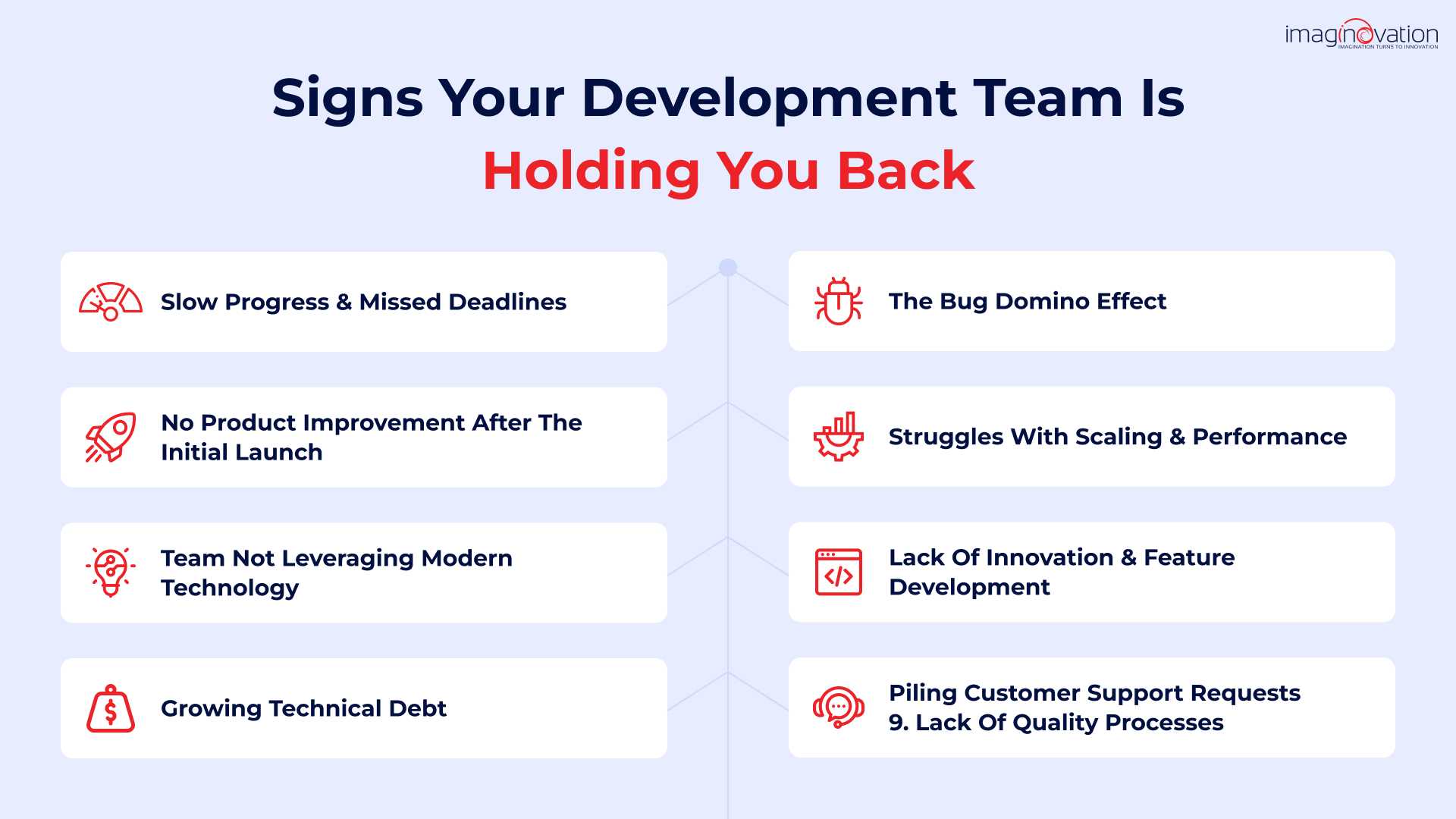
1. Slow Progress & Missed Deadlines
If your team consistently misses deadlines and progress feels sluggish, it’s a major red flag. While some unpredictability is expected, a strong team sets realistic timelines and meets them.
Many teams overpromise and underdeliver due to poor planning, lack of transparency, or misaligned expectations. If simple features take months instead of weeks and budgets spiral due to unexpected change orders, your team is likely struggling with accurate estimations.
A good team is expected to break work into achievable milestones, balance uncertainty, and maintain momentum. If your team can’t hit targets—or isn’t setting them properly—you’ll struggle to scale.
2. No Product Improvement After the Initial Launch
Does your startup feel stuck after launching your MVP?
If your dev team fails to iterate and improve the product, it can lead to declining user interest and missed growth opportunities.
Your users expect updates, enhancements, and bug fixes—if your dev team isn’t delivering, you could lose potential customers.
For example, after you launched the new project management tool, your users started requesting integrations with popular apps. If your dev team fails to act on this feedback, competitors will, and you will find users switching to other applications.
3. Team Not Leveraging Modern Technology
If your development team isn’t using modern tools and automation, they’re slowing down your ability to scale. Tracking user behavior, automating bug reporting, and integrating workflows are essential for efficiency with IT —yet many teams neglect them.
Take bug reporting, for example. Most users never file a bug report; they retry, work around it, or churn quietly. That does not tell you what share of your critical problems are going unnoticed — only that inbound reports are a weak sample of what is actually happening in your product. You cannot infer a failure rate from a reporting rate.
What closes that gap is instrumentation, not arithmetic:
- Error and crash monitoring (Sentry, Crashlytics, Datadog) catches exceptions the user never mentions, with the stack trace and the release attached.
- Structured logging and tracing across your services tells you where a slow or failing request actually broke, rather than which screen the user was looking at.
- Product analytics on funnel drop-off shows you where people abandon a flow — often the clearest signal of a defect nobody reported.
- Session replay and in-app feedback prompts turn a silent abandonment into something you can watch and reproduce.
- A small, recurring round of user interviews surfaces the problems that never throw an exception at all: confusing copy, a missing step, a workflow that does not match how the job is really done.
Pair the two. Monitoring tells you what broke; talking to users tells you what mattered. A team that has neither is flying on inbound complaints alone, and that is a genuinely thin signal to run a scaling decision on.
To scale effectively, you need a team that leverages automation, integrates analytics, and optimizes workflows—ensuring your app evolves with your business.
4. Growing Technical Debt
Rushing to launch your MVP often means taking shortcuts—quick fixes, messy code, and minimal testing. While this speeds up development, it also creates technical debt—the hidden cost of those compromises.
Over time, this debt slows development, drives up maintenance costs, and leads to recurring bugs that frustrate users.
If your team constantly patches issues instead of fixing root problems, they’re building on an unstable foundation. Left unchecked, technical debt can make scaling nearly impossible, leaving you stuck while competitors move ahead.
5. The Bug Domino Effect
Fix one bug, and another appears. Then another. If your team is stuck in this endless cycle, it signals a fragile codebase and possible inexperience.
This bug domino effect happens when one fix unintentionally breaks something else, often due to poor code structure, lack of testing, and rushed development. Instead of progressing, your team is constantly firefighting, delaying new features and improvements.
If they spend more time fixing than building, your product’s growth will stall.
6. Struggles with Scaling & Performance
Growth should fuel success, not slow down your app with performance issues and crashes.
Scalability issues are at play if your app becomes sluggish because of increased users. Many teams cut corners on database design and system architecture, leading to bottlenecks and downtime.
Your team isn't built for scale if you're constantly dealing with crashes instead of focusing on strategy. To grow effectively, you need a team that optimizes performance, not one that struggles to keep up.
7. Lack of Innovation & Feature Development
If your product lacks meaningful updates, your team may be reactive instead of proactive. A strong dev team does more than fix bugs—they drive innovation, suggest improvements, and optimize for growth.
Without this mindset, your product risks falling behind and losing relevance before it ever reaches its full potential. Scaling requires progress, not just maintenance.
8. Piling Customer Support Requests
If customer support is drowning in tickets about crashes, slow performance, or broken features, it’s a sign of deeper technical issues.
A stable, well-tested product should minimize user frustrations—and not turn customer support into a crisis management center. If support emails keep piling up, your dev team may not be delivering reliable, high-quality software.
9. Lack of Quality Processes
Without structured workflows, confusion and inefficiency take over—tasks get lost, priorities shift unpredictably, and progress stalls. A strong dev team follows transparent processes, ensuring smooth execution and steady growth.
If your team lacks disciplined planning, communication, and project management, inefficiencies—not just technical challenges—could be stopping you from scaling beyond your MVP. Growth demands structure, not chaos.
How a Weak Dev Team Can Hurt Your Startup’s Growth
A competent development team is the backbone of any successful startup, driving innovation, efficiency, and scalability.
However, a weak dev team can create bottlenecks, slow product development, and make scaling beyond the MVP stage difficult.
Here are the potential pitfalls of having an underperforming team that can hinder your startup’s growth.
1. Misalignment with Goal Setting
Successful startups often have a clear goal after launching an MVP (Minimum Viable Product). For example, aiming to get 100 happy customers can drive focused efforts post-launch.
A weak dev team, however, might not prioritize setting or adhering to goals, leading to stagnation and unclear progress markers.
2. Wasted Time and Budget Due to Inefficiencies
An inefficient development team can waste time and budget, slowing your startup’s growth due to poor workflow and missed deadlines. Lack of structure leads to delays, increased costs, and inconsistent outputs, making it harder to scale.
Clear roles, realistic timelines, and strong project management practices are essential to avoid these pitfalls. A team that sets and meets deadlines reliably ensures steady progress, helping you stay competitive and seize market opportunities.
3. Losing Ground to Competitors Who Move Faster
A weak development team can cause your startup to lose ground to faster-moving competitors. Inefficiencies and missed deadlines hinder your ability to innovate and respond swiftly to market changes, allowing rivals to outpace you.
As competitors introduce new features and improvements, your stagnant progress can lead to customer attrition and diminished market share.
To stay competitive, it's crucial to have a proactive and efficient development team that drives continuous growth and adaptation.
4. Stained Investor Relationships Due to Slow Execution
A weak development team can strain investor relationships due to slow execution. Investors expect timely progress and clear communication; delays and missed milestones can erode their confidence and trust.
To maintain strong investor relations, it's crucial to have an efficient development team that meets deadlines and communicates effectively.
What to Look for in a Strong Development Team?
A strong development team is necessary to scale beyond the MVP stage and ensure long-term product success. Here are the key qualities to look for in a development team:
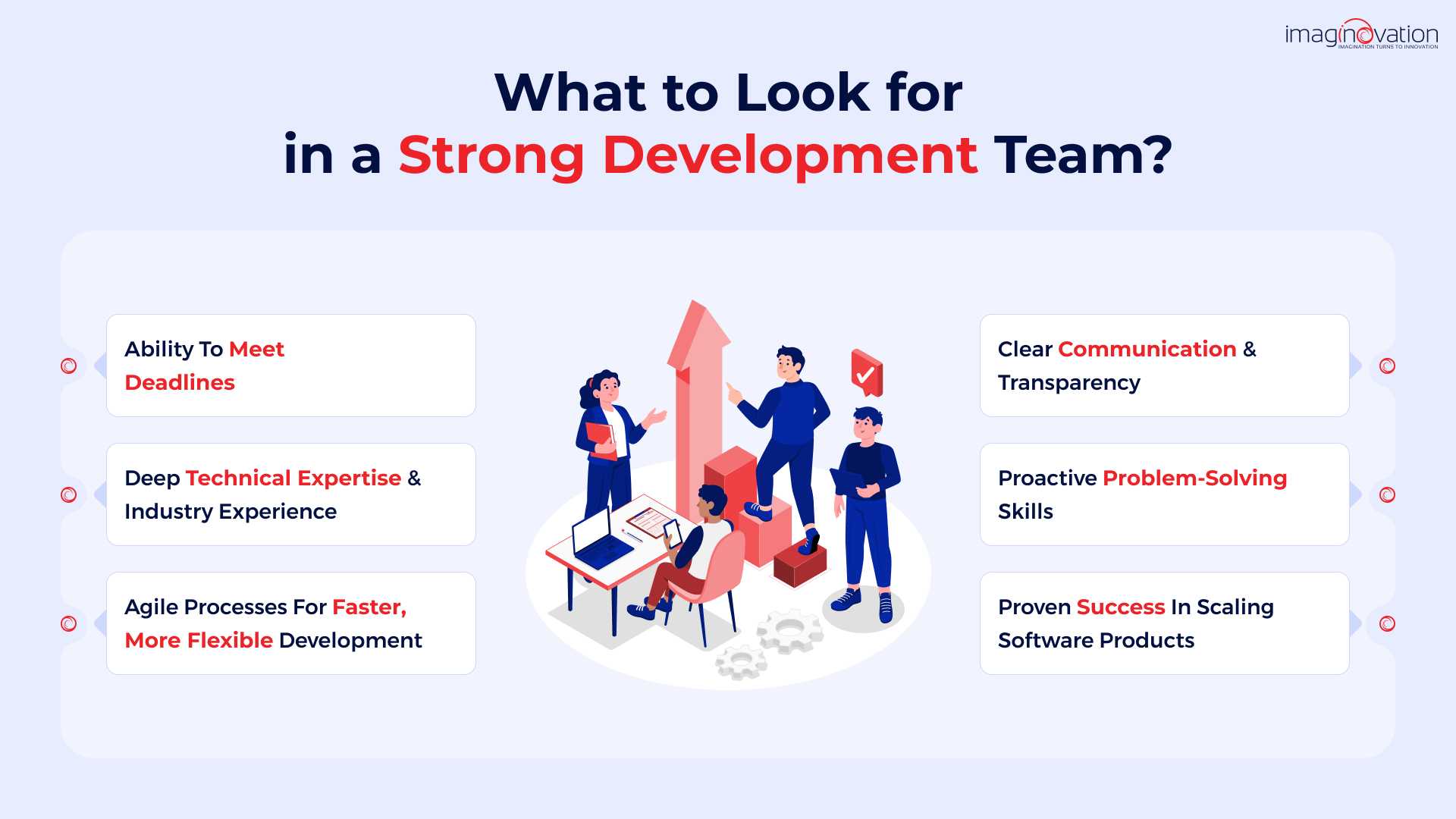
1. Ability to Meet Deadlines
Consistently hitting deadlines is a key trait of a high-performing development team. Since software development is unpredictable, a good team knows how to set realistic goals, manage expectations, and stay on track.
2. Deep Technical Expertise & Industry Experience
Look for a development team with the required technical expertise and industry experience—one that goes beyond just writing code. Remember, such a team will be able to use the right automation tools and integrate analytics, allowing you to adapt quickly to user feedback.
3. Agile Processes for Faster, More Flexible Development
You need an Agile dev team if you want faster development, smoother collaboration, and a product that truly meets user needs.
Agile breaks work into small sprints, allowing your team to release updates quickly, adapt to changes, and stay aligned through regular check-ins.
4. Clear Communication & Transparency
Look for a dev team that is open about progress, challenges, and timelines and fosters trust with founders and investors.
When everyone understands project goals and tasks, mistakes are minimized, and the project stays on track. On the other hand, siloed information and poor reporting lead to inefficiencies and delays.
5. Proactive Problem-Solving Skills
Choose a dev team that solves problems before they happen. A great team does more than just build features—they anticipate challenges, suggest improvements, and drive innovation.
When your team can foresee and fix issues before they escalate, your project stays on track, runs smoothly, and delivers a better, more reliable product.
6. Proven Success in Scaling Software Products
Choose a dev team with a proven track record in scaling software.
An experienced team knows how to handle growing user bases and maintain stability as your product expands.
This prevents downtime, keeps users happy, and ensures your business can adapt to market changes and new opportunities.
How to Switch to a Better Development Team Without Disrupting Growth?
Switching development teams after launching an MVP (Minimum Viable Product) can be daunting. Many startups hesitate, fearing disruptions to product growth.
However, if your current team fails to meet expectations, making a change is crucial. Here’s how to transition smoothly while keeping your MVP’s momentum intact.
1. Run a team-capability assessment.
Replace the gut feeling with something you can point at. Score each capability below over your last two months of actual work — not intentions, not the plan — on a simple scale: in place, partial, or absent.
Delivery
- Work is broken into increments that ship in days, not quarters.
- Estimates and actuals are compared afterwards, and the gap is shrinking.
- Missed dates are flagged early, with a reason, rather than discovered on the due date.
Engineering practice
- There is automated testing on the paths that would cost you money if they broke.
- Deployments are repeatable and reversible, and someone other than the original author can run one.
- Code review happens, and rejected work is common enough to be believable.
- Technical debt is tracked as named items with an owner, not described as a general feeling.
Operations
- Error monitoring and alerting exist, and someone acts on the alerts.
- You can answer “what changed?” after an incident within minutes.
- There is a documented recovery path for the failures you have already seen once.
Product alignment
- Engineers can explain which metric a feature was meant to move.
- The team pushes back on requests that will not move it.
- Someone owns the decision when requirements conflict.
Continuity
- More than one person understands each critical system.
- Onboarding a new developer takes days, not months.
- Architecture and deployment are documented well enough for a stranger to follow.
Read the result honestly. Mostly “in place” and the problem is probably elsewhere — go back to the four checks at the top of this article. Mostly “partial” is usually a coaching, process and seniority problem: adding one experienced engineer and fixing the operating model often beats replacing everyone. Mostly “absent” across delivery, practice and continuity is the case where a change of team is genuinely justified.
Document the gaps before you act on them. They become the brief for whoever comes next, and the baseline you measure them against.
2. Setting clear goals for your next phase of growth.
Many startups fail to scale because they lack clear goals after MVP launch. A strong next step is to focus on getting 100 happy customers—an indicator that your product is delivering value.
To track progress:
- Define success metrics, such as retention rates and customer satisfaction scores.
- Use tools like Hotjar to analyze user behavior and optimize the experience.
- Set clear deadlines for improvements to ensure momentum.
3. Finding the right development partner.
Not all development teams are created equal. To ensure a smooth transition, look for a team that:
- Integrates well with your workflow: A good team ensures that bug reports and feature requests seamlessly feed into task management systems (e.g., Sentry, Raygun, Jenkins).
- Has experience with scaling products: They should understand how to optimize for user growth without breaking the product.
- Communicates transparently: Regular updates, honest assessments, and reporting are key indicators of a reliable team.
Managing a Smooth Transition for Minimal Downtime
A handover fails in the gaps, so run it as a sequence with a checkpoint at the end of each stage rather than as a single switchover date.
Before anyone changes hands — secure the assets. Confirm in writing who owns the code, designs and documentation. Take administrative ownership of every account the product depends on: repositories, cloud and hosting, domain and DNS, CI/CD, app store listings, analytics, error monitoring, payment and email providers. Verify you can log in to each one yourself. This is the step startups skip, and the one that turns a transition into a hostage negotiation.
Week one — establish a baseline. Have the incoming team build and deploy the existing product to a staging environment from a clean checkout, using only the written instructions. Whatever they cannot do without asking the outgoing team is your real documentation gap. Record current behaviour too: error rates, response times, and the key conversion steps. You will need it later to tell a migration problem from a pre-existing one.
Weeks two to four — overlap deliberately. Keep the outgoing team available for questions, ideally on a short paid retainer, while the new team ships something small and low-risk end to end. A minor bug fix released to production proves the whole pipeline works while the people who built it are still reachable.
Then — transfer ownership in slices. Move one service or module at a time, each with a named owner and a rollback path. Freeze new feature work during the changeover so any regression is unambiguously attributable to the move rather than to a new feature.
Checkpoint before you cut the cord. The new team has deployed to production more than once, resolved an incident without escalation, and can explain the architecture back to you. Only then end the overlap.
Two things to expect and plan for: velocity drops for roughly a month while the new team learns the codebase, and some of what the outgoing team knew was never written down. Budget for both rather than being surprised by them.
Preserve What Works, Replace What Doesn’t
Not everything needs to be scrapped when transitioning to a new development team. However, if the existing codebase is weak, consider rebuilding key components rather than patching bad code.
At Imaginovation, we believe that sometimes starting fresh is the best path forward. If your MVP is built on a weak foundation, patching it up will only create more issues down the road.
We focus on stabilizing your platform to ensure it is robust and ready for long-term growth. While this might require taking a step back initially, it ultimately leads to a scalable and successful product.
Reusing old designs and documentation may seem like a quick fix, but it’s often like adding a wing to a house that’s already falling apart—ineffective and risky. Many startups come to us believing their MVP is functional, yet they struggle to scale.
Upon closer analysis, we frequently discover that the product is fundamentally flawed—like a fake diamond in Donnie Brasco. It may look solid on the surface, but in reality, it’s a house of cards, ready to collapse under pressure.
Imagine building a second floor on a house with a faulty foundation. It’s not just impractical—it’s a disaster waiting to happen. Instead of investing in temporary fixes, we recommend demolishing the unstable parts and rebuilding the foundation properly. This ensures that your MVP is strong enough to support future growth without limitations.
We understand how frustrating this realization can be, especially after significant investments. However, pouring more resources into a flawed structure is a waste. While rebuilding might seem costlier upfront, it is the smartest long-term solution for sustainable growth and scalability.
How Imaginovation Can Help Scale Your MVP?
If your startup is stuck in development bottlenecks, we help eliminate inefficiencies, improve adoption, and build resilient systems.
Many teams come to us with broken platforms; in some cases, we rebuild products from the ground up to ensure stability.
We specialize in custom-built solutions tailored to your business needs. Take our much-loved productivity tool (that we built internally), MagicTask, as an example. It evolved from an internal tool into a full-scale product through structured development, automation, and continuous optimization.
Scaling doesn’t have to be stressful. Let’s make your transition smooth, contact us today!