



Get a personalized assessment of your operational efficiency and accelerate growth for your business.
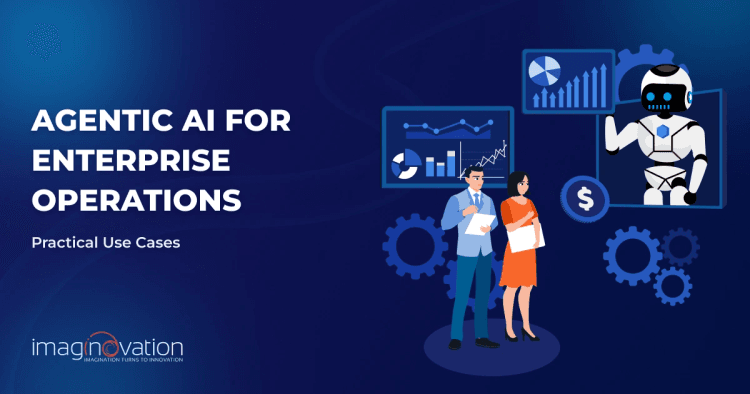
Agentic AI is increasingly used in enterprise operations to manage decisions, exceptions, and complex workflows that traditional automation cannot handle well.
These systems work autonomously, adapt as conditions change, and coordinate actions across multiple platforms to deliver business outcomes.
In this article, we take a look at how enterprises are using agentic AI in practice today. We focus on proven operational use cases, how these systems integrate with existing enterprise infrastructure, and the metrics leaders use to measure ROI and scale adoption.
Why Agentic AI Is the Next Step for Enterprise Operations?
Agentic AI is the next step for enterprise operations because rule-based automation cannot scale decision-making and exception handling at enterprise speed. As operational complexity increases, static workflows fail to adapt in real time.
Adoption data confirms this shift. 88% of enterprises now use AI in at least one business function, and 23% are already scaling agentic AI systems in production (Source). This reflects a move from experimentation to production-grade autonomous capabilities.
The practical question is clear: where are enterprises using agentic AI today? The following sections examine proven use cases already deployed in enterprise operations.
5 Practical Agentic AI Use Cases You Can Deploy Now
The following section outlines five practical agentic AI use cases already deployed in enterprise operations, focusing on real implementations rather than experimental pilots.
1. Intelligent Process Orchestration
How does agentic AI enable intelligent process orchestration?
Agentic AI enables intelligent process orchestration by autonomously routing work, managing approvals, and resolving standard exceptions across multiple enterprise systems.
These agents coordinate workflows across finance, procurement, HR, and IT while escalating only policy violations or high-risk cases that require human judgment.
What problem does this solve?
Traditional process orchestration depends on static routing rules and manual coordination between teams.
As volume increases, approvals stall, exceptions pile up, and handoffs create delays that teams must resolve manually.
How is it implemented?
Implementation typically follows this pattern:
- Integrate the agent with core enterprise systems such as ERP, CRM, and HRIS using APIs.
- Define policy-based decision logic for routing, approvals, and exception thresholds.
- Allow the agent to execute routine decisions autonomously and escalate only when human judgment is required.
Real-world application
A global manufacturing company deployed an orchestration agent for procurement workflows. The agent:
- Routes purchase requests based on spend thresholds and cost-center budgets
- Validates approvals against ERP budget data
- Resolves standard exceptions, such as substitute approvers during PTO
- Escalates only policy violations or flagged vendors
Finance teams apply the same pattern to invoice approvals, with the agent tracking dependencies across procurement, legal, and budget systems.
Measured outcomes
- 32% reduction in procurement cycle time (12 days to 8 days)
- 68% decrease in manual approval touchpoints
- 94% SLA compliance, up from a 71% baseline
Why does this work?
Agentic AI removes coordination delays and manual handoffs in high-volume, rule-based processes. Teams focus on genuine exceptions instead of routine routing and approval decisions.
2. Predictive Maintenance and Resource Optimization
How does agentic AI enable predictive maintenance and resource optimization?
Agentic AI enables predictive maintenance by analyzing live asset telemetry to detect failure risks and act before breakdowns occur.
These agents schedule maintenance, rebalance machine workloads, and optimize resource use in real time, escalating only high-risk cases to humans.
How is it implemented?
- Ingest real-time telemetry from machines and IoT sensors.
- Detect failure signals using predictive models.
- Automatically create maintenance tickets and schedule repairs.
- Shift workloads to healthy machines to maintain output.
Real-world application
In manufacturing plants, agents monitor vibration and temperature patterns to detect early equipment wear. When thresholds are reached, the system schedules maintenance during low-production windows and reallocates workloads to avoid downtime.
Key metrics
- Unplanned downtime reduction (%)
- Maintenance cost savings
- Increase in production throughput
Why does this work?
Agentic AI continuously evaluates asset health and acts immediately. This prevents failures, improves asset utilization, and aligns maintenance decisions with production priorities.
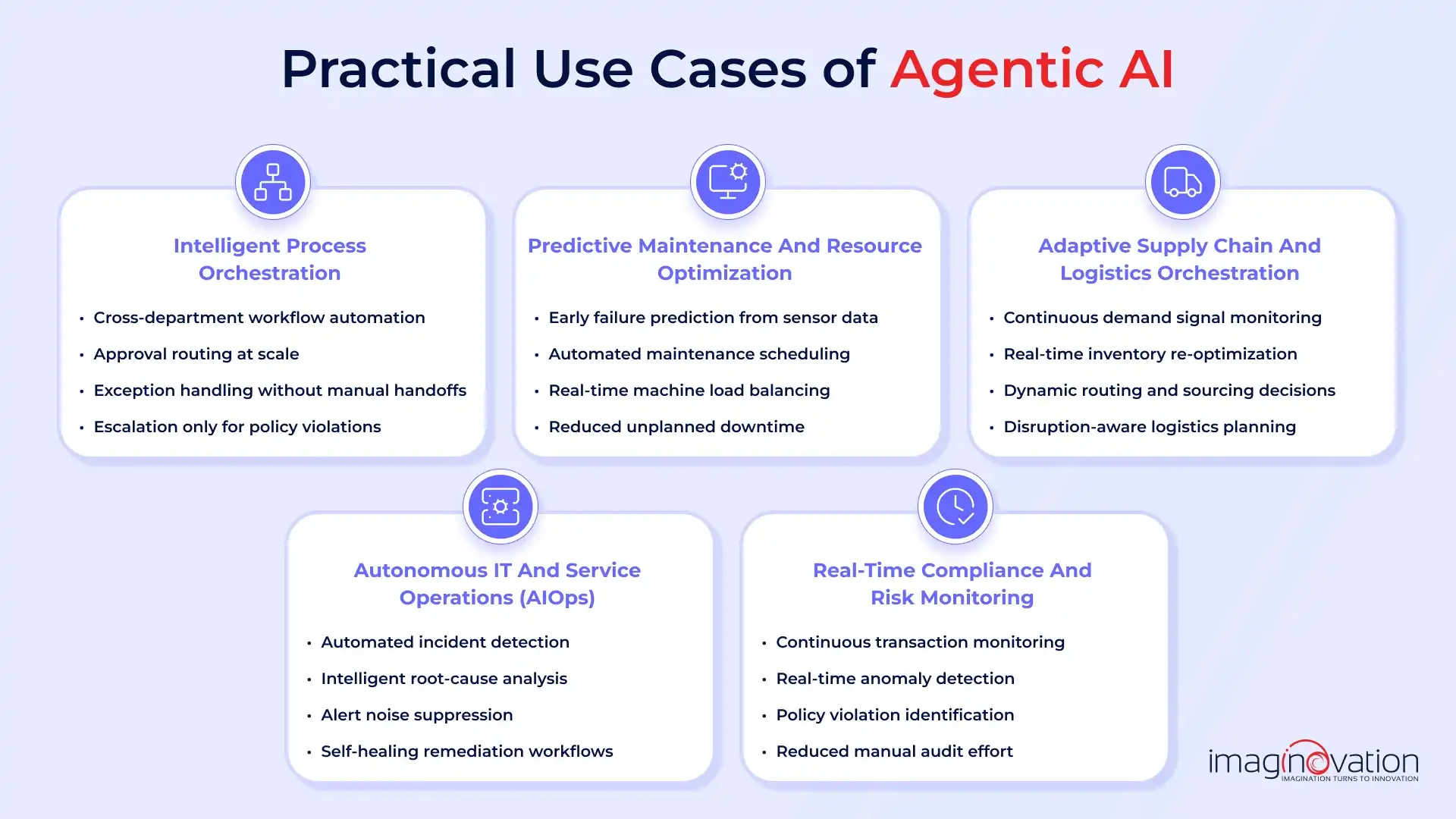
3. Adaptive Supply Chain and Logistics Orchestration
How does agentic AI enable adaptive supply chain and logistics orchestration?
Agentic AI enables adaptive supply chain orchestration by continuously monitoring demand, inventory, and logistics constraints and re-planning decisions in real time.
These agents adjust inventory positions, delivery routes, and supplier priorities as conditions change, without waiting for manual intervention.
Also Read: Optimizing Supply Chain Performance Using Technology
How is it implemented?
- Integrate the agent with ERP, WMS, and TMS systems.
- Continuously evaluate demand signals, inventory levels, and logistics constraints.
- Automatically re-plan inventory allocation, routing, and sourcing decisions.
- Execute changes in real time as disruptions or demand shifts occur.
Real-world application
In retail and logistics environments, agents detect port delays or sudden demand spikes and respond immediately.
The system reroutes shipments, shifts sourcing to alternate suppliers, reprioritizes high-margin SKUs, and reallocates inventory across warehouses to prevent stockouts.
Key metrics
- Improvement in on-time delivery (%)
- Reduction in expedited and premium freight costs
- Inventory holding cost reduction
Why does this work?
Agentic AI replaces periodic planning with continuous optimization. By balancing cost, service levels, and risk across the network in real time, organizations absorb disruptions without overstocking, expediting, or missing customer commitments.
4. Autonomous IT and Service Operations (AIOps)
How does agentic AI enable autonomous IT and service operations?
Agentic AI enables autonomous IT and service operations by diagnosing incidents, identifying root causes, and executing remediation actions with minimal human involvement.
These agents reduce alert noise, resolve routine incidents automatically, and escalate only complex or high-risk issues to IT teams.
How is it implemented?
- Integrate the agent with enterprise monitoring and ITSM tools such as Datadog, ServiceNow, and PagerDuty.
- Ingest alerts, logs, and events in real time.
- Perform root-cause analysis and suppress duplicate or low-signal alerts.
- Trigger automated remediation scripts or escalate when thresholds are exceeded.
Real-world application
A large enterprise deployed an agent to reduce MTTR by automating incident triage. The agent suppresses alert noise, identifies likely root causes, and executes remediation steps for known failure patterns, allowing teams to focus on unresolved or systemic issues.
Key metrics
- Mean Time to Resolution (MTTR)
- Percentage of incidents resolved autonomously
- Alert noise reduction
Why does this work?
Operational data follows repeatable patterns.
Agentic AI handles the full incident lifecycle, from detection to resolution, without delay. This reduces outages, improves response consistency, and shifts teams away from reactive firefighting toward long-term system improvements.
5. Real-Time Compliance and Risk Monitoring
How does agentic AI enable real-time compliance and risk monitoring?
Agentic AI enables real-time compliance monitoring by continuously analyzing transactions, system logs, and workflows to detect policy violations and emerging risks.
These agents identify anomalies as they occur and alert human reviewers only when confidence thresholds are exceeded.
How is it implemented?
- Deploy a streaming data agent connected to transaction systems and log sources.
- Apply adaptive rules and anomaly detection models to identify compliance risks.
- Generate real-time alerts for high-confidence violations.
- Route flagged cases to human reviewers for investigation or intervention.
Real-world application
In financial services environments, agents monitor transactions and activity logs to detect compliance breaches or fraud patterns in real time. This enables intervention during active violations instead of relying on retrospective audits.
Key metrics
- Anomaly detection speed
- Manual audit effort reduction
- Reduction in regulatory incidents or penalties
Why does this work?
Compliance risk increases with time. Agentic AI replaces periodic audits with continuous monitoring, reducing exposure windows and limiting human review to high-confidence cases. This improves regulatory responsiveness while lowering operational workload.
Pete Peranzo, Co-founder of Imaginovation, identifies compliance as the area where enterprises are currently extracting the most concrete value from agentic AI.
According to Pete, successful deployments rely on agentic AI functioning as an always-on compliance manager that continuously monitors systems across the organization.
These AI agents can oversee all systems simultaneously, issuing alerts whenever compliance standards like SOC 2, ISO, or HIPAA are violated or at risk.
Rather than requiring human oversight, the technology operates autonomously, understanding regulatory requirements and intervening only when it detects issues related to data storage, data transfer, or documentation practices.
How Should Enterprises Deploy AI Agents in Enterprise Operations?
Enterprises should deploy AI agents by starting with a narrowly scoped workflow, defining clear decision boundaries, and scaling only after measurable results are proven.
This approach reduces risk, builds trust, and prevents organizations from over-automating before governance and controls are in place.
Deployment steps
1. Start with a micro-pilot
Select a single workflow with clear boundaries and visible outcomes. Prioritize use cases where impact is measurable within weeks, such as ticket triage, alert summarization, or report generation.
2. Define a Minimum Viable Agent (MVA)
Clearly define the agent’s goal, success metrics, and limits. Establish human-in-the-loop escalation rules that specify when the agent must pause, request approval, or hand control to a human.
3. Integrate with existing systems
Avoid re-platforming during early deployments. Connect agents to existing tools using APIs or prebuilt connectors across systems such as ERP, ITSM, or data platforms.
4. Establish governance and safety controls
Implement access controls, audit trails, and logging from day one. Maintain a clear human override mechanism to stop or correct agent actions when required.
5. Measure, iterate, then scale
Track performance using two to three core KPIs, such as decision accuracy and cycle-time reduction. Refine the agent based on results and scale only after consistent performance is demonstrated.
For large organizations looking to explore agentic AI without disrupting their current infrastructure, the most pragmatic approach is layering AI agents on top of existing systems. Pete outlines a phased implementation strategy:
Start small with a pilot. Begin by deploying a single agent targeting your most critical pain point, whether that's data storage challenges, compliance bottlenecks, or another pressing issue. Treat this first deployment as a pilot program, collect feedback, measure impact, and use those insights to inform your next steps.
Limit the initial scope. Keep the rollout narrow by focusing on a specific department, such as accounting, or even a single team. This contained approach helps validate effectiveness and surface issues before scaling.
Enhance existing workflows. Above all, the AI must support current processes rather than disrupt them. It should reduce friction, complement your team’s work, and avoid introducing additional complexity or slowdowns.
Key Takeaway: Start narrow and move to scaling slowly. Enterprises can take small steps with agents, which helps in building trust faster and achieving sustainable impact.
What are the common challenges when deploying agentic AI, and how can enterprises mitigate them?
Enterprises face integration, security, and adoption challenges when deploying agentic AI.
These risks can be mitigated through API-first architecture, security-by-design controls, and human-in-the-loop operating models that balance autonomy with oversight.
1. Data silos and poor integration readiness
- Risk: Agents fail when critical data is fragmented across disconnected systems.
- Mitigation: Expose core systems using an API-first integration approach. Use secure, reusable connectors to allow agents to operate across workflows without brittle, point-to-point builds.
2. Security and compliance risks
- Risk: Autonomous agent actions can introduce vulnerabilities related to auditability, access control, and regulatory compliance.
- Mitigation: Deploy agents in sandboxed environments with strict IAM and role-based access controls. Enforce full activity logging, audit trails, and policy-driven guardrails to ensure compliance by design.
3. Change management and adoption resistance
- Risk: Teams mistrust automation, bypass agents, or override decisions without governance.
- Mitigation: Establish structured training, clear accountability models, and human-in-the-loop designs where agents assist decision-making rather than replace it.
How Imaginovation addresses these challenges
Imaginovation applies disciplined system architecture using API-first platforms, security-by-default patterns, and human-centered agent workflows. This approach ensures enterprise-grade scalability, safety, and adoption from the first deployment.
Pete highlights that once AI agents operate autonomously, organizations face several critical risks.
He adds that agents can make catastrophic errors, such as wiping hard drives, deleting vital data, or executing flawed decisions that cause severe organizational damage. Even agents with 99% accuracy can inflict significant harm during that single failure.
This reality demands mandatory safeguards, including approval gates for high-stakes actions, continuous human oversight, and verification protocols before execution. He explains that complete autonomy isn't viable.
Instead, humans must shift from performing tasks to supervising agents, trusting their capabilities while verifying every output. The new work isn’t doing the heavy lifting; it’s ensuring AI-generated results are accurate and won’t cause harm.
How should enterprises measure the impact of agentic AI in enterprise operations?
Enterprises should measure the impact of agentic AI using a combination of business KPIs and agent-level performance metrics.
This ensures leaders can quantify operational impact, justify continued investment, and make informed decisions about scaling autonomous systems.
Core business KPIs
These metrics measure tangible operational and financial impact:
- Process cycle time: Reduction in end-to-end workflow execution time.
- Downtime: Decrease in service disruptions or incident duration.
- Operational cost reduction: Savings from automation, efficiency gains, and reduced manual intervention.
Agent-level KPIs
These metrics assess how effectively agents perform and scale:
- Decision accuracy: Percentage of agent decisions that meet defined success criteria.
- Autonomy rate: Percentage of actions executed without human intervention.
- Successful action rate: Percentage of agent actions that complete with the intended outcome.
ROI expectations
In most enterprise pilots, ROI becomes measurable within 3 to 6 months. Returns typically come from faster processing, fewer errors, reduced downtime, and lower operational costs.
These early results provide the confidence required to expand agentic AI deployments responsibly.
Pete explains that operations leaders should focus on two essential metrics to demonstrate the business value of agentic AI.
Labor reduction is the primary measure. These tools directly replace manual work, reducing costs by eliminating tedious, repetitive tasks.
The second critical outcome is execution speed. AI agents compress work that normally takes days or weeks into minutes or hours, such as generating complex reports in a fraction of the time.
While speed gains can be considered a form of labor reduction, they more clearly illustrate how agents multiply productivity by accelerating workflows that would otherwise require significant human time and effort.
If you are ready to move from understanding agentic AI to applying it in your own operations, the next step is execution.
Building Enterprise-Ready Agentic Systems with Imaginovation
Imaginovation helps enterprises design and deploy agentic AI systems within existing infrastructure, with a focus on secure integration, practical use cases, and human-in-the-loop control.
If you are evaluating agentic AI and want to move beyond experimentation, our team can help assess readiness and define a safe, scalable starting point. Let's talk.