



Get a personalized assessment of your operational efficiency and accelerate growth for your business.
AI agents in logistics have moved from hype to measurable results in the industry.
Logistics professionals have to make micro-decisions that may seem minor in isolation, but when viewed holistically, they can erode profit margins that compound across logistics networks.
AI agents mark a significant shift in how logistics operations make decisions. Unlike simple automation of repetitive tasks, these systems continuously monitor operations and autonomously execute decisions after evaluating options against business constraints.
The focus isn’t on replacing human judgment on strategic matters; instead, it is hyper-focused on eliminating the cognitive burden of routine operational choices that accumulate into systemic problems.
This article examines what deploying agentic AI in logistics actually requires: assessing organizational readiness, calculating realistic returns, and navigating the transition from controlled pilots to full-scale production.
What Are Micro-Decisions in Logistics?
Micro-decisions refer to all the moments that logistics teams have to make daily, which can range from determining where to locate a pallet to deciding whether to consolidate orders.
Even though they appear to be small decisions, which only take seconds, over time, they can consume hours.
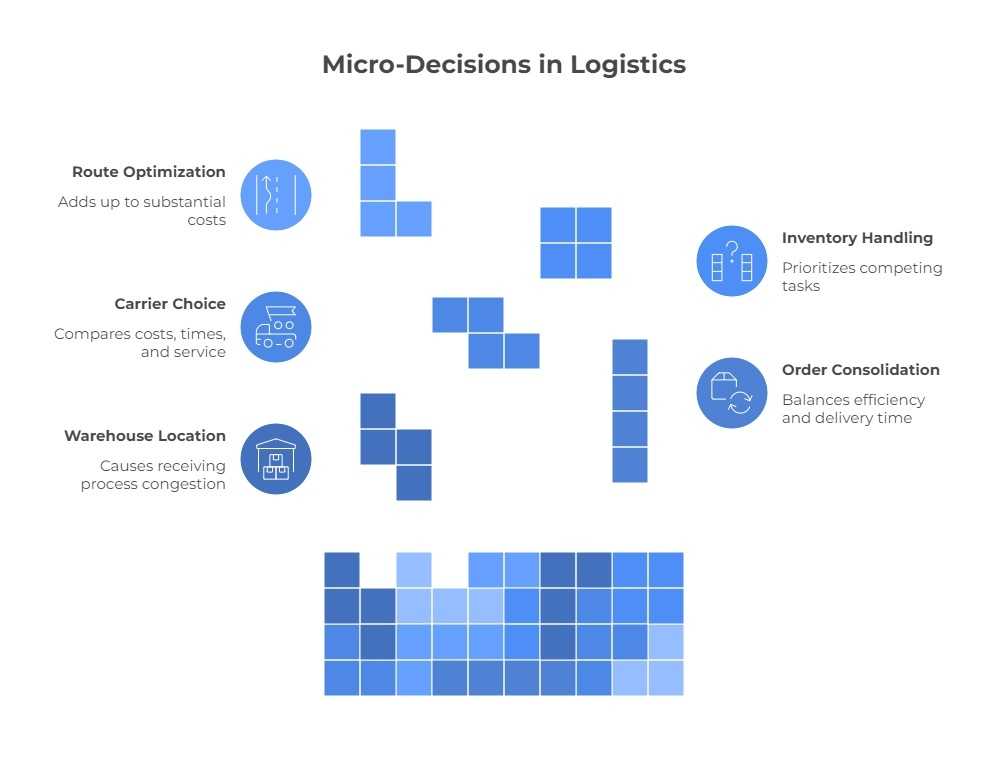
Common Types of Micro-decisions in Logistics:
- Warehouse location decisions: Employees stopping to decide where to place merchandise on shelves, causing congestion in the receiving process.
- Order consolidation decisions: Teams rapidly figure out if it is worthwhile to consolidate orders, weighing the trade-off between efficiency and delivery time, and customer requirements.
- Carrier choice: Dispatchers spend time evaluating similar carriers on a shipment-by-shipment basis, comparing costs, times, and levels of service.
- Priorities in inventory handling: Employees making decisions on what to do first when they have competing tasks such as restocking, picking, or putaway operations.
- Route optimization micro-adjustments: Drivers and route planners make many small routing adjustments that appear to be trivial but add up to substantial costs.
The cumulative effect
In a warehouse that handles thousands of SKUs or a network that coordinates hundreds of shipments per day, such trivial decisions have a cumulative effect that significantly impacts operations.
Also Read: Warehouse Automation: Strategies to Achieve The High ROI
How Do Micro-Decisions Slow Logistics Operations Across Key Areas?
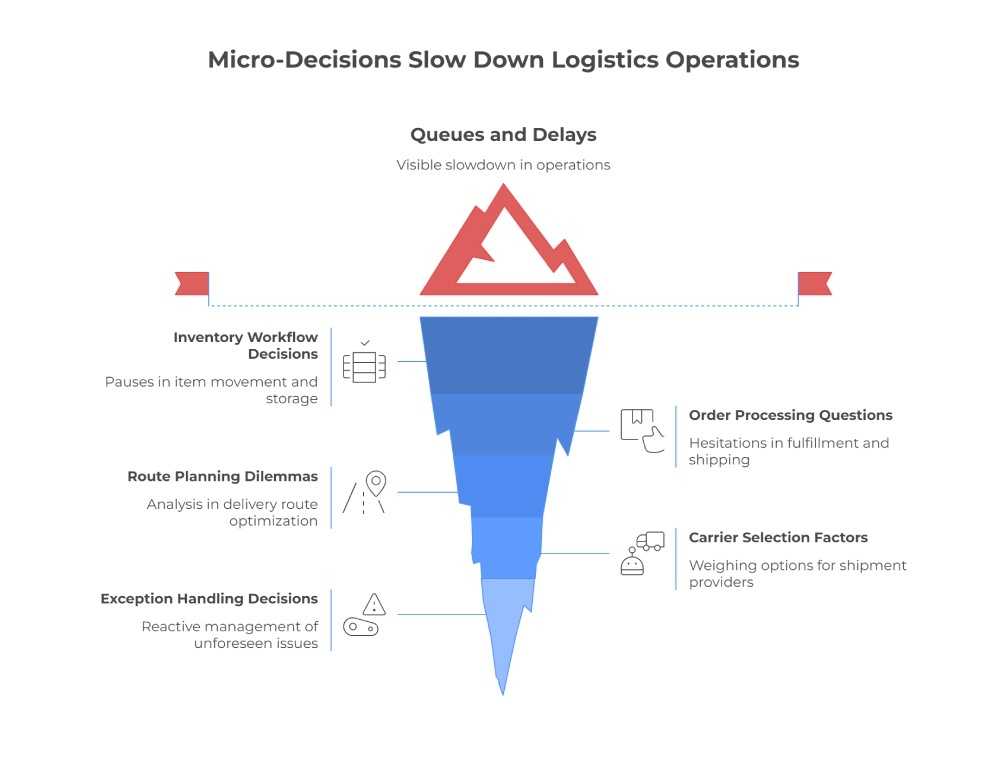
Micro-decisions slow operations by creating pauses across workflows. Pauses multiply in high-volume tasks.
The result includes queues and delays.
1. Inventory + Warehouse Workflow
Every item movement triggers decisions: Where should this be stored? Is this pick location optimal? Should we replenish now or later?
Workers pause to check storage locations, review inventory levels, and weigh slotting priorities.
These 30-second hesitations multiply across hundreds of daily putaways and picks, turning into hours of lost productivity.
2. Order Processing
Each order presents questions that slow fulfillment: Can we fulfill this completely, or partially ship? Which warehouse should handle this? Should these orders be batched?
Processing teams review priorities, verify inventory, decide on packing materials, and determine shipping methods before orders even reach the floor.
These assessments create queues and delay order release.
3. Route Planning
Dispatchers face routing dilemmas: Which driver takes this delivery? Should we add this stop to an existing route or create a new one? What's the optimal sequence? Is it worth waiting to fill the truck?
Every route modification, load rebalancing decision, and delivery window negotiation requires analysis, slowing scheduling, and delaying departures.
4. Carrier Selection
Teams weigh multiple factors per shipment: Which carrier offers the best rate for this lane? Do we have capacity with our preferred partner? Should we use a pricier but more reliable backup? Is expedited shipping necessary?
Comparing rates, checking service levels, and negotiating exceptions takes two to twenty minutes per shipment.
5. Exception Handling
When things go wrong, micro-decisions multiply: How do we handle this out-of-stock? Should we divert this late shipment? Accept this damaged return? Which orders get priority with limited inventory?
Exception management is reactive and disruptive, pulling people from scheduled work to address urgent situations, creating ripple delays while teams wait for direction.
Key Takeaway:
The end result is a dramatic impact. What may appear to be a seamless operation on the surface is, in reality, driven by thousands of micro-delays that trigger these compounding factors, gradually pushing timeline disruptions into view.
How Do AI Agents in Logistics Speed Up Operations?
AI agents speed operations by autonomously handling repetitive micro-decisions.
AI agents monitor real-time data. AI agents evaluate constraints. AI agents execute actions. Result: 10-40% gains in speed, capacity, and reliability.
In our client work, fastest wins occur in high-frequency decisions like carrier selection.
Here are some high-impact deployments where agentic AI can replace delay-prone human judgment, which also include rigid rules with continuous, context-aware decisioning.
1. AI Agents for Inventory Slotting and Picking
- Example micro-decision: Which SKU should be re-slotted closer to dispatch after demand shifts mid-week?
- Problem: Static slotting can't keep up with changes in order pace, causing longer pick paths and congestion.
- Agentic AI action: Continuously analyzes order frequency, picker movement, and space constraints to re-slot inventory dynamically.
- Impact: 10-20% reduction in pick time; measurable improvement in picks per hour.
2. AI Agents for Carrier Selection
- Example micro-decision: Which carrier should handle this shipment given current capacity, rate volatility, and SLA risk?
- Problem: Manual selection relies on outdated rate cards or past preferences, increasing cost and delay risk.
- Agentic AI action: Evaluating real-time carrier performance, including aspects of pricing and reliability, to auto-select the optimal carrier.
- Impact: Freight cost savings of around 5-15% and fewer missed SLAs.
3. AI Agents for Real-Time Route Optimization
- Example micro-decision: Should a delivery sequence be reordered due to an unexpected traffic spike?
- Problem: Traditional routing locks plans too early and reacts only after delays occur.
- Agentic AI action: Continuously recalculates routes using live traffic, weather, and delivery constraints.
- Impact: 8-12% reduction in transit time; improved on-time delivery rates.
4. AI Agents for Exception Handling
- Example micro-decision: Can rerouting be used as a solution to address the delay? Is a notification system needed for customers?
- Problem: Exceptions are not noticed early and may even be manually supplier-reviewed, increasing RTs.
- Agentic AI action: The capability to detect anomalies early, along with taking corrective measures for them, to potentially take direct action themselves.
- Impact: Exception resolution improves by 30-50%.
5. AI Agents for Load Planning and Consolidation
- Example micro-decision: Would these partly filled loads be consolidated within delivery commitments?
- Problem: Current human planning has difficulties in handling usage, cost, and timing.
- Agentic AI action: It is able to simulate various scenarios of consolidation and thus make an optimal loading plan.
- Impact: Improvement ranging from 10-25% in vehicle capacity usage and reduced cost per shipment.
6. AI Agents for Warehouse Task Assignment
- Example micro-decision: Which microtask should next be assigned to which associate, according to skill, proximity, and workload?
- Problem: Static task queues do not consider real-time floor conditions, leading to idle time and bottlenecks.
- Agentic AI action: Assigns tasks dynamically in an ongoing manner by analyzing the worker availability as well as the warehouse status.
- Impact: About 15-30% decrease in waiting time; smoother flow in the warehouse.
7. AI Agents for Demand Prediction & Replenishment
- Example of micro-decision: Do we need to replace stock at the current moment or wait so as not to overload?
- Problem: The forecast has a periodic nature and fails to capture the short-term needs.
- Agentic AI action: Live sales and lead time, as well as other external events, are used as actions to trigger the replenishment decision.
- Impact: 20-40% reduction in stockouts; lower excess inventory.
Bottom line:
Deploying AI agents at high-frequency decision points delivers the greatest improvements in speed, cost, and reliability.
Focusing on eliminating delays in routine micro-decisions allows logistics teams to accelerate operations and achieve compounding benefits.
How Can Micro-Decisions Be Mapped to AI Agents Using a Decision Matrix?
Map micro-decisions using a decision matrix.
Plot each decision against automation difficulty, AI fit, and ROI timeline. Prioritize 0-3 month wins like carrier selection. Scale to complex decisions after proof.
The matrix creates phased implementation plans. Quick wins build trust. Complex decisions follow proven performance.
Table 1: The Decision Matrix
| Workflow Area | Micro-Decision Type | Automation Difficulty | AI Agent Fit Score | Expected ROI Timeline |
|---|---|---|---|---|
| Order Fulfillment | Should this order ship partially or wait for the full inventory? | Medium | ⭐⭐⭐⭐⭐ | 0–3 months |
| Carrier Selection | Choosing the optimal carrier based on SLA, cost, delivery window, and weight | Medium | ⭐⭐⭐⭐⭐ | 0–3 months |
| Warehouse Picking | Selecting the fastest pick path for multi-SKU orders | Medium–High | ⭐⭐⭐⭐ | 3–6 months |
| Inventory Management | Deciding when to trigger replenishment for fast-moving SKUs | Medium | ⭐⭐⭐⭐⭐ | 3–6 months |
| Routing & Dispatching | Rerouting trucks in real-time due to delays, traffic, or weather | High | ⭐⭐⭐⭐⭐ | 6–9 months |
| Load Planning | Determining optimal pallet or truck configuration for capacity and cost | High | ⭐⭐⭐⭐ | 6–12 months |
| Exception Handling | Approving/escalating mismatched ASNs, damaged goods, or inaccurate counts | Medium | ⭐⭐⭐⭐⭐ | 0–3 months |
| Customer Notifications | Deciding when to alert customers/partners about a potential delay | Low | ⭐⭐⭐⭐ | 0–2 months |
How Can AI Agents Be Deployed in Logistics Without Disrupting Operations?
The use of AI agents in the logistics industry does not mean disrupting the operations.
Brainstorm and look at the workflows that are low on risk and high on decision-making. They are a good starting point for deployment before scaling, and ensure that there are guardrails and success metrics.
This is a good way to set the tone and ensure that there is balance in order to build confidence and address more complex decisions in real-time.
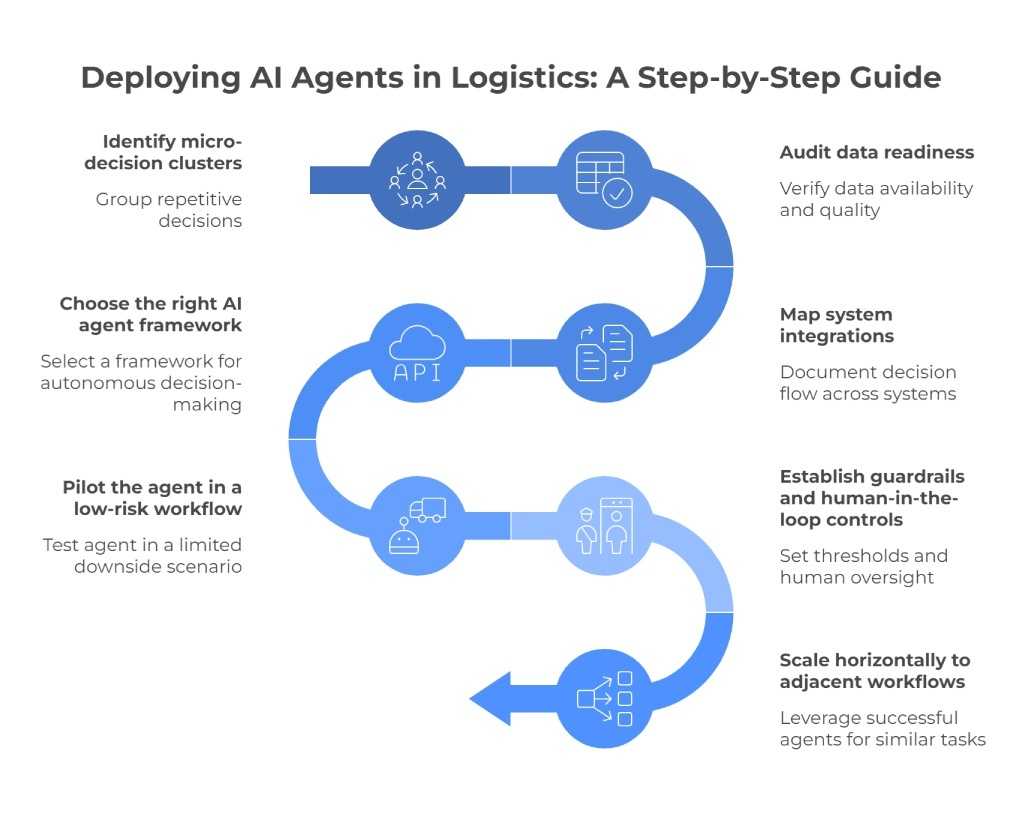
Key Steps to Deploy AI Agents in Logistics
- Identify micro-decision clusters: Start with grouping repetitive decisions. These could include carrier selection, order prioritization, or exception triage that occur frequently and follow clear rules.
- Audit data readiness: Verify data availability across systems before planning to assign decisions to AI agents. It is vital to also check for quality, latency, and ownership across systems.
- Map system integrations (ERP, WMS, TMS): Document how all decisions flow across enterprise systems and also observe and understand where agents will read data or execute actions.
- Choose the right AI agent framework: Understanding the environment and then selecting a framework that supports autonomous decision-making can help. When choosing, also ensure that it supports constraint-based logic and human escalation.
- Pilot the agent in a low-risk workflow: Look out for decisions that have a limited downside, and that’s a great place to start, and they can be decisions, such as customer notifications or shipment prioritization.
- Establish guardrails and human-in-the-loop controls: Next, we set up our thresholds, which include cost, level of service, and our risk.
- Scale horizontally to adjacent workflows: Leverage existing successful agents for similar choice spaces instead of prematurely making them overly complex.
AI Agent Readiness Checklist
Here is a checklist that can be very handy when looking at the AI agent readiness:
- Decision logic is repeatable and rule-bound
- Historical data is available and reliable
- ERP, WMS, or TMS APIs support read/write access
- Exception thresholds are clearly defined
- Human escalation paths are agreed upon
- Success metrics are measurable within 90 days
If more than two items are unclear, deployment should pause. Next, let’s look at a tabular representation of the integration complexity.
Table 2: Integration Complexity Table
| System | Typical Role | Integration Complexity | Common Risks |
|---|---|---|---|
| ERP | Orders, billing, master data | Medium | Data latency, rigid workflows |
| WMS | Inventory, picking, putaway | High | Real-time constraints, process variance |
| TMS | Routing, carrier selection | Medium–High | Optimization conflicts, SLA dependencies |
Key Takeaway:
The goal is not focused on perfect automation right from day one. The early wins bring trust and operational clarity, with momentum that will safely expand into the more complex logistics decisions.
Wrapping Up
If your logistics operations are slowed by routine micro-decisions, approving shipment reroutes, adjusting inventory levels, or resolving dock scheduling conflicts, agentic AI can eliminate those bottlenecks.
Start by identifying one high-frequency exception that doesn't require complex judgment but causes consistent delays waiting for human review.
Not sure which process to automate first? Our team at Imaginovation can help. Let's discuss.