



Get a personalized assessment of your operational efficiency and accelerate growth for your business.
AI in healthcare has moved past the pilot phase. Hospitals use machine learning for medical imaging and predictive analytics. Pharma companies use generative models to design drug candidates in months. Payers use natural language processing to automate claims and flag fraud.
The market reflects this. Fortune Business Insights values the global AI in healthcare market at $39.34 billion in 2025, projecting it to exceed $1 trillion by 2034.
The FDA has cleared over 1,451 AI-enabled medical devices, with 295 new authorizations in 2025 alone, a record.
Here’s what’s working, what’s changing, and where the real opportunities are for healthcare organizations.
AI and Its Increasing Presence in Healthcare
The healthcare landscape has enormous datasets, and AI can help unlock billions of data points.
AI in healthcare blends machine learning, deep learning, computer vision, and natural language processing to bring insights into pharmaceutical processes, diagnostics, and patient outcomes. Healthcare organizations can use these insights to modernize their ecosystems and create efficiencies that were previously impossible.
With significant success stories emerging across the industry, healthcare professionals should explore the full spectrum of AI solutions to make better-informed decisions and improve the quality of care.
Fortune Business Insights values the global AI in healthcare market at $39.34 billion in 2025, projecting $1.03 trillion by 2034 at a 43.96% CAGR. North America holds a 44.5% market share. However you slice the projections, we are looking at 15x to 25x growth within a decade.
On the adoption side, the numbers are equally striking. According to the Menlo Ventures 2025 State of AI in Healthcare Report, healthcare AI spending reached $1.4 billion in 2025, nearly tripling from the prior year.
Healthcare organizations are adopting AI at 2.2x the rate of the broader economy, with 22% of organizations now deploying domain-specific AI tools, a 7x increase over 2024.
Clinical decision support systems, healthcare data analytics, and AI-powered medical imaging and precision medicine platforms are driving much of this adoption.
Key Takeaway: The infrastructure race in healthcare AI is intensifying. In January 2026, OpenAI acquired healthcare startup Torch for roughly $100 million to build a “unified medical memory” into ChatGPT Health.
The same week, Anthropic launched Claude for Healthcare with HIPAA-ready products. Google DeepMind, NVIDIA, and Microsoft are all scaling healthcare-specific platforms.
Healthcare organizations that wait will find themselves buying commodity tools instead of building competitive advantages.
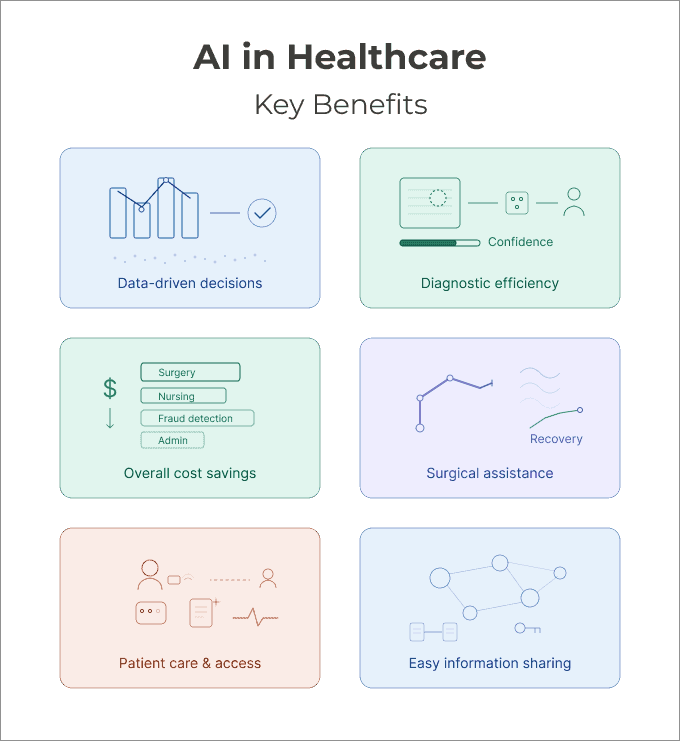
Key Benefits of AI in Healthcare
AI is poised to drive innovations and can be highly beneficial to both patients and healthcare organizations. Let’s look at how AI can help healthcare providers within their ecosystem.
1. Improved Data-Driven Decisions
Healthcare professionals have hectic schedules and need access to data that is extremely sensitive and important. Finding it manually is time-consuming.
AI-powered solutions collect documents from valid sources, analyze them, and make data accessible at a click. Cloud-based storage ensures better accessibility and security.
When diagnosing diseases, AI can interpret data much faster than humans. AI processes millions of data points, and the outcomes help healthcare providers make better decisions.
At scale, this is what healthcare data analytics looks like: AI-powered predictive analytics surfacing patterns across millions of patient records that no human team could process manually, feeding clinical decision support systems that guide treatment in real time.

2. Enhanced Diagnostic Process Efficiency
A lack of complete medical history can lead to large caseloads, inefficiency, and human errors in healthcare settings. AI-powered technology solutions can provide the most accurate diagnosis and efficient treatments.
Researchers at MIT CSAIL developed a machine learning system with a critical built-in capability: it knows when to defer to a human expert.
The algorithm evaluates its own confidence on each case and, when uncertain, routes the decision to a clinician rather than guessing. In experiments focused on cardiomegaly diagnosis, this human-AI hybrid model performed 8% better than either humans or AI working alone.
The practical takeaway: rather than forcing clinicians to review every AI output, the system self-selects only the cases where human judgment adds value, saving time without sacrificing accuracy.
In radiology, computer vision algorithms are now standard for detecting anomalies in CT scans, mammograms, and chest X-rays, the core of what the industry calls medical imaging AI.
3. Saves Overall Costs
According to the Menlo Ventures 2025 State of AI in Healthcare Report, U.S. healthcare organizations nearly tripled their AI spending to $1.4 billion in 2025, with the majority flowing into production deployments that deliver measurable operational savings.
The returns come from predictive analytics catching problems early, NLP-powered automation handling administrative workflows, and computer vision reducing the manual work of analyzing medical images for signs of disease.
AI-based tools and solutions continue to help save between 5% and 10% in U.S. healthcare spending through improved clinical operations, quality, and safety. Healthcare IT News projects cost savings from AI automation in key areas:
- Robot-assisted surgery: $40 billion
- Virtual nursing assistants: $20 billion
- Fraud detection: $17 billion
4. Assistance in Surgery
When it comes to preoperative and intraoperative planning, AI has a critical role to play. Surgical planning and navigation have improved significantly through the use of computed tomography (CT), ultrasound, and magnetic resonance imaging (MRI). When blended with robotic assistance, these solutions have decreased surgical trauma and improved patient recovery.
U.S. health systems are leading the adoption curve. In early 2026, the Cleveland Clinic became the first hospital in the country to perform a robotic-assisted prostatectomy using a newly FDA-cleared system.
The system features modular robotic arms and an open-console design that lets the surgeon maintain full situational awareness during the procedure. The hospital reported that its AI-assisted robotic systems, introduced in 2024 for cardiac and orthopedic surgeries, improved post-surgery recovery times by 35% and reduced complication rates by 22% within the first year.
Da Vinci by Intuitive Surgical (Sunnyvale, CA) remains the most widely adopted robotic surgery platform in U.S. hospitals, performing minimally invasive cardiac, urological, and gynecological procedures.
Mayo Clinic supports over 300 AI initiatives and has expanded robotic surgery programs across specialties.
5. Improved Patient Care and Expanded Care to Remote Areas
AI can significantly enhance the patient care journey in areas such as self-diagnosis, drug development, monitoring, and personalized health. Advanced chatbots can help emergency responders identify a heart attack in progress, and AI-based software platforms automate the healthcare industry’s most repetitive tasks.
AI also brings enormous opportunities for specialty care access in remote areas. Telemedicine solutions that are AI-enabled can overcome the shortage of healthcare providers and offer access to a wider community.

Two fast-growing categories stand out:
Ambient AI documentation: Systems like Microsoft’s Dragon Copilot listen to patient-provider conversations and auto-generate clinical notes using natural language processing. In March 2025, Kyndryl partnered with Microsoft to launch these solutions for healthcare settings.
Remote patient monitoring: Wearables and connected devices feed continuous data to machine learning models that flag deterioration before it becomes critical.
6. Easy Information Sharing
Another benefit of AI in healthcare is easy information sharing, which is critical for healthcare providers. Patient data management is a big challenge.
However, AI can help efficiently track patient data and elevate knowledge discovery. AI algorithms analyze massive data sets and offer easy access to information.
How Can AI Be Used in Healthcare?
AI has the potential to revolutionize healthcare by improving diagnostic accuracy, optimizing treatment plans, enhancing patient outcomes, and reducing costs. From identifying patterns in medical data to developing personalized treatments, AI can provide valuable insights and support to healthcare professionals.
1. Disease Prediction Using AI
The healthcare landscape contains valuable information that is very helpful in making predictive decisions, especially in medicine. Intelligent data mining methods blended with AI-based techniques are a powerful combination that can analyze massive datasets and give accurate results.
The insights and patterns help healthcare providers address diseases through early detection.
Deep learning is making great strides as a solution for complex problems that need human-like thinking, such as medical imaging and diagnosis. A good example is Ezra, which offers full-body MRI scans to support clinicians in the early detection of cancer.
AI-powered predictive analytics continues to improve diagnostic accuracy across specialties. These advances are accelerating the shift toward precision medicine, matching treatments to individual patient profiles based on biomarkers, genomics, and real-time monitoring data.
2. Personalized Medications and Patient Care
AI and big data are helping with high-throughput analysis of complex diseases. The solutions offer personalized treatment plans, which may include preventive care for diseases at higher risk of developing.
For example, increased screening for cancer in patients who possess BRCA 1 or BRCA 2 gene mutations.
AI generates insights from biomarkers and genetic information to predict how patients may respond to different treatment options. GNS Healthcare uses machine learning to match patients with treatments and make recommendations. Oncora Medical’s software learns and analyzes patient data to offer personalized treatment.

The field has accelerated significantly. Generative AI is now being used to create synthetic patient data for clinical trials, reducing recruitment timelines and costs. Companies like Syntegra and Huma combine real-world patient data with AI-generated insights to match patients with optimal treatment protocols.
The generative AI in healthcare market alone is projected to grow from $3.3 billion in 2025 to $39.8 billion by 2035.
Also Read: Generative AI in Healthcare: Use Cases & Real-World Examples
3. Real-Time Prioritization and Triage
Patient intake and triage can be an inefficient process and is an exciting area for AI. Prescriptive analytics on patient data aids in precision real-time case prioritization.
Jvion uses AI-enabled prescriptive analytics to recommend actions for patients while adhering to clinically validated best practices. Jvion’s solution blends clinical, socioeconomic, environmental, and behavioral data with sophisticated algorithms to identify unforeseen risks.
Enlitic offers patient triaging solutions deploying AI-enabled tools, unlocking the power of healthcare data for faster and more accurate prioritization.
Conversational AI is expanding rapidly in triage. The global conversational AI in healthcare market reached $18.83 billion in 2025 and is projected to hit $59.12 billion by 2030.
AI chatbots powered by natural language processing now automate patient intake, route emergencies, and reduce clinician burnout. Health systems like HCA Healthcare are among early partners deploying these AI healthcare workflows at enterprise scale.
4. Drug Discovery
It is an increasing trend for drug makers to turn to AI solutions such as deep learning for drug development and testing. AI-enabled solutions can address the challenge of processing large amounts of data, helping drug makers cut costs with higher research and development efficiency.
The defining milestone came in 2025. Insilico Medicine’s rentosertib (ISM001-055) became the first drug where both the target and the molecule were discovered entirely by AI.
Phase IIa results published in Nature Medicine showed the 60mg dose improved lung function by 98.4 mL versus a decline in the placebo.
The discovery cost was approximately $6 million. For context, the traditional path to the same milestone typically costs $100 to $200 million and takes 6 to 8 years. That is not a marginal efficiency gain; it is a fundamentally different cost structure for bringing drugs to patients.
The Recursion-Exscientia merger in 2024 combined high-throughput computer vision-based cellular imaging with automated machine learning-driven chemistry. Their NVIDIA-powered supercomputer, BioHive-2, is among the most powerful in biopharma.
An estimated 15 to 20 AI-originated drugs are expected to enter pivotal trials in 2026.
5. Optimized Standard of Treatment
Digitized medical records work brilliantly with AI solutions in optimizing the standard of treatment (ST). An ST guide extends a compiled list of best practices vetted by subject matter experts for medical care based on the patient’s symptoms and conditions.
Bayesian learning methods, a type of AI, can blend current patient medical records and treatment information to evolve an optimized standard of care. The optimized ST will continually learn from current treatment information and allow AI to learn and grow as new treatments are developed.
The integration with electronic health records (EHR) systems is what makes this scalable. When AI can read and learn from the structured and unstructured data in EHR platforms, the optimized standard of treatment updates itself continuously across an entire health system.
The FDA and AI in Healthcare Regulation
No conversation about AI in healthcare is complete without regulation. The FDA has been the global benchmark, and the pace has accelerated dramatically.
Through 2025, the FDA authorized 1,451 AI-enabled medical devices, with 295 new clearances in 2025 alone, a record. Radiology and medical imaging AI accounts for 76% of all devices, followed by cardiovascular and neurology applications.
Key regulatory milestones worth tracking:
- Predetermined Change Control Plans (PCCPs): The FDA’s 2025 guidance lets manufacturers ship iterative AI model updates without a new review, as long as changes stay within scope. Roughly 10% of 2025 clearances included PCCPs.
- Foundation models enter the clinic: Aidoc’s CARE1 received FDA clearance in February 2025 as the first foundation-model-powered clinical AI device.
- CPT 2026 codes: 288 new codes cover digital health and AI services, addressing a long-standing reimbursement barrier for AI-assisted clinical workflows.
- EU AI Act: High-risk obligations take effect in August 2026 to 2027, adding regulatory requirements for companies marketing AI medical devices globally.
At Imaginovation, we build for regulatory compliance from day one, including audit trails, model versioning, data provenance, and HIPAA-compliant architectures. It is significantly cheaper than retrofitting.
Future of AI in Healthcare
Agentic AI in Clinical Workflows
The next wave is AI that takes action, not just answers questions. Agentic AI systems coordinate multi-step clinical workflows: scheduling follow-ups, triggering lab orders, routing referrals, and managing prior authorizations.
OpenAI, Anthropic, and Google are all building health copilots that function as proactive clinical decision support assistants.
Ambient Clinical Intelligence
AI-powered ambient listening is automating clinical note-taking, one of healthcare’s biggest time sinks. Systems like Microsoft’s Dragon Copilot and Abridge use natural language processing to transcribe patient conversations, extract structured data, and generate documentation automatically.
Cedars-Sinai is testing Aiva Nurse Assistant for the same purpose.
AI Diagnostics Moving Beyond Radiology
While medical imaging AI still dominates FDA approvals, computer vision and machine learning are expanding into digital pathology, ophthalmology, and cardiology.
The FDA recently authorized an at-home blood pressure monitor that simultaneously detects atrial fibrillation using AI algorithms, a sign that AI diagnostics are moving closer to the patient.
Foundation Models and Healthcare LLMs
General-purpose foundation models are being fine-tuned for clinical use. Google’s Med-PaLM, NVIDIA’s BioNeMo, and Insilico’s Chemistry42 represent different approaches to AI in medicine: systems that understand biomedical language, molecular structures, and clinical reasoning natively.
Predictive and Preventive Care at Scale
Wearable devices, continuous glucose monitors, and remote patient monitoring platforms generate unprecedented volumes of data.
Predictive analytics powered by machine learning turns that data into actionable signals: flagging patients at risk of deterioration, personalizing medication dosing, and identifying population-level trends. This is where precision medicine and AI in healthcare converge.
Build an AI-Enabled Healthcare Application with Imaginovation
AI in healthcare is moving from pilots to production. Whether you are building ambient documentation, predictive analytics, patient engagement tools, or clinical decision support systems, we can help you go from concept to compliant production.
At Imaginovation, we bring deep experience in AI development, machine learning, custom healthcare software, and HIPAA-compliant architectures. We have helped healthcare organizations and health-tech businesses build futuristic digital solutions.