
Get a personalized assessment of your operational efficiency and accelerate growth for your business.
Companies struggle to prove AI value because they often track usage and time saved without connecting those gains to financial results.
Missing baselines, broken workflows, unreliable data, hidden costs, and low employee adoption make that harder.
To fix the AI ROI problem, start with one measurable use case, record performance before implementation, track the full cost, and show how the results reduce expenses or increase revenue.
AI spending is climbing, yet the promised business impact is still hard to see. BCG’s AI Radar 2026 says companies plan to nearly double AI spending, from 0.8% to 1.7% of revenue. For half of CEOs, getting AI right has never mattered more. But demonstrating its financial impact is another matter.
A promising demo can make an AI investment look like an easy decision. The harder part comes after the pilot: can your team use it to cut costs, improve output, or bring in more revenue?
To get those results, you need reliable data, clear processes, and people who actually use the tool. You also need to know what the work costs today and what AI will cost you over time.
AI ROI compares the business value you gain from an AI initiative with its total cost. But how do you measure that value, and how do you spot the costs that eat into your returns?
Start by checking five places where you may be losing value. Then use the examples and five-step plan below to measure what your AI investment delivers.
What Does the Research Say About AI ROI in 2026?
If you’re struggling to connect AI spending to business results, you’re not alone. The following studies show where companies report returns and where they still struggle to measure them.
What the research found (2025–2026)
| Source | Key Finding |
|---|---|
| MIT Project NANDA, The GenAI Divide (2025), covered by Virtualization Review | About 95% of generative AI pilots showed no measurable P&L impact. |
| IBM CEO Study (2025; 2,000 CEOs) | Only 25% of AI initiatives delivered the expected ROI; just 16% scaled enterprise-wide. |
| McKinsey, The State of AI (2025) | About 39% reported an enterprise-level EBIT impact from AI, mostly below 5%. |
| Deloitte, State of AI in the Enterprise (October 2026; 3,500 business leaders) | Reported revenue gains reached 28%, but only 44% tracked per-unit inference costs, and 51% tracked token volume. |
| Gartner’s 2025 prediction | Gartner predicted that organizations would cancel over 40% of agentic AI projects by the end of 2027 due to costs, unclear value, or weak risk controls. |
You can’t compare these figures directly. Each study measures something different, from cost savings and productivity to revenue growth.
For your own project, you need to track both the value AI creates and the full cost of running it. If you only measure one, you can’t tell whether your investment is paying off. Now let’s look at what really affects the AI ROI.
Where AI ROI Disappears: 5 Common Leaks
You might have a decently working AI-driven platform and still struggle to show a return. If so, you gotta check these five areas to find what’s getting in the way.
1. No Baseline, So Nothing to Prove
You’ve probably heard the pitch: big annual savings, hours cut from every workday, or a 30% productivity lift. However, before you consider those KPI projections, measure how your team handles the work today.
When Andrew Cherry, COO of Movement for Life, joined us on Tales from the PROS, he described how those promises can fall short: “…we’re going to save you $100,000 a year, or we’re going to save you two hours a day… And then at the end of the year, you’re like, well, that didn’t make me $100,000. It didn’t save me two hours a day.”
Often, the real business outcomes are far from the shiny pitches.
Tim Condon, CRO of Clutch, shared a useful reminder in our conversation about B2B buying: agree upfront on which data matters and what the thresholds are, before you see the results. Otherwise, people tend to find data that supports their opinion.
The fix: Measure your current process before you introduce AI, and agree on success metrics in writing. You need that baseline to show what improved. Also, make sure tracking and data measurement are properly set up before you start the AI initiative.
2. AI on Top of Broken Processes and Messy Data
AI can fast-track your processes and data, but that doesn’t automatically make them better. If the underlying process is inefficient or the data is unreliable, AI simply makes the problem bigger.
In our conversation about using AI in your operations, Imaginovation’s co-founder, Pete Peranzo, asked a question you should answer before you automate:
“Is the process you’re automating correct?”
He adds an analogy he heard recently: you don’t put nitrous oxide in a Ford Pinto.
The underlying system has to be ready first.
Matt Soltau of IntelliPaaS put it bluntly when he joined us to discuss why AI projects fail to scale:
“The AI graveyard is ultimately full of projects that actually didn’t fail at the model, but failed at the pipe that feeds it.”
He shared an example of an insurance company that built an AI assistant to guide call-center agents in real time. It worked in the sandbox, then failed in production because the production data was not clean; some data was duplicated and untraced.
His diagnosis is simple: count the manual spreadsheets your team uses to bridge systems that should be talking to each other.
The fix: Fix your process, clean up your data, and connect your systems before you introduce AI.
If your team keeps moving data between spreadsheets and disconnected tools, start by bringing that data together.
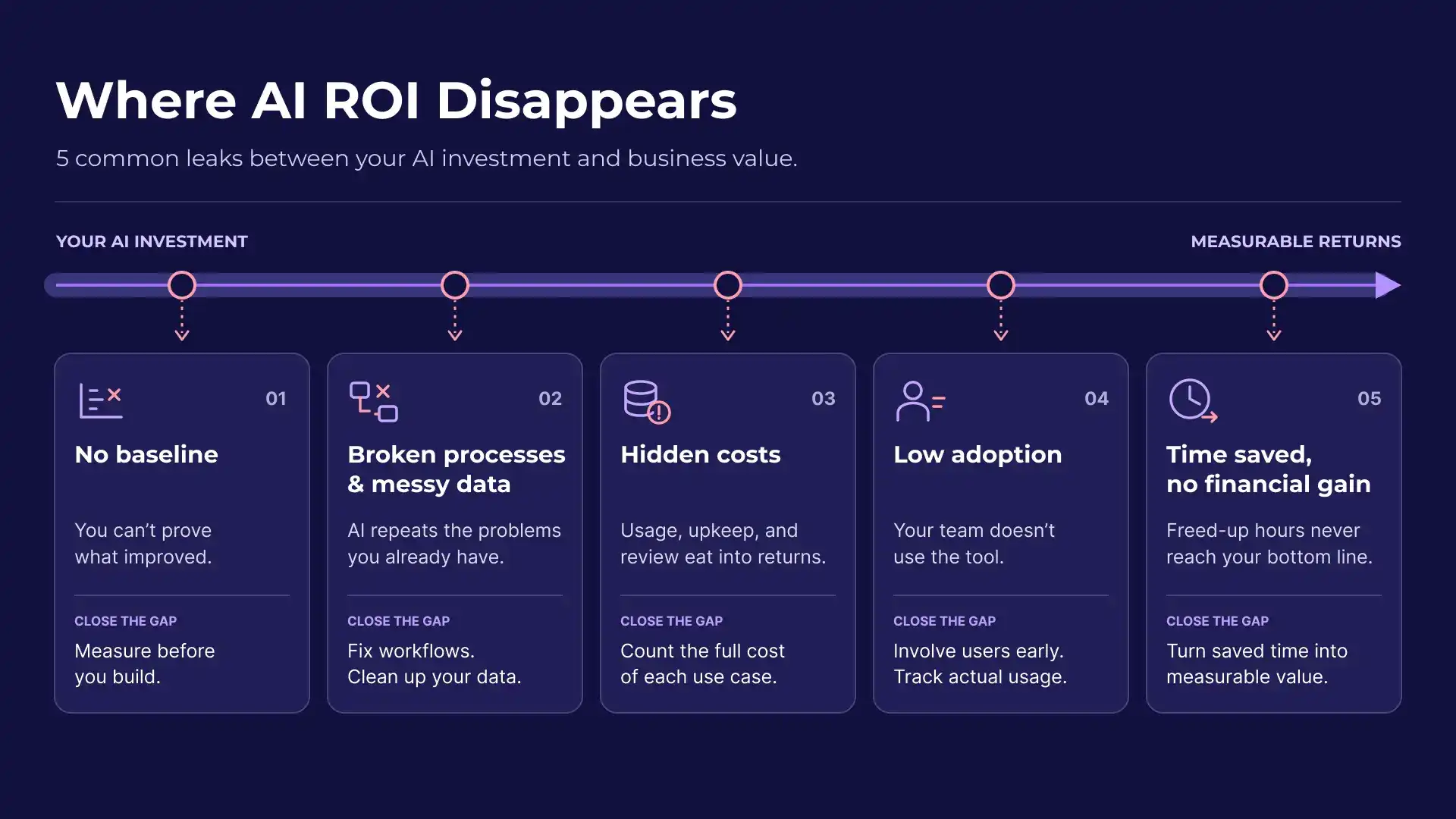
3. Hidden Costs Nobody Included in the Business Case
You may have budgeted for software licenses and development. Did you also include token usage, inference costs, integrations, maintenance, and the time your team spends checking and correcting AI outputs?
Deloitte's October 2026 findings indicate that only 44% of organizations track per-unit inference costs.
Jim Ferry, Partner at Volition Capital, told us how AI is changing spending across his portfolio in our conversation about AI and tech investing.
Companies are keeping R&D team sizes flat while increasing output, and he notes that “you might even be spending a little bit more on R&D because now it’s usage-based and token-based.”
The savings show up elsewhere, in G&A, sales and marketing, and customer support. AI moves costs between budget lines, so measure its impact across all of them.
Gal Vered, CEO of Checksum AI, told us in our conversation about AI-assisted coding that he writes nearly all his code with Claude Code.
Even so, he still sees AI produce what he calls “20, 30, 50% slop code.”
People need to catch and fix the errors, and the damage compounds because the AI repeats bad patterns it finds in the codebase. If your team spends hours fixing what AI produces, include those hours in your costs.
The fix: Calculate the full cost of each AI use case. Include tokens, integrations, maintenance, and the time your team spends reviewing outputs.
If usage charges keep climbing, compare the costs of an AI API and a custom LLM.
4. People Don't Actually Use It
Even a technically excellent AI tool won’t help your business if your team doesn’t use it.
Involve the people who will use the tool before you choose or build it. Find out how they work and what would make their jobs easier.
When Cesar Viana Teague of NextLevel Consulting joined us to talk about leading change, he explained that roughly 70% of change initiatives don’t succeed because people aren’t bought in. He recommends inviting employees to co-design the change rather than simply announcing it.
The fix: Bring your end users into the project early and track how often they use the tool. If usage stays low, find out what’s stopping them before you expand the rollout.
5. Time Saved Never Reaches the P&L
If AI saves your team 200 hours a month, where does that time go?
If your team fills those hours with low-value work, or leaves the extra capacity unused, you may never see a financial return.
Time saved isn’t the same as money saved. Productivity gains turn into business value only when you put that freed-up capacity to work.
The fix: Decide upfront how you’ll use the time you save. Will you cut overtime, avoid a new hire, eliminate vendor costs, or bring in more revenue? Track that financial impact alongside the hours saved.
Before you accept a vendor’s savings forecast, check for promises they may struggle to deliver.
How to Calculate AI ROI
To calculate AI ROI, subtract your total costs from the value you gain, then divide the result by those costs. Use the same time period for both.
AI ROI = (Measured Value − Total Cost of Ownership) ÷ Total Cost of Ownership
| Value | Total cost |
|---|---|
| Labor hours saved × fully loaded hourly cost | Build or license |
| Fewer errors and less rework | Integration and data work |
| Vendor spend eliminated | Inference and token costs |
| New revenue attributable to AI | Testing and review |
| Training | |
| Ongoing maintenance |
What Would This Look Like for Your Team?
Our Director of Growth, Eric Lawrence, shared in our conversation about software automation that when clients reach out about automation, the problem often affects “at least five to 10 employees.” The case comes down to simple math: “If we could save our employees this amount of hours per week and we’re paying them this much, we know that we can get a return after a year or so.”
Suppose eight people on your team each save six hours a week. Using hypothetical costs, here’s how you would calculate the return:
- Value: 8 employees × 6 hours/week × $45 fully loaded cost × 48 weeks = $103,680 a year
- Hypothetical first-year total cost: $60,000
- ROI: ($103,680 − $60,000) ÷ $60,000 = 73%
- Payback: about $8,640 of value per month, so the investment pays for itself in month 7
Remember: those hours only count as value if you put them to work, such as cutting overtime or avoiding a hire. Hours saved that go unused don’t show up in the numbers.
How fast will it pay back?
Eric’s “year or so” applies to small, well-defined projects. Deloitte found that most respondents achieved satisfactory ROI on a typical AI use case within two to four years. The difference is scope: small, internal projects pay back faster than big transformation bets. Start with a process you can clearly define and measure. Record how long the work takes before you change it.
If AI is part of a larger technology project, measure the return across your digital transformation.
Where AI ROI Is Actually Showing Up
To choose a useful AI project, focus on a specific job and a measurable result. These examples from our conversations on Tales from the PROS give you a few ways to think about value:
Time back for frontline staff. Andrew Cherry also describes a tool that delivered on its promise. It is “literally saving, I would say, an hour to two hours a day of our providers’ time.” The difference is a specific role and a measurable benefit.
Speed over headcount. One large Checksum AI customer moved all 40 of its QA automation engineers into software engineering roles. Gal Vered says the savings weren’t the point: “the benefit is not the cost savings, it’s just the ability to ship much faster and delight your customers.”
Replacing software spend selectively. Jim Ferry says one portfolio company “eliminated almost a million dollars in spend” by building some vendor tools in-house. Others ran the same analysis and decided a tool costing “only five grand a year” was “not worth our time to maintain.”
Faster internal builds. Pete Peranzo says his team can now get an MVP out in eight hours, work that used to take a month. He also describes non-engineers building internal tools in about an hour, work that once took developers a couple of weeks.
Before you choose a project, check whether your business is ready for automation.
How to Prove AI ROI: A Simple 5-Step Playbook
Give your team clear targets, reliable data, and a regular schedule for reviewing results. Follow these five steps to track whether your AI investment earns its keep:
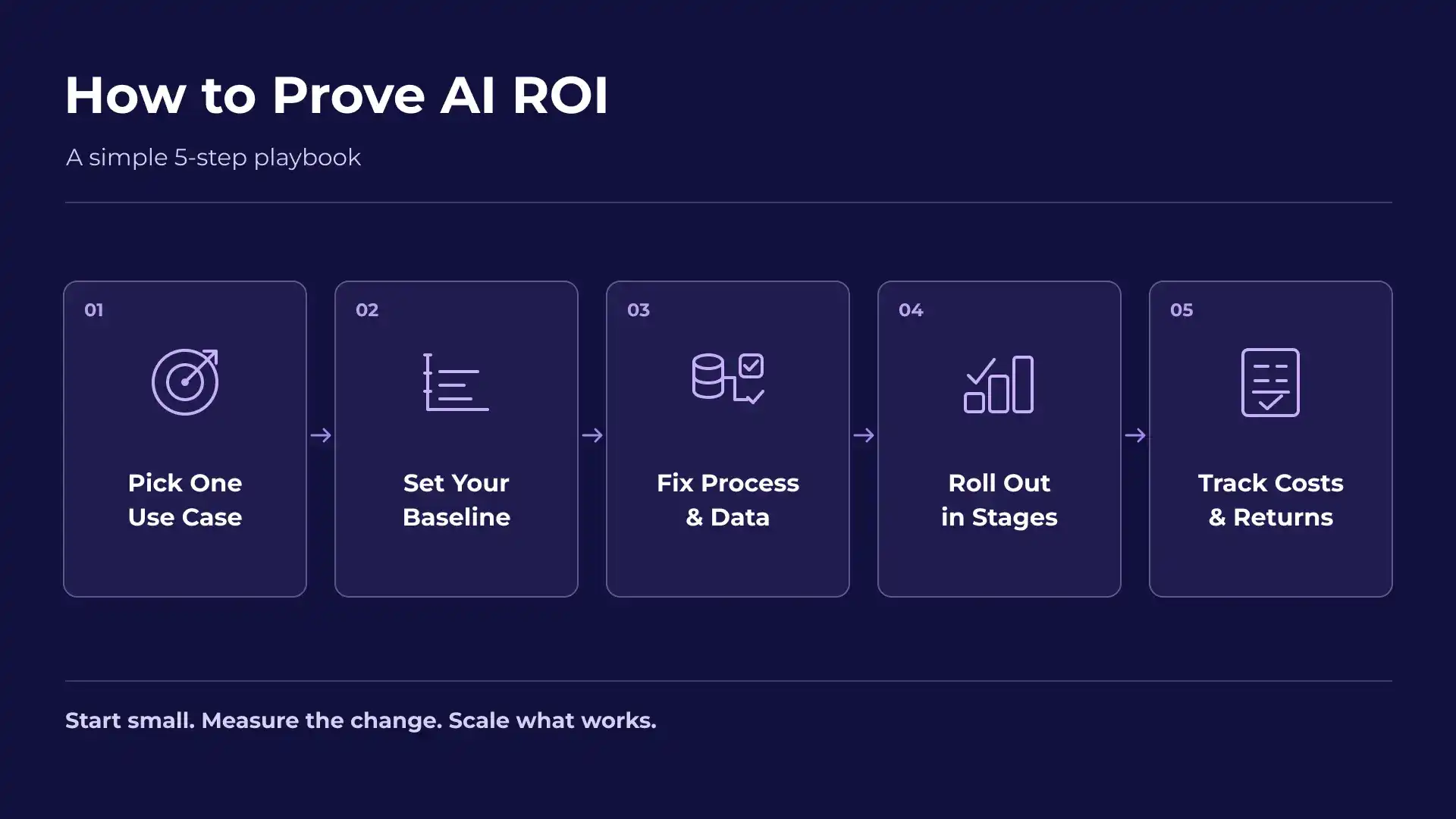
- Pick one narrow use case. Choose a single process with a clear owner and a metric you can measure.
- Baseline first. Measure current performance for 2-4 weeks before you build anything. Without a “before” number, you can’t prove an “after.”
- Fix the process and data, then add AI. AI amplifies what’s already there, so a broken workflow or messy data will undercut your results. Cleaning those up first is often where the earliest gains come from.
- Roll out in stages. Matt Soltau puts it this way: “…AI is no different than training your puppy.” Start at home, then move to the park, not straight onto a world trip. Eric Lawrence recommends a phased pilot for the same reason: you catch problems while they’re small and cheap.
- Track full cost and report in dollars. Include licenses, integration, training, and staff time. Report value in dollars to leadership every quarter, and scale only what clears the bar.
Ready to move beyond your pilot? See how to bring AI into production and avoid common scaling mistakes.
Turning Your AI Investment Into Measurable Value
To judge whether AI is worth the investment, measure where you started, count all your costs, and track what changes. Fix the process and data problems that hold your team back, then check whether the improvements show up in your business results.
Use those results to decide what to improve, what to expand, and what to stop.
Want to see where your business stands?
- Take our free AI readiness assessment.
- Need help getting more value from AI? Contact our team.