





To estimate the cost of building a website or an app, use our app cost calculator tool.

Building an MVP fast without creating technical debt is not about cutting corners. It is about making the right decisions early, so speed does not come back to haunt you later.
You see, an MVP is the smallest, leanest version of a product that delivers real user value and produces meaningful learning.
Many teams build MVPs only to launch. But a scalable MVP is built to evolve and support change without major rewrites.
This is where technical debt shows up. Technical debt refers to the hidden cost of early compromises that slow development, weaken reliability, and make future changes harder.
It often starts with good intentions, but it compounds when speed is prioritized without a clear technical foundation.
The common myth is that speed and quality are tradeoffs. In practice, teams move faster over time when they are intentional about what can wait and what must be done right from the start.
So, let’s take a look at how to build an MVP quickly while keeping the foundation strong enough to scale.
Why Does Speed Matter in MVP Development?
Speed matters in MVP development because it creates early learning and a competitive advantage.
Startups that build MVPs fast can test assumptions sooner, gain market feedback earlier, and build momentum before competitors ship.
That early momentum matters. Teams that move quickly learn what works while others are still planning. Those insights shape better product decisions and often help attract user interest and investor confidence.
However, speed without structure comes at a price.
Rushed MVPs often struggle as they scale. Teams are forced to rewrite core features, patch fragile systems, or slow development just to keep the product running.
This is where founders often get it wrong. The goal is not to eliminate technical debt entirely. That is unrealistic when building an MVP quickly.
The real goal is to avoid compounding technical debt by taking on only controlled debt with a clear plan to address it.
💡 Bottom line:
Speed wins only when it is paired with intent. Build fast to learn and gain momentum, but design enough structure so today’s shortcuts do not become tomorrow’s growth blockers.
Step-by-Step Process to Build an MVP Fast Without Technical Debt
To build an MVP without technical debt, you need to validate the problem first.
Each step that follows is designed to protect speed while preventing shortcuts that compound into long-term technical issues.
1. Validate the Problem Before Writing Code
Validation saves time because it prevents teams from building the wrong product.
Before starting MVP development, founders must confirm that a real problem exists and that users care enough to pay for a solution.
Early validation allows teams to learn without writing production code.
Lean experiments, surveys, clickable prototypes, and landing pages make it possible to test demand quickly and discard weak ideas early.
This reduces wasted effort and prevents technical debt caused by building features that later need to be removed or rewritten.
In our work at Imaginovation, we repeatedly see founders rush into development before validating the problem.
This mistake shows up in predictable ways:
- Teams skip hypothesis testing and move straight to implementation
- Founders avoid direct pricing conversations with potential customers
- Features are prioritized based on internal assumptions rather than user evidence
We experienced this firsthand while building MagicTask. The product attracted early users, but converting them into paying customers proved difficult.
The lesson was clear: validation must happen before development, not after a product is already live.
2. Define the MVP Scope
An MVP is not a smaller version of the final product. It is the sharpest version of the idea.
Founders should focus on solving one core problem through one clear user journey.
Outcome-based prioritization frameworks such as MoSCoW or Kano can help identify which features truly matter.
Every additional feature increases future complexity and maintenance cost. Disciplined scope control is essential when building an MVP quickly.
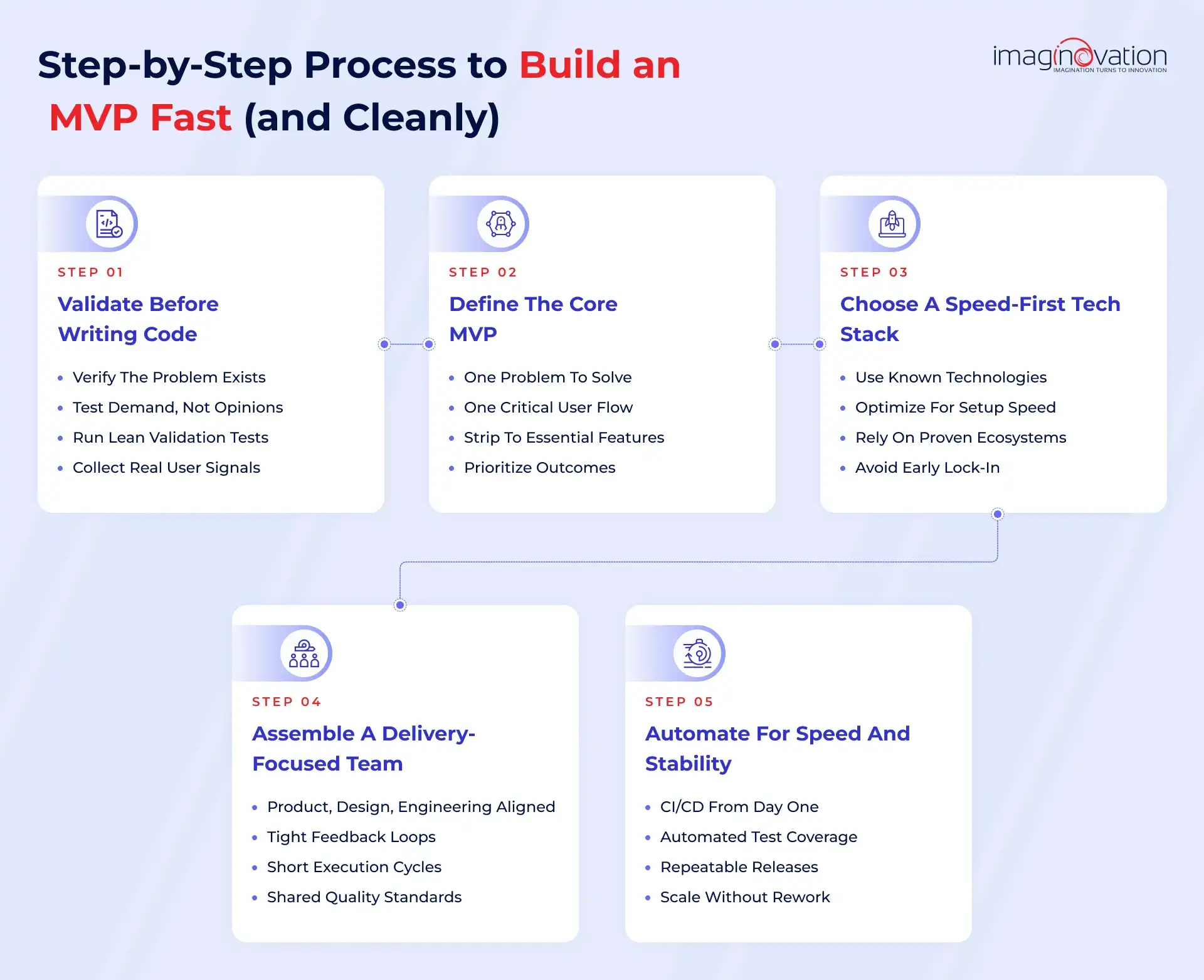
3. Choose a Lean and Proven Tech Stack
Speed comes from familiarity, not novelty. Teams move faster when they use technologies they already understand and that have strong community support.
Using familiar stacks such as React with Node.js, Flutter for cross-platform development, or Laravel for backend services helps teams move quickly and avoid surprises.
At the same time, locking into rigid technologies or infrastructure too early should be avoided, as it increases long-term maintenance costs and reduces flexibility.
4. Build a Small, Aligned Team
Fast MVPs are built by teams that collaborate early and often.
When designers, developers, and product managers work together from the beginning, teams reduce misalignment and rework.
Short development sprints create rapid feedback loops. A clear definition of done, including testing and documentation, helps maintain quality while moving quickly.
This alignment allows teams to build fast without sacrificing stability.
5. Automate Early to Protect Speed
Automation is not a nice-to-have. It is a growth enabler.
Basic CI/CD pipelines and unit and integration testing should be implemented from the start.
Founders should always ask their development partner, “What’s our release process?” If the answer is manual, technical debt is already forming.
A few hours invested in automation early can save weeks of firefighting after launch. Automation ensures that speed does not turn into chaos as the product grows.
💡 Key Takeaway:
You can build an MVP fast and avoid technical debt when speed is intentional, focused, and supported by smart early decisions. Validation, scope discipline, proven technology, team alignment, and automation work together to protect long-term momentum.
Common Mistakes That Slow You Down Later
Most speed-related problems are created early, not later. I see teams lose momentum because of a few avoidable decisions made during MVP development, often in the name of moving fast.
1. Overengineering Before Learning Begins
Overengineering slows teams before real learning starts. I’ve seen founders spend weeks perfecting architecture, scalability, or edge cases that haven’t been validated. That effort delays feedback and locks teams into assumptions that may be wrong.
Instead of learning from users, teams optimize for hypothetical future needs and lose the speed an MVP is meant to provide.
2. Underengineering Core Systems
Underengineering creates the opposite problem. Hacky code, minimal structure, and rushed fixes may help a team ship quickly, but they break down as soon as usage grows.
When the foundation is weak, teams are forced into expensive rewrites just to keep the product stable. Any early speed gains disappear fast.
3. Ignoring Documentation
Ignoring documentation is a silent speed killer. Speed without shared context does not scale.
When decisions are not documented, the reasoning behind trade-offs, assumptions, and shortcuts disappears. As developers leave or new ones join, onboarding slows down, changes become risky, and progress stalls while teams reverse-engineer intent.
What once felt fast quickly becomes fragile.
4. Failing to Track and Evaluate Technical Debt
Technical debt itself is not the problem. Untracked and unevaluated technical debt is.
Every shortcut taken during MVP development should be visible and intentional. But visibility alone is not enough. The real question is whether that debt is acceptable in the short term.
When I evaluate technical debt during early development, I look at several factors at the same time:
- Usage frequency: Low-traffic features can reasonably remain imperfect. In MagicTask v2, we intentionally deprioritized known template bugs because usage was minimal and a full application refactor was already planned.
- Available resources: Budget, timelines, and team capacity shape what can be addressed immediately versus what must wait. Not every issue is worth fixing early if it threatens momentum.
- Customer impact: Usage data alone does not tell the full story. When a key customer identifies a buggy feature as business-critical, that debt needs immediate attention, regardless of overall adoption metrics.
- Data-driven judgment: I rely on all available information before making prioritization calls. That means gathering the data, evaluating trade-offs, and making a deliberate decision using whatever analysis tools are available.
Teams get into trouble when these decisions are implicit instead of intentional. When debt is not tracked and evaluated this way, it compounds quietly and slows every release.
Table 1: Quick Summary of Mistakes and Fixes
| Mistake | Why It Hurts | Fix |
|---|---|---|
| Too many features | Delays learning | Trim to core use case |
| No documentation | Onboarding chaos | Keep a simple decision log |
💡 Bottom line:
Speed without awareness creates drag. Teams that move fastest long-term are the ones that track trade-offs, document intent, and stay ruthlessly focused on what actually matters.
How Do We Manage Technical Debt After Launch?
Technical debt after launch is inevitable. The goal is not a pristine codebase. The goal is to maintain shipping velocity as the product scales.
Technical debt becomes a problem only when it starts slowing teams down or blocking growth.
Post-launch, we focus less on eliminating debt and more on managing it deliberately. That starts with knowing which debt actually matters.
1. Triage Debt Based on What Slows You Down
Not all technical debt deserves immediate attention. We start by evaluating whether a piece of debt affects any of the following:
- User experience
Are users encountering errors, bugs, or reliability issues? - Team velocity
Are deploys slowing down? Are engineers building workarounds around fragile code? - System reliability
Are failures becoming more frequent or harder to diagnose?
If debt impacts any of these areas, it needs attention. If it does not, it may be safe to defer.
2. Use the Interest vs. Impact Filter
To prioritize effectively, we evaluate technical debt through two lenses:
- Interest
This is the ongoing cost of leaving the debt in place. We look for signs such as repeated QA cycles, recurring support tickets, brittle areas touched in most pull requests, or new features that require workarounds. - Impact
We ask what happens if the debt is ignored. Does it block the roadmap? Increase outage risk? Make onboarding new engineers painful?
High-interest, high-impact debt gets prioritized.
Low-interest, low-impact debt gets documented and ignored. Some debt simply is not worth paying down.
3. Prevent Debt from Compounding Through Routine Maintenance
Technical debt becomes dangerous when teams only address it during emergencies.
To avoid this, we recommend reserving 10–20% of each sprint for refactoring, test coverage, and documentation. This is not slowing down to clean up. It is an investment in sustained speed.
Teams that skip this discipline often hit periodic crises where velocity collapses, and everything stops for emergency refactors.
We also track leading indicators that surface debt early, including:
- Deployment frequency
- Pull request review time
- Bug recurrence rates
These metrics reveal friction long before it becomes critical.
4. Frame Technical Debt as Business Risk, Not Engineering Preference
When advocating for debt work, we translate technical issues into business impact.
Saying, “This refactor can reduce our release cycle from five days to two,” resonates more than saying, “We need to modularize the authentication layer.”
Stakeholders care about outcomes such as customer experience, time-to-market, and operational cost.
When debt is framed this way, alignment comes faster.
Practices We Use to Keep Technical Debt Under Control
Over time, we’ve seen a small set of practices consistently help teams move fast without letting technical debt spiral:
- Continuous deployment and daily builds
Frequent releases encourage a shift from “perfect later” to “working now.”
Teams ship smaller, higher-quality increments, reducing risk while maintaining momentum. Quality is not sacrificed. It is enforced at every release.
- Rigorous code reviews with clear ownership
Experienced engineers review pull requests before merging and act as quality gatekeepers. As teams grow, this oversight must scale.
A practical rule of thumb is one strong reviewer for every five engineers.
- Clear standards and living documentation
Engineers cannot meet expectations that are not visible. Clear coding standards, core documentation, and reference templates remove ambiguity and reduce rework later.
- Hiring engineers who care about craft
The strongest defense against technical debt is mindset. Engineers who take pride in their work naturally resist sloppy shortcuts.
When quality is a habit, it does not need to be enforced.
Bottom Line:
When managed deliberately, technical debt becomes a strategic tool rather than a burden. Teams ship faster, maintain flexibility, and demonstrate execution maturity.
Experienced investors and operators recognize the difference between moving fast and building fragile systems.
What Tools and Practices Help You Build an MVP Faster?
Speed in MVP development does not come from cutting corners. It comes from choosing tools and practices that reduce friction while preserving clarity and future flexibility.
The right tools help teams validate ideas faster, ship reliably, and avoid creating unnecessary technical debt.
Below are practical, founder-friendly tools and practices we see consistently accelerate MVP development when used with clear scope and discipline.
1. No-Code and Low-Code Tools for Rapid Validation
No-code and low-code platforms are most effective when the goal is learning, not long-term scale. They allow teams to test assumptions, observe real user behavior, and validate demand before committing to full engineering builds.
- Bubble
Build functional workflows and test real user behavior without writing production code. - Webflow
Ship polished frontends quickly without engineering overhead.
Best used for: early validation, landing pages, internal tools, and proving demand before investing in custom development.
2. Automation and CI/CD for Clean Velocity
Automation protects speed after launch. Even basic CI/CD prevents fragile releases and reduces the risk of compounding technical debt.
- GitHub Actions
Automate testing, builds, and deployments from day one. - Bitrise
Mobile-focused CI/CD that eliminates “it works on my machine” issues.
Small investments in automation early save weeks of manual fixes and firefighting later.
3. Collaboration and Async Tools for Clarity at Speed
Fast teams depend on clear ownership and visibility into work. Async tools help reduce coordination overhead and keep execution moving without constant meetings.
- Linear
Lightweight issue tracking without enterprise bloat. - MagicTask
Helps teams organize, prioritize, and track tasks so execution stays clear as work scales. - Loom
Async video walkthroughs for demos, reviews, and feedback.
These tools support faster execution by improving visibility and reducing friction in day-to-day collaboration.
Bottom Line:
The right tools create speed with clarity. Tools alone do not prevent technical debt. Without clear scope, documentation, and decision logs, moving fast simply creates problems later.
A strong MVP leaves behind understandable systems, not mysteries to debug six months down the line.
MVP Development - Build Fast, but Build for Growth
Building an MVP fast only works if the product can continue to move after launch.
Sustainable speed comes from intentional architecture, disciplined execution, and decisions that hold up as complexity increases.
At Imaginovation, we help founders move from early validation to production-ready MVPs without shortcuts that create long-term drag. Our focus is simple: ship quickly, keep systems clean, and protect momentum as products scale.
If you’re moving fast today but unsure what that speed will cost you tomorrow, it may be worth taking a closer look at how your MVP is being built.
Next: Feeling Stuck After an MVP Launch? Why You Need a Stronger Dev Team to Scale