




To estimate the cost of building a website or an app, use our app cost calculator tool.

Most enterprise organizations already run a mature, often custom-built document management system. What is becoming harder to manage is not storage itself, but the growing effort required to find, classify, govern, and act on documents at scale.
As volumes increase and regulatory expectations rise, even well-structured DMS platforms can place a heavy operational load on teams.
Integrating AI into an existing DMS offers a practical way to ease that pressure.
Applied thoughtfully, AI can enhance search accuracy, automate classification, minimize manual intervention, and facilitate stronger compliance without disrupting established systems.
This guide looks at how enterprises can integrate AI into their document management systems in a way that is controlled, secure, and aligned with real operational needs.
Benefits of Integrating AI into Document Management Systems
Integrating AI into document management systems delivers concrete tangibles and does not give vague technology promises.
At its core, AI in a document management system can enhance speed and enable smarter information handling.
1. Smart Document Classification
AI-driven classification can get rid of manual tagging and switch to automated content-based sorting.
With NLP (Natural Language Processing) and ML (machine learning) algorithms, it is easy to recognize patterns, generate accurate metadata, and group documents by intent.
This means there are reduced errors, and users can enjoy faster retrieval across the entire AI-powered document management system.
2. Intelligent Search and Retrieval
With NLP and semantic search, AI document management can facilitate faster and more precise search results because it understands context, intent, and relationships between documents.
This helps your searches get dramatically faster, especially in complex enterprise environments.
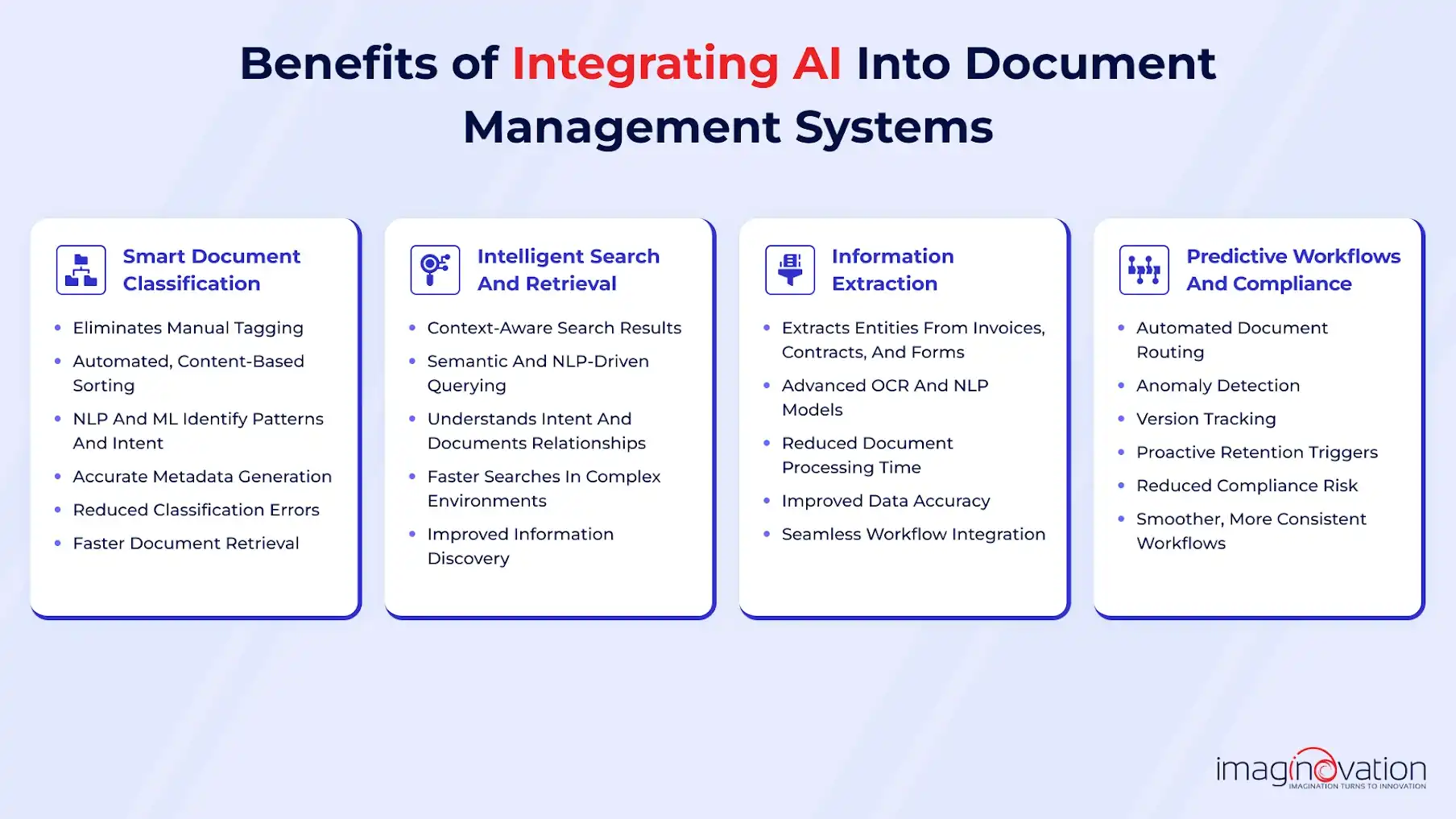
3. Information Extraction
Extracting key entities from invoices, contracts, and forms is a cakewalk with advanced OCR and NLP models.
The feature helps reduce processing time. Moreover, it improves data accuracy and supports seamless AI integration in DMS workflows.
4. Predictive Workflows and Compliance
AI automates routing and can flag anomalies, track versions, and also activate retention triggers before issues arise.
For organizations exploring how to integrate AI into DMS, predictive intelligence ensures smoother workflows, reduced risk, and consistent regulatory compliance.
✒️ With several benefits, there are still challenges, and Pete Peranzo, Co-founder of Imaginovation, highlights:
“One of the main challenges is the presence of legacy applications within large enterprise systems, which can complicate integration efforts.”
He notes that many enterprises have outdated or incompatible systems that make it difficult to seamlessly incorporate new AI solutions.
Additionally, complex and inefficient processes, along with a lack of proper documentation or understanding of existing workflows, further delay AI integration.
Together, these factors create significant technical and organizational hurdles when embedding AI into existing document management systems.
How to Integrate AI into Your Existing Document Management System
Modernizing a Document Management System (DMS) with artificial intelligence (AI) is an interesting use case in which you don't replace what already works, but instead elevate functionality and experience.
Enterprises have years of rich data in terms of documents and workflows or even institutional knowledge, but most of this intelligence remains trapped in static repositories.
With an AI-enabled DMS, meaning a platform for storing, tracking, and managing documents, one can unlock this value and make content more searchable and action-ready.
The journey needs a great blend of both technical depth and strategic clarity.
Step 1: Assess Current DMS Maturity and Architecture
A great place to start is to understand your existing system. Try to understand things around how information flows, and then get your team to brainstorm and pinpoint where AI can add the greatest value, which could range from indexing to search, tagging, or document automation.
✒️ In this context, Pete reiterates that organizations should first ensure their processes are well documented and verified for correctness before integrating AI.
This may involve reviewing and, where necessary, updating existing processes to ensure they are suitable for AI implementation.
Additionally, the document management system should be prepared with clean, organized data and a clear understanding of the problems to be addressed, creating a strong foundation for successful AI integration.
Step 2: Build an AI Layer Instead of Rebuilding the System
Next, plan to modernize by integrating AI through APIs or microservices while retaining your core platform.
In this context, one can consider using vector databases and embedding-based search, which can help with semantic discovery.
The step is useful for users to find relevant information more easily and act on it quickly, without disrupting legacy systems.
Step 3: Select the Right AI Models and Frameworks
It is vital to have the right AI models and frameworks in place; therefore, choosing them based on the problem can help.
For instance, choose NLP for text understanding or OCR for scanned documents. You can choose ML for metadata prediction and classification, and RAG for high-accuracy retrieval.
Step 4: Ensure Security, Compliance, and Governance
When modernizing, one must plan to keep sensitive data inside private environments.
Yet another aspect is to ensure that there are strict access controls and to maintain full auditability across AI-driven decisions, such that they meet enterprise governance standards.
Step 5: Pilot, Measure, and Scale
You can begin with one high-impact use case.
Let's say, contract search or maybe automated classification, which helps prove its value with measurable metrics, and then expand AI capabilities confidently across the enterprise.
Pete emphasizes that organizations should focus on areas where AI can significantly enhance efficiency and security, such as automating document creation, standardizing file names, and preventing issues like duplication and race conditions.
By targeting these practical applications, companies can achieve measurable ROI and improve the overall document management process.
💡 Key Takeaway:
Ultimately, integrating AI into your existing DMS isn’t about rebuilding; it’s about unlocking the hidden intelligence in your documents to make your entire system smarter and enterprise-ready.
Key Considerations Before Implementing AI in a Custom DMS
It's a great start that you want to embed AI into the existing Document Management System.
To ensure that the foundation is ready, one must make sure that the data, systems, and workflows are aligned.
They work as practical checkpoints that can ensure that the AI layer enhances rather than disrupts existing operations.
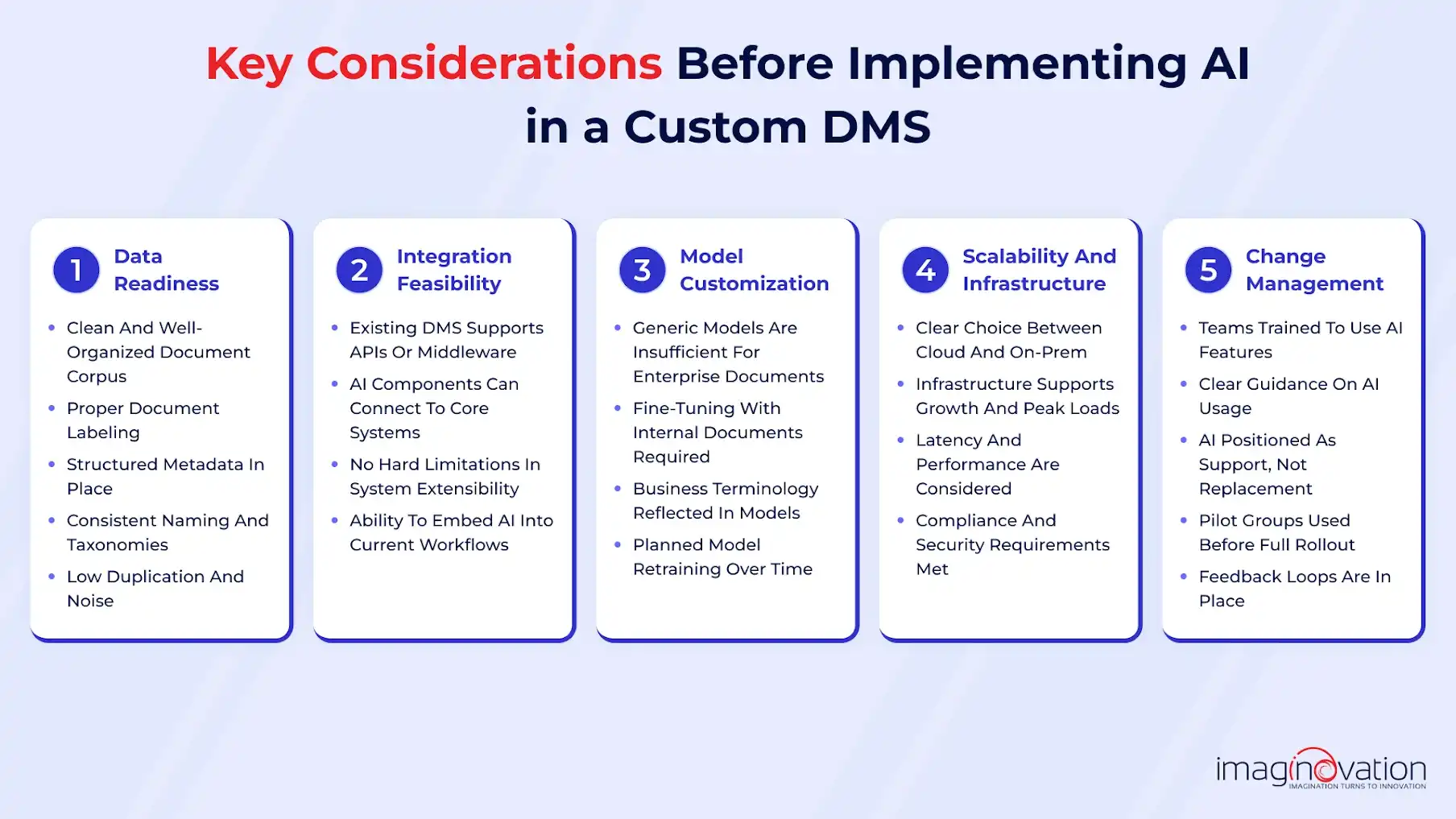
1. Data Readiness
AI needs strong inputs of data because it can learn from them. Therefore, the document corpus must be clean, and one must take care to properly label it.
Moreover, it should be easy to retrieve and be free from duplication or noise. When the metadata is structured and there are consistent taxonomies, the model accuracy is better, and the post-processing burden is reduced.
2. Integration Feasibility
Yet another aspect is to ensure that your DMS is capable of “talking” to AI components.
Whether through APIs or middleware, it is the integration pathway that determines how well AI functions can be embedded into daily workflows.
Thus, one quick check is to see if your current system has limited extensibility. If you find it affirmative, you must plan for connectors or an abstraction layer to avoid breaking core operations.
3. Model Customization
In enterprise settings with domain-heavy documents, generic models rarely perform well.
Fine-tune with internal data, business terminology, and workflow patterns for higher accuracy and better context.
One must also consider planning how often to retrain the model, as this is crucial for ongoing evolution.
4. Scalability and Infrastructure
Yet another important decision is around the choice between cloud and on-prem models.
The choice can impact many facets, which include cost, latency, compliance, and long-term performance.
Thus, it is vital to evaluate storage, compute power, security constraints, and peak-load patterns to design for both current needs and future expansion.
5. Change Management
Ultimately, the AI system needs adoption because, without adoption, even the best systems can fail.
To achieve holistic adoption, first get your team together and equip them with training. It will also help to have clear usage guidelines and communication on how AI enhances and does not replace their roles.
There could still be resistance, and to minimize it, one can work on pilot groups and continuous feedback loops, ensuring that the shift is smooth.
💡 Key Takeaway:
A successful DMS that is AI-powered goes far beyond a technology upgrade; it’s a readiness exercise across data, systems, infrastructure, and people to ensure AI delivers meaningful, scalable value.
Real-World Use Cases of AI in Enterprise Document Management
Real-world scenarios showcase how AI is actually changing the face of document management, and that too for all types of enterprises.
They reveal the possibilities waiting inside a custom DMS and demonstrate just how deep and wide the impact can be.
Here are examples from multiple industries to bring those possibilities to life.
1. Legal and Compliance
There are several use cases that support minimizing the legal workload while helping regulatory compliance, which range from AI reviews of contracts, identifying risks, or even extracting critical clauses
Real-World Examples:
- LegalOn and Ironclad are legal AI and contract management platforms that help teams review contracts quickly by extracting key clauses, risks, and deviations.
- AI powered the review of more than 18,000 contracts for the British multinational consumer goods company, Unilever, during one of its largest M&A projects. It saved thousands of hours of manual labor and increased accuracy.
- Another fine example is of companies like Integreon, which uses AI for metadata migration and first-level contract review, achieving almost 70-85% accuracy. The good news is that it cuts down the review cycles drastically.
2. Healthcare
AI can categorize large volumes of patient records; it can also auto-redact sensitive PHI. These allow for quicker clinical workflows and safer data sharing.
When it comes to compliance, one can expect consistent HIPAA-compliant document handling.
Real-World Examples:
- A global healthcare services provider worked on automating medical document processing; with the adoption of AI, it was able to achieve 99%+ accuracy, with a saving of 15,000 hours per month.
- The AI also groups EHR documents into clinical categories, thus streamlining administrative load and improving retrieval times for hospital networks.
- Yet another great example is where AI-powered redaction models work around removing PHI from documents, and the final versions are then shared for audits or research.
Also Read: How AI is Transforming Healthcare: Key Benefits And Use Cases
3. Finance
In the finance landscape, AI works on extracting and validating invoice data.
It further initiates the approval workflows and detects anomalies in transaction documents, which helps streamline financial operations and improve fraud detection and auditability.
Real-World Examples:
- Extracting invoice fields, validating amounts, and auto-triggering approval workflows with AI reduces the processing time of financial operations teams by 50-70%.
- Banks implement anomaly-detection AI on transaction documents to flag suspicious behaviors, improving fraud detection rates and reducing investigation cycles.
- AI-powered DMS systems are increasingly integrated with ERP platforms that automatically update records after the processing of documents.
4. Manufacturing and Engineering
AI tracks document versions, ensures engineering teams work with the latest specifications, and flags updates that would make a document non-compliant, reducing rework, avoiding errors, and keeping the regulatory standards current.
Real-World Examples:
- Engineering teams use AI in many ways, which include tracking revisions across thousands of SOPs, CAD drawings, and technical specifications. The exercise helps teams always access the latest version.
- Large manufacturing plants employ AI to highlight obsolete or non-compliant documentation, thereby minimizing rework and guaranteeing updated standards throughout.
- AI-driven document comparison helps engineering firms around the world to instantly identify changes across versions, improving accuracy during design updates.
💡 Key takeaway:
AI's impact on enterprise document management is already proven. These use cases and the real examples behind them show how AI strengthens compliance.
It also highlights the speeding up of processing, reducing risk, and transforming how large organizations manage unstructured information.
Best Practices to Future-Proof Your AI-Enabled DMS
Future-proofing businesses with AI-powered DMS can be a step forward to earning that competitive edge. Here are some top picks.
1. Modular, API-First Integration
When future-proofing DMS, if you are considering tight coupling to any single AI provider or model, that's something you'd want to avoid.
With an API-first modular architecture, there are new capabilities that you get access to, which include OCR engines, LLMs, classification models, and that too without the need to rework the entire system.
Moreover, as AI rapidly evolves, this flexibility ensures your DMS can adopt better models, integrate third-party tools, and support cross-platform workflows with minimal friction.
2. Continuous Model Retraining With Live Document Data
AI models degrade over time, especially when they aren’t updated to reflect real-world changes, which may include new document templates, updated compliance forms, and evolving business processes.
Regular retraining using anonymized document data keeps extraction, classification, and summarization highly accurate. Automating this retraining pipeline helps reduce downtime and guards against “model drift” in mission-critical workflows.
3. Routine Security and Compliance Audits
The great facet is that with DMS becoming more intelligent, it can handle more sensitive information, including contracts to health records, and financial statements.
Try regular auditing that allows teams to verify encryption standards, data access patterns, retention policies, and model outputs for compliance with frameworks such as GDPR, HIPAA, or industry-specific mandates.
With the regulations in continuous evolution, a proactive audit rhythm keeps your system defensible and enterprise-ready.
3. Build Explainability Into AI Decisions
There are many sectors, such as finance, insurance, and legal, where black-box AI is a non-starter.
One of the ways you can work on is to consider embedding explainability to understand scenarios better - for instance, why a clause was flagged.
In the same manner, it would help understand why a document was categorized in a particular way or why certain metadata was extracted. Explainability builds trust; it gives the teams confidence to rely on automation when it comes to high-stakes decisions.
4. Scalable Infrastructure for AI Workloads
While scaling your business, it only makes sense that volumes will increase. AI workloads spike the moment you introduce more automation layers.
A great way to handle such scenarios is to consider cloud-native scaling, where it can focus on computing on demand, elastic storage, and autoscaling inference endpoints.
All these ensure that your DMS is able to handle millions of documents with no performance degradation and, at the same time, prepare your system for future use cases such as real-time processing or multimodal AI.
5. Human-in-the-Loop Oversight for High-Risk Tasks
Even the most advanced AI systems benefit from human judgment. Validation loops, especially for edge cases, exceptions, or high-risk documents, can significantly improve accuracy and reduce the risk of compliance failures.
Over time, this human feedback also strengthens the AI, leading to faster automation and better decision quality.
💡 Key Takeaway:
Future-proof your AI-enabled DMS by keeping it modular, explainable, and continuously updated.
One must also work on securely auditing, making it scalable, and supporting human oversight for high-risk decisions.
Ultimately, Pete emphasizes that AI is evolving at an unprecedented pace, comparing it to an arms race where organizations that build advanced systems quickly gain a competitive advantage.
To stay ahead, companies must actively use AI, collaborate with innovative partners, and keep pace with emerging trends. Continuous engagement and experimentation are essential, as real AI capability is built through consistent, hands-on use.
By staying at the cutting edge and applying AI effectively, organizations can realize meaningful benefits such as cost savings, stronger user engagement, and increased value for customers.
Wrapping Up
Here’s the thing - AI doesn’t replace your DMS, it evolves it. When intelligence is woven into how documents are processed and secured, enterprises gain a lasting competitive edge in how they manage and act on information.
The future belongs to systems that can learn, scale, and adapt just as fast as the business does. If your organization is exploring how to embed AI into your document ecosystem, Imaginovation can help architect, build, and deploy a scalable solution tailored to your workflows. Our team is expert and can help you integrate AI into your DMS.