
Get a personalized assessment of your operational efficiency and accelerate growth for your business.
Five beta testers love the product. It was built over a weekend with Cursor, Lovable, or v0, and it works. But an enterprise procurement team isn't five friendly beta testers. It wants SOC 2 compliance, multi-tenant security, and uptime commitments in writing. The demo falls flat.
That's the vibe-coding hangover, and it's the gap between a vibe-coded app and custom-built software. AI writes vulnerabilities as easily as it writes features, and working code isn't always secure code. Your prototype is a proof of concept, not an enterprise product. That's not a failure: it proves demand. The next step is turning prompt-generated code into a hardened engineering architecture.
To scale an AI-built app into an enterprise platform, you need to stabilize the underlying process, decouple the architecture, automate testing, build a real data moat, make the code maintainable by anyone, isolate tenant data, secure your supply chain, automate deployments, govern AI output, and make an honest retain, refactor, or rebuild decision.
This guide draws on conversations from Imaginovation's Tales from the Pros podcast with Pete Peranzo (Co-Founder and Head of Technology, Imaginovation), Gal Vered (Co-Founder and CEO, Checksum AI, and a former Google product leader), Jim Ferry (Partner, Volition Capital), Tim Condon (CRO, Clutch), Matt Soltau (IntelliPaaS), and Zach Bruno (Chief Product Officer, Imaginovation).
The 10-Point Enterprise Readiness Scorecard
Before you spend money on fixes, find out where your app actually stands. This scorecard grades an AI-built app across the ten areas enterprise buyers scrutinize most. Engineering leaders can run it as an internal audit, and founders can use it to see what a procurement team will find before they do.
Score yourself as you read. Each strategy below maps to one row of the table. Rate every dimension from 0 to 2:
- 0 points: demo or vibe-code state
- 1 point: partially hardened
- 2 points: enterprise-grade
Score only what you can prove. "We plan to add tests" earns a zero. Then add up your ten scores for a total out of 20.
Table 1: The 10-Point Enterprise Readiness Scorecard (0–2 Scoring Model)
| # | Enterprise Dimension | 0 Points (Demo / Vibe-Code State) | 1 Point (Partially Hardened) | 2 Points (Enterprise-Grade Standard) |
|---|---|---|---|---|
| 1 | Process & Data Maturity | AI bolted onto inconsistent, ad hoc workflows. | Documented data models, but business rules contain manual exceptions. | Normalized data schemas, predictable business logic, and audited workflows. |
| 2 | Architectural Decoupling | Monolithic prompt-generated scripts; UI tightly coupled to the database and APIs. | Basic separation of frontend and backend; shared database connections. | Modular architecture with defined API contracts and concurrency limits. |
| 3 | Verification & Test Coverage | Zero automated tests; QA relies on manual clicks and quick PR reads. | Basic happy-path unit tests; no integration or regression coverage. | Continuous automated test suites (end-to-end, integration, edge cases). |
| 4 | Defensibility & Data Moats | Pure LLM wrapper; no proprietary logic; features easily cloned. | Private database, but prompts and workflows are easily copied. | Proprietary data feedback loops, private integrations, and workflow stickiness. |
| 5 | Codebase Maintainability | "Orphaned" prompt code; other developers can't trace or debug errors. | Partially commented code; heavy reliance on the original prompt history. | Clean, standardized code with documentation that any engineer can debug at 2:00 AM. |
| 6 | Multi-Tenant Isolation & RBAC | Single database schema; client-side route protection; permissive API tokens. | Organization IDs in queries, but no row-level database enforcement. | Database-enforced tenant isolation, strict server-side access control, and tamper-evident audit logs. |
| 7 | Supply Chain & Secrets | API keys hardcoded in the frontend; unvetted or hallucinated packages. | Secrets in environment variables; unmanaged third-party dependencies. | Secrets vault, automated dependency scanning, and a maintained SBOM. |
| 8 | Deployment & Rollback Pipelines | Manual deploys via dashboard; irreversible database migrations; Friday fear. | Basic CI script; manual rollbacks; staging drifts from production. | Automated CI/CD, preview environments, reversible migrations, and automatic rollbacks. |
| 9 | AI Governance & Reliability | Unbounded prompt costs; silent hallucinations; no timeout or fallback. | Basic retry logic and static system instructions. | Model fallbacks, token cost limits, latency budgets, and human review for high-stakes output. |
| 10 | Architectural Debt Triage | Endless patching of a brittle foundation. | Refactoring isolated files while leaving broken data models intact. | A clear decision: retain, refactor, or rebuild. |
Your total places you in one of three bands:
- 0–8 points: Prototype / High Risk. The foundation can't carry enterprise load. Rebuild from the ground up.
- 9–15 points: Partially Hardened. The core is workable, but gaps remain. A modular refactor is required.
- 16–20 points: Enterprise-Ready. The baseline is solid. Retain it, close the remaining gaps, and scale.
The ten strategies that follow show how to move each dimension from zero toward two.
Strategy 1: System & Process Maturity (The "Ford Pinto" Rule)
AI is a multiplier, and a multiplier doesn't care what it multiplies. Point it at a clear process, and you get speed. Point it at a broken one, and you get chaos at machine pace.
"Is the process you're automating correct? That's where a lot of companies jump the gun. And if the processes aren't correct, it doesn't matter if you automate it or stick AI on top of it," says Pete Peranzo, Co-Founder and Head of Technology at Imaginovation, in an episode on how to make your operations flow with AI. He sums it up with an analogy he likes: you don't put nitrous oxide into a Ford Pinto.
The vibe-code failure mode: A founder prompts AI to automate a workflow that nobody has fully defined. The app runs, but it executes ambiguous, inconsistent logic quickly and at scale, and every exception becomes a hidden bug.
The enterprise standard: Define the data structure, identify edge cases, and set clear business rules before coding begins. The same input always produces the same output.
How to fix it:
- Audit the underlying workflow before changing any code.
- Map every input and output.
- Track how often people manually override the system. If that rate stays high or keeps climbing, the business rules are still incomplete.
Fix the process first. Then let AI speed it up.
Strategy 2: Architectural Decoupling & Complexity Boundaries
AI is brilliant at simple software. The trouble starts when the app has to coordinate multiple systems, run background jobs, and handle many users at once.
Pete compares it to a ladder of games: "…checkers to chess to go… a year ago, these tools were good enough to solve checkers, right? Now today, maybe it can solve chess, but it can't quite solve go yet." Enterprise software lives at the chess-and-go end. Even simple bugs can stall AI tools there. Describing a recent experiment with Lovable, he admits, "We've been trying to fix one bug for three days."
The vibe-code failure mode: A single prompt produces code where UI components run raw database queries and call third-party APIs directly. Everything touches everything, so one change breaks three other things. This is spaghetti architecture.
The enterprise standard: A layered architecture, such as Clean Architecture or Domain-Driven Design (DDD), with separate layers for the interface, business logic, data storage, and outside integrations. Each layer can change without breaking the others.
How to fix it:
- Move database queries out of frontend handlers and into a separate service layer.
- Define strict API contracts between layers.
- Add connection pooling (reusing a limited set of database connections) so many simultaneous users don't overwhelm the database.
- Set concurrency limits on background workers.
Decouple first, and complexity becomes manageable.
Strategy 3: Continuous Verification, Not Surface PR Review
AI has made writing code fast and cheap. Knowing whether it works is now the expensive part.
Gal Vered, Co-Founder and CEO of Checksum AI, warns that bad code compounds when AI speeds up coding but not verification: "…if you have bad pattern in your repository, the AI is going to repeat it again and again and again. And if you have good patterns in your repository, then the code that the AI will produce will be better."
The vibe-code failure mode: A developer generates 500 lines in seconds, glances at the UI to confirm it renders, and merges without test coverage. Nothing visibly breaks, so nothing gets questioned. Meanwhile, every unverified merge adds another bad pattern for the AI to copy.
The enterprise standard: Core business transactions are fully covered by automated tests. Required CI checks run unit, integration, and end-to-end tests on every change, and nothing merges until they pass.
How to fix it:
- Add automated tests before shipping new features, using tools such as Playwright, Vitest, or Checksum.
- Run regression tests on every change, so AI-generated code is checked against known-good behavior.
- Make CI checks required, not optional.
- Cover revenue-critical flows first, then expand outward.
Speed without verification is just a faster way to ship bugs. Build the safety net first, then let AI run.
Strategy 4: Defensibility and Data Moats
Anyone with a weekend and an API key can build an MVP now, so code alone no longer protects a product.
"…it's like a user interface on top of something that Claude or ChatGPT have created. That's easily replicable. That means there's no defensibility. Code is no longer a barrier to entry," says Jim Ferry, Partner at Volition Capital. Instead, he points to first-party data, distribution, hard-to-get integrations, and network effects as the moats investors now look for in AI and tech companies.
The vibe-code failure mode: A team ships an AI API wrapper with no proprietary business logic. It demos well, but a competitor can clone it quickly, because there's nothing underneath to copy except a prompt.
The enterprise standard: Defensibility comes from proprietary data feedback loops, private APIs, and deep integrations into the customer's core systems. Each one gets harder to replace the longer a customer uses the product.
How to fix it:
- Track domain-specific usage data inside the application.
- Use your proprietary operational data to improve the product, for example by tuning retrieval and embeddings on it.
- Build two-way ERP and CRM integrations, so your product becomes part of the customer's daily workflow.
- Treat usage data as a product asset, within your customers' contractual and privacy limits.
If a competitor can rebuild your product in a weekend, you don't have a moat. Build what they can't copy.
Strategy 5: Codebase Maintainability and the 2:00 AM Test
Every production system fails eventually. What matters is who can fix it, and how fast.
Tim Condon, CRO at Clutch, puts it plainly in a conversation about how AI is changing the way businesses buy B2B services. A small business can spin up a site with tools like Base44, "…but they're not, they can't maintain it, right?… if something goes wrong, they can't fix it."
The vibe-code failure mode: Conversational prompts produce orphaned code that nobody fully understands. When an outage hits at 2:00 AM, the non-technical founder can't debug it, and AI can't troubleshoot a live production system on its own. The product stays down until someone untangles code no one designed.
The enterprise standard: The code follows standard conventions, strict linting, and searchable logs, so a senior engineer new to the project can diagnose and patch a defect quickly.
How to fix it:
- Run a code audit to find and remove dead and duplicated prompt-generated code.
- Standardize the folder structure so any engineer can navigate it.
- Record architectural decision records (ADRs), short notes that explain why each major technical choice was made.
- Add searchable logging and monitoring before launch.
If a stranger can't fix it by sunrise, it isn't production-ready.
Strategy 6: Multi-Tenant Data Isolation and Strict Access Control
In a multi-tenant product, where many customers share one system, one leaked query can expose every customer's data at once.
The vibe-code failure mode: AI-generated apps typically run on a single database schema, protected by client-side route guards or a basic WHERE company_id = ? filter. It works in a demo with two test accounts. But client-side protection is only a suggestion, since anyone can bypass the UI and call the API directly. And one forgotten filter on one query becomes a cross-tenant data leak. Because the AI writes each query independently, nothing guarantees that every one includes the filter.
The enterprise standard: The system enforces tenant isolation, so developers don't have to remember it. Every request is checked for permissions on the server through role-based access control (RBAC), and PostgreSQL Row-Level Security (RLS) makes the database itself refuse to return another tenant's data, even if the application code has a bug. Tamper-evident audit logs record who accessed what and when.
How to fix it:
- Move authorization logic to server-side middleware, so no permission check depends on the browser.
- Implement PostgreSQL RLS policies so tenant boundaries are enforced at the database layer.
- Log access to sensitive data to support SOC 2 audits.
- Test isolation explicitly, with automated checks that confirm one tenant can never read another's data.
Enterprise buyers will ask how you isolate their data, usually as part of a broader SaaS security review. "We add a WHERE clause" is not an answer that closes deals. Enforce isolation at the database, and the question gets an easy answer.
Strategy 7: Software Supply Chain Integrity and Secrets Management
Your product is only as secure as the code you didn't write and the keys you forgot to hide.
The vibe-code failure mode: AI assistants take shortcuts that feel harmless at the moment. They hardcode API keys directly into frontend code, where anyone can read them in browser dev tools. They also sometimes suggest packages that don't exist, and a developer who installs a similarly named package without checking may pull in malware from npm or PyPI. Exposed cloud keys are actively hunted by automated scanners, so a single leak can turn a prototype into a billing disaster or a data breach. And because nobody tracks what was installed, nobody knows what to patch when a vulnerability is announced.
The enterprise standard: A complete Software Bill of Materials (SBOM), an inventory of every dependency in the product, lets you check your exposure to a new vulnerability quickly. No credentials are ever committed to source control. Dependency scanning runs continuously, not just once before launch.
How to fix it:
- Scan your full commit history with a tool like TruffleHog or GitGuardian, then rotate every exposed secret immediately.
- Store credentials in a secrets manager such as AWS Secrets Manager or HashiCorp Vault, and call third-party APIs from your server, never the browser.
- Block future leaks with pre-commit hooks or push protection on your repository.
- Run continuous dependency scanning with Dependabot or Snyk.
- Generate an SBOM (SPDX or CycloneDX format) automatically in your build pipeline.
- Before installing any AI-suggested package, confirm it exists, is maintained, and is the one you intended.
Rotating a leaked key after the breach is cleanup. Keeping it out of the repository is security.
Strategy 8: Zero-Downtime Deployment & Automated Rollback Pipelines
A deployment should be a non-event. When shipping feels risky, teams ship less, and every release grows bigger and scarier.
Gal Vered argues that quality checks have to run continuously: on every line of code "when you develop locally, before you integrate it on the PR level, before you deploy to production and after you deploy to production." The payoff, he says, is knowing "that when there are no bugs, you can trust it and deploy."
The vibe-code failure mode: Manual dashboard pushes with no preview environments, irreversible database migrations, and a team living with Friday deployment dread.
The enterprise standard: A fully automated CI/CD pipeline with gradual releases (blue-green or canary deployments, which send new code to a small slice of traffic first), database changes made in reversible steps, and rollbacks that happen automatically when health checks fail.
How to fix it:
- Build an automated deployment pipeline, for example with GitHub Actions.
- Make database migrations backward compatible, so a release can be rolled back safely.
- Set up health checks that trigger an automatic rollback.
When rollback is instant, Friday deployments stop being scary.
Strategy 9: AI Output Governance, Latency Budgets & Fallbacks
An LLM is a dependency, not an oracle. Treat it like any other external service: it will be slow sometimes, wrong sometimes, and expensive if left unchecked.
Governance also covers what data reaches the model at all. "You want to make sure it's illegal to put personal identifiable information into… an LLM. Many people disregard that, but not just it's bad business practice, but on top of that, many AI laws around the world simply prohibit it," says Matt Soltau of IntelliPaaS in an episode on why AI projects fail to scale. He adds that sensitive requests, such as HR questions, should be routed to models running on internal servers rather than public ones.
The vibe-code failure mode: A single LLM API call with no timeout, uncontrolled token spending, and unchecked answers shown straight to users. One slow response freezes the screen, and one bad answer lands in front of a customer.
The enterprise standard: A latency budget for interactive features, fallback models if the primary one is slow or down (for example, switching providers or to a local model), strict output validation with tools like Pydantic or Zod, human review for high-stakes output, and clear rules for which data can be sent to which model. The OWASP Top 10 for LLM Applications is a useful checklist for the risks to cover.
How to fix it:
- Add timeouts and a circuit breaker (code that stops calling a failing service and switches to a fallback) around every LLM call.
- Validate every response against a strict schema, so malformed output never reaches users.
- Set per-customer token limits and add caching to control cost and latency.
- Filter or mask personal data before it's sent to any external model.
Govern the output before your customers find the flaws.
Strategy 10: Architectural Debt Triage: Retain, Refactor, or Rebuild
At some point, patching costs more than rebuilding. The hard part is admitting it.
Imaginovation went through this with its own product, MagicTask, before rebuilding it as V3. Looking back on version two, Pete Peranzo says, "…when we first built V two there was a lot of bugs. So it took us a long time to clean everything up. We didn't have the best architecture." For version three, the team chose a full rebuild instead of more patches. In his words, "So we started over."
The vibe-code failure mode: The sunk cost fallacy. A team spends months and a large part of its budget patching an unscalable prototype because "the UI already works." Each fix exposes two more problems underneath, and the team burns out on band-aids.
The enterprise standard: An unemotional architecture review. Leadership asks one question: is keeping the prototype code cheaper than a clean rebuild? It's the same refactor-or-rewrite decision teams face when modernizing any legacy system. The answer comes from evidence, not attachment.
How to fix it: Use your scorecard total and the triage protocol below. If the score lands under 9 points:
- Freeze new feature development.
- Use the prototype as an interactive requirements document (PRD).
- Rebuild the backend foundation cleanly.
The prototype still has real value. Zach Bruno, Chief Product Officer at Imaginovation, notes that in the discovery phase, "…it's becoming easier and easier to build a real functioning prototype… by coding AI tools, even if it's not great." That's exactly its job: put something real in front of users and validate the idea quickly, before investing in the architecture that has to scale. (If you're starting fresh, here's how to build an MVP fast without creating technical debt.)
The prototype did its job when it proved the idea. Let it retire gracefully.
The Triage Decision Protocol: Retain, Refactor, or Rebuild?
Score the codebase from 0 to 20, then follow the tree.
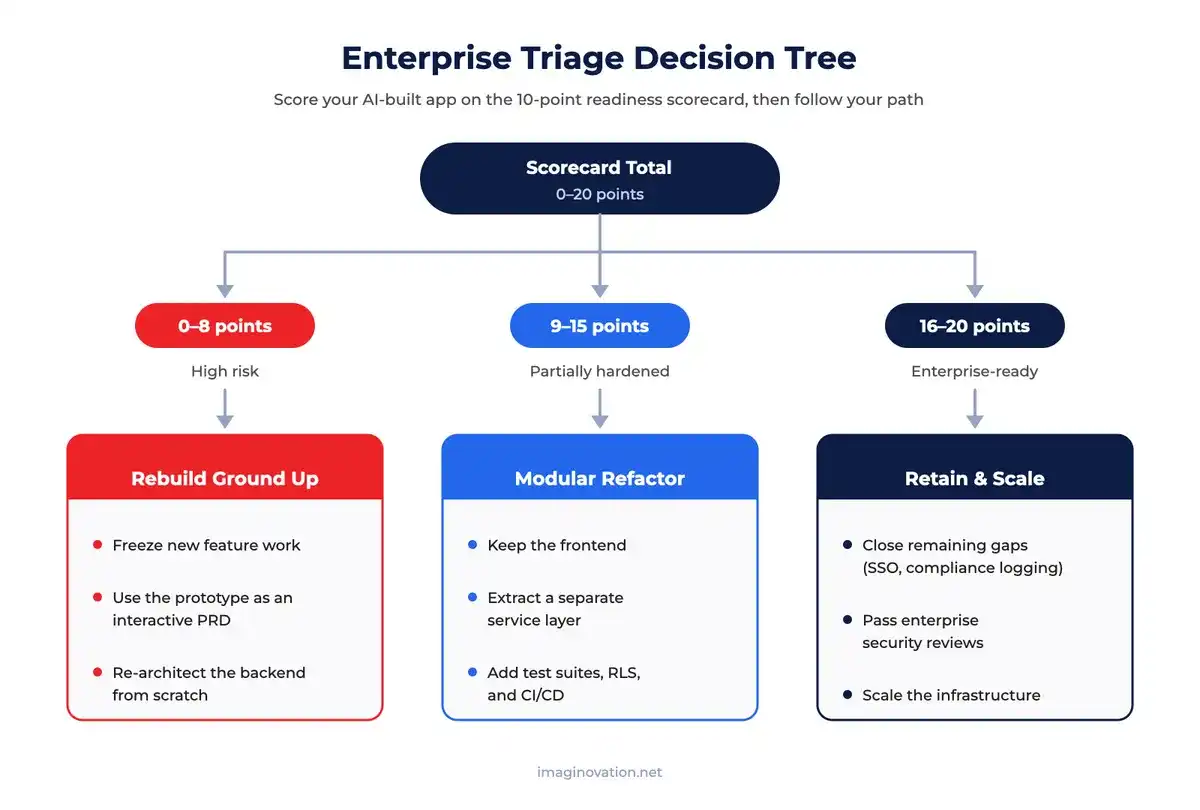
Path 1: Retain and Scale (16–20 points). The foundation holds. The work is additive: enterprise SSO, compliance logging, and other gaps layered onto an architecture that already works.
Path 2: Modular Refactor (9–15 points). Keep the frontend while extracting service boundaries and adding test suites. Users see continuity, while the structure underneath gets sturdier.
Path 3: Rebuild Ground Up (0–8 points). Use the prototype as a visual PRD while engineering a clean, scalable architecture. The prototype defines what to build, and little or none of its code carries forward.
Case Study: A Rescue That Started With an Audit
The triage logic isn't unique to AI-built apps. It applies to any product built on a weak foundation. In an episode on the mistakes that sink funded startups, Eric Lawrence, Director of Growth at Imaginovation, described two founders, John and Caleb, who came to Imaginovation after working with an offshore team.
They had spent tens of thousands of dollars over a year and a half, and the app was stuck in QA. Every fix exposed new problems, what Eric calls a "mouse wheel of breaking, fixing, breaking, fixing." Their confidence was low, and they were questioning whether to keep going at all.
Imaginovation audited the full system first. The finding was a tough pill to swallow: the app kept breaking for a structural reason, so it had to be rebuilt from the ground up. The team redesigned the product and rebuilt it, and the app has since launched and is growing.
The money they'd spent proved the idea was worth pursuing. Only the foundation failed, and an honest audit is what told the two apart.
Conclusion
An AI prototype proves that users want your product. An enterprise architecture proves that your company can reliably deliver it.
The first gets you a demo and a few excited early users. The second gets you through security reviews, production outages, and the scale that real customers bring. Neither is a failure. The mistake is confusing one for the other, and the cost of that confusion grows with every feature you add on top of a weak foundation.
Start by scoring your own application. Take Imaginovation's Free AI Readiness Assessment Audit to score your codebase against this framework and see which path fits: retain, refactor, or rebuild.
Already have an active AI prototype?
Book an Enterprise Architecture Discovery and Code Audit with our senior engineering team. We'll review what you've built, keep what's valuable, and map the fastest route to production-grade.